 Powered by

My Dear Friends,
Two hundred and fifty years ago this day, I dated a letter to my publisher describing the last illness of a friend. I thought it harmless. But after it was published, it “brought upon me ten times more abuse than the very violent attack I had made upon the whole commercial system of Great Britain.” That attack you now call The Wealth of Nations.
This is an imagined letter from Adam Smith to the Americans of 2026. The letters in this series are constructed from Smith’s own words and ideas, primarily those in “The Theory of Moral Sentiments” and “The Wealth of Nations.” All quotations are verbatim; paraphrases are faithful to Smith’s views. Interested readers can learn more about the sources here.
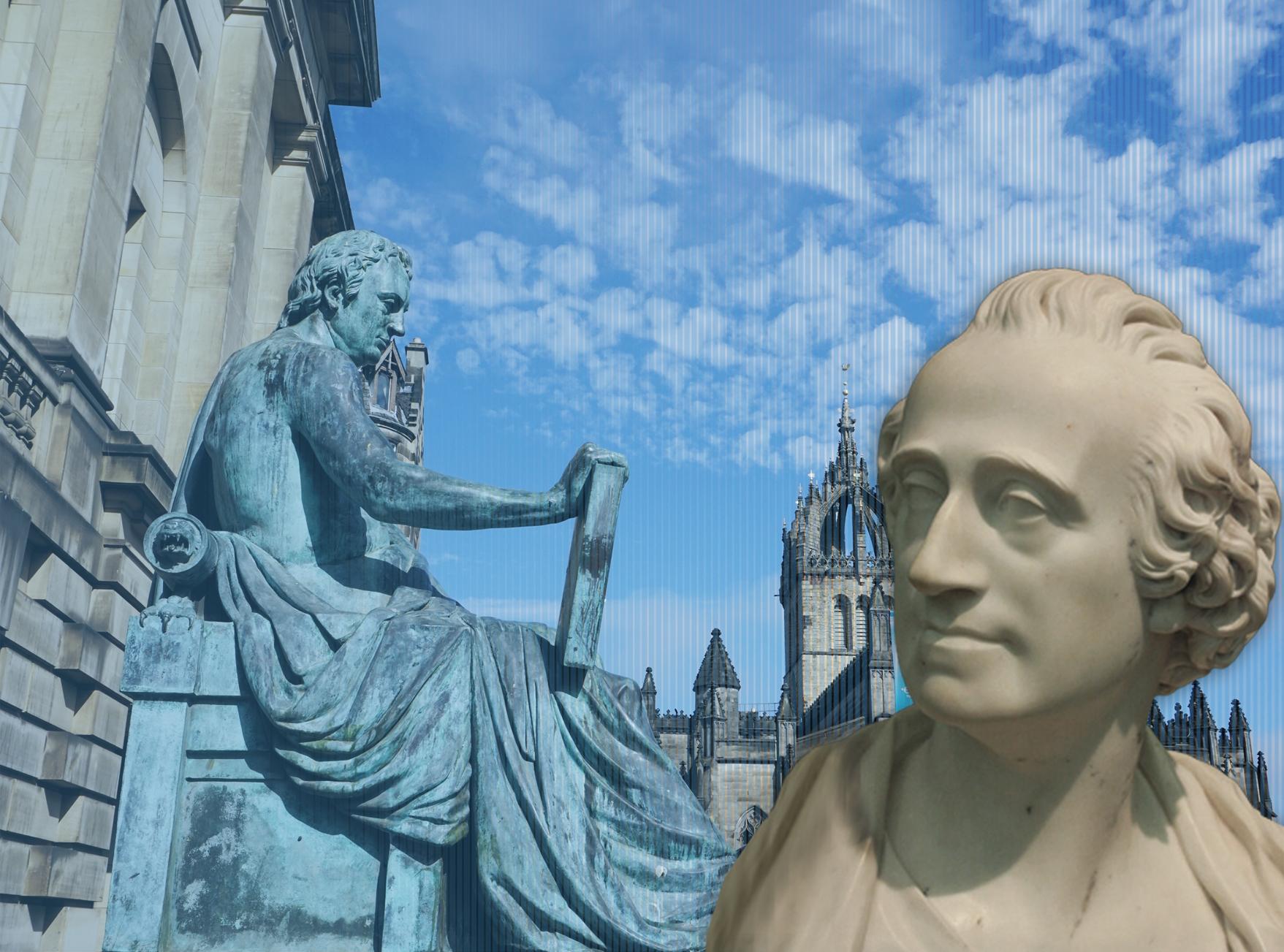
The friend was David Hume—to you, perhaps, the greatest philosopher ever to write in English; to respectable Britain, the most notorious unbeliever—the Great Infidel. To me, David was my best friend.
An island between us
We lived, almost always, in different towns. When I was at Kirkcaldy and David at Edinburgh, the Firth of Forth lay between us. The friendship lived in letters and visits. He kept a room ready all the same: “Your Chamber in my House is always unoccupyed: I am always at home: I expect you to land here.”
Having heard nothing of my work for some time, he wrote: “I am positive you are in the wrong in many of your Speculations, especially where you have the Misfortune to differ from me.” He added that he would challenge me to meet him on Inchkeith, the empty island between us, if there were lodgings there—and that neither of us would leave the place “till we were fully agreed on all points of Controversy.”
We would be there still.
Book reviews
When my Theory of Moral Sentiments appeared, I was desperate to learn of its reception in London, where David then lived. He began a long letter promising to describe its fate. But the letter kept breaking off for other news—university business, literary gossip, a warning that popular judgment is worthless. At last came “the melancholy News”: my book had been “very unfortunate: For the Public seem disposd to applaud it extremely.”
Meanwhile he had been giving away copies to the very judges whose opinion could make the book’s reputation. He was promoting my success while making sure I did not grow too solemn about it.
I had written a book about our longing for approval—and what happens when it goes wrong. David made sure I knew the book’s author was not exempt.
What we disagreed about
A lot. We disagreed about where to start a history of England, about paper money and banks, about Britain’s American colonies, and about the foundations of morality and justice themselves. When The Wealth of Nations appeared, David wrote: “If you were here at my Fireside, I shoud dispute some of your Principles.” And we differed on religion—or at the least, on how much of one’s doubts a person ought to print.
Mark what the disagreement never contained: a withdrawal. My errors were simply additional reasons to spend time together. His disputes came with invitations to visit.
David practiced what I had only described: mutual regard that renders friends “happy in one another.”
Such friendship is among the great pleasures of life. It rests on esteem earned over time, not agreement on every question. It is built on affection, virtue, and character, not “the giddy admiration of shining accomplishments.” And it is great enough that a person will tell a friend they are wrong, and tell the world it is wrong about their friend.
A difficult request
In his last year David asked the most difficult thing he ever asked of me: to see his Dialogues Concerning Natural Religion—his most dangerous work—into print after his death. I was unwilling, and told him so. It was not that I had ceased to esteem the author. I dreaded the clamor the book would raise, and I prized my quiet.
He thought my scruples groundless, and said so. But he quietly arranged for others to print it.
This was a difficult matter between us.
But we still had a summer we wished to spend together.
I spent part of it in Edinburgh to be near him. By August even conversation exhausted him, and at his request I returned home to Kirkcaldy.
Even as he weakened, the jokes continued. Three days before the end, I teased him for sending me a letter by the slow carrier—a dying man, saving a penny on the mail. His reply—dictated, for he could no longer rise—bade me farewell: “Adieu My Dearest Friend.”
A very harmless sheet of paper
It was not the death Britain expected of its Great Infidel. Some who abhorred his opinions had waited for the terror that must surely seize the unbeliever at the last; a few came to his door to see it. There was nothing to see.
So I wrote down what I had actually witnessed, and had it printed: the cheerfulness, the jokes, the generosity to the end. People would always disagree about his philosophy, I said. But concerning his character and conduct there could scarce be a difference of opinion. And I set down the sentence that would cost me more than I guessed: that I had always considered him “as approaching as nearly to the idea of a perfectly wise and virtuous man, as perhaps the nature of human frailty will permit.”
The most virtuous man I had known—and the most notorious infidel in Britain. Respectable opinion could believe only one of those at a time, and it had long since chosen. Readers who could not forgive his unbelief could not forgive my praise of his character. The abuse followed. Britain, I learned, could pardon an attack on its commerce more readily than kindness toward its infidel.
Come over
You will soon gather around your tables for Thanksgiving. Perhaps someone came to mind as you read this: a friend of the wrong opinions, whose kindness you have had years to know, whose company you keep postponing until the work is finished. The work will not be finished. My arguments with David were never finished either. And his answer was always the same: come over.
I wish I had gone more often.
Your humble servant,
Adam Smith
Ross Levine is the Booth Derbas Family/Edward Lazear Senior Fellow at the Hoover Institution and co-director of Hoover’s Financial Regulation Working Group. He is a founding member of the Hoover Program on the Foundations of Economic Prosperity. Levine is also a research associate at the National Bureau of Economic Research.