 Powered by

This article is part of Liberty Amplified, a series produced in partnership with the Hoover Institution’s Human Security Project and the Hoover Institution Library & Archives, featuring voices that challenge authoritarianism in pursuit of freedom. Thirty-seven years ago, as freedom triumphed over oppression at the Berlin Wall, cellist Mstislav Rostropovich marked the occasion in a characteristic way: by performing at Checkpoint Charlie. Rostropovich’s concert is one of many acts of resistance in support of freedom. To read my personal account of witnessing East Germans embrace their newfound freedom while I was stationed in Coburg, Germany, and for reflections on strategic narcissism, click here.—H.R. McMaster
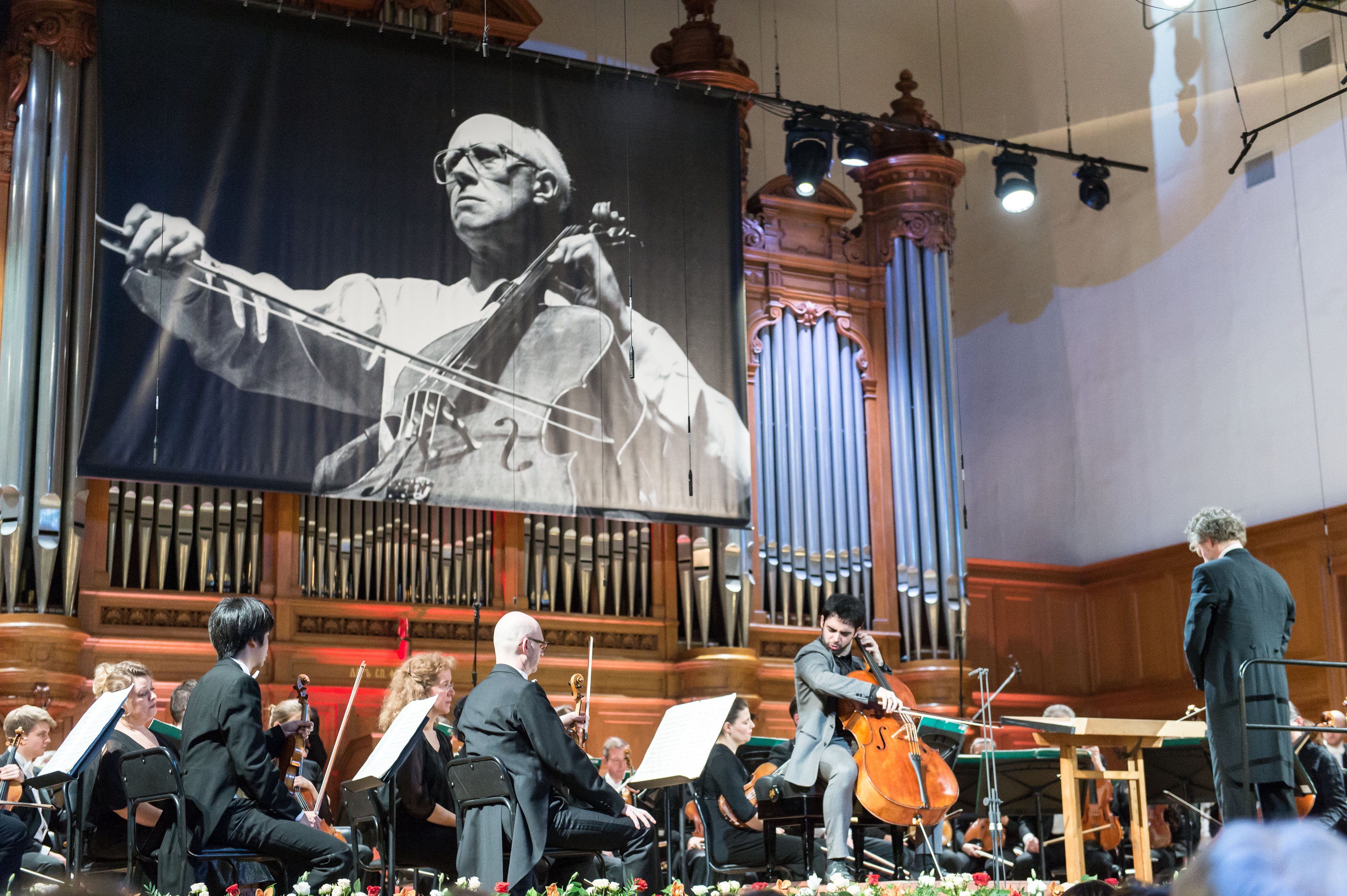
Bow in hand, Mstislav Rostropovich made his cello sing amid the fall of the Berlin Wall in November 1989, the bright, varying colors of the graffiti juxtaposed with the solemn yet celebratory music. From a chair at Checkpoint Charlie, two days after the wall was opened, Rostropovich played the Sarabande of Bach’s second cello suite, a very purposeful choice. Bach’s suites for solo cello are generally joyous, but amid this impromptu performance meant to celebrate the fall of the wall and the freedom of East Berlin from the USSR, the cellist also sounded the solemn tone of the Sarabande, the emotional heart of the second suite.
Rostropovich chose this specific part of the suites to honor those who had lost their lives trying to cross the wall between the two Germanys. The Russian knew the tragic outcomes from the politics surrounding repression—loss of culture, voice, livelihood, and even, at times, life. In this singular moment, Rostropovich’s dissidence from the Soviet Union expressed itself in front of the wall that for so long had represented the division between the repression the cellist sought to escape and the freedoms he defended.
Rostropovich’s performance at the Berlin Wall was a culmination of his political protest for the right to free speech and expression. He was an outspoken defender of the rights of artists to convey their beliefs through art. A profound interpreter of Russian culture, Rostropovich was not quiet about his opposition to the Soviet Union. The intensity of his performance encompassed a complex journey involving his homeland and the Soviet Union’s institutionalized oppression.
In an open letter in 1970, Rostropovich, still residing in the Soviet Union, had written to Soviet newspapers to express his frustration with the suppression of writers, artists, and musicians: “Every man must have the right fearlessly to think independently and express his opinion about what he knows, what he has personally thought about and experienced, and not merely to express with slightly different variations the opinion which has been inculcated in him.” The state refused to print his letter, and he and his wife, soprano Galina Vishnevskaya, were denied permission to travel abroad. However, Western newspapers did print it, and it was circulated throughout the world.
Perhaps his most significant resistance against the Soviet Union was in sheltering Aleksandr Solzhenitsyn in 1969–70. The writer had become a target of near-continuous official persecution. Instead of turning Solzhenitsyn away, Rostropovich housed the author in his dacha and actively defied Soviet orders to force him to leave. The above quote about free expression was written in protest of these orders. In response, Soviet officials accused the musician of halting Russian cultural development through his criticisms and by sheltering a Soviet dissident.
Rostropovich and his wife left the Soviet Union permanently when given a document that was supposed to last for two years of travel. Despite missing his homeland, Rostropovich said he could not return until artists were able to speak freely. To Western media outlets in 1977, Rostropovich insisted: “I will not utter one single lie in order to return. And once there, if I see new injustice, I will speak out four times more loudly than before.”
Rostropovich, who was born, raised, and trained in the Soviet Union, was a hallmark musician within the USSR, held up as an example of Soviet greatness. He was praised for his interpretations of music by composers such as Tchaikovsky, Prokofiev, and Shostakovich. However, despite the love for his homeland and the love his homeland returned, free speech was not negotiable for Rostropovich, who held human rights as high as, if not higher than, his love for his craft and his homeland.
After leaving the country on the two-year travel visa, Rostropovich and Vishnevskaya saw their citizenship revoked. The exact reason is unclear because a variety of Rostropovich’s actions enraged the USSR, including his outspoken criticism of the restrictions on creatives and his frequent travel requests to Western nations like France or the United States. Ultimately, Rostropovich’s refusal to express loyalty to a government he vehemently disagreed with led to a buildup of tension that culminated in the loss of citizenship.
The tipping point appears to have been an invitation in 1974 to perform three concerts at Lincoln Center in New York City. When struggling to obtain permission to travel from France to New York, the cellist met with American consular officer Peter K. Murphy at the US Embassy in Paris. Throwing his Soviet passport on Murphy’s desk, he said: “You tell them they can keep it. I want to be stateless. I’ll give up my Soviet citizenship if they won’t let me go to New York.” If forbidden to express himself, in music or in words, the cellist would refuse to belong to the Soviet Union, much less represent it. Moscow ended up approving the trip to New York. Once abroad, the cellist and his wife declined to return.
After the dissolution of the USSR, Rostropovich continued defending human rights and freedoms. In September 1993, as conductor of Washington’s National Symphony Orchestra, he returned to Moscow to lead a free concert in Red Square before an audience of 100,000 that represented support for democracy and hope for the future. The program included Tchaikovsky’s 1812 Overture, complete with cannon fire. Rostropovich told a journalist at the time, “Events disrupt things a little sometimes, but listening to this music is a reminder that there’s a great nation here.”
The recipient of many human rights awards, Rostropovich continued defending free speech and human rights until his death in 2007.
The use of music as active resistance is not exclusive to Mstislav Rostropovich’s story, nor is it exclusive to the Cold War. Today, musicians of all genres speak out and use their prominence to convey the importance of free speech and political voice. The US coalition Musicians for Democracy includes more than six hundred classical musicians who have signed an open letter and petition to protest political interference and threats of retaliation against cultural institutions.
One example of an outspoken musician is contemporary classical composer Catherine Likhuta, a native of Ukraine. She is prominent for composing symphonies about geopolitics and advocates music as a connector between people. One of her most celebrated works is the chamber concerto Bad Neighbors, commissioned as the 2014 invasion of Ukraine commenced. In the piece, the music portrays fighting and dialogue between two horn soloists, going back and forth between the two voices.
Today, the fight symbolized in her concerto continues between Ukraine and its “bad neighbor.”
Alia Saphier is a sophomore at Stanford University pursuing a bachelor of arts degree in international relations. She is a Hoover Student Fellow with the Human Security Project interested in the intersection between governance, resistance, and culture. She is also involved with the Stanford Political Review, the Society for International Affairs, and the a capella group Mixed Company.
Liberty Amplified features the voices of those who defy autocracy in pursuit of freedom. It is produced in partnership with the Hoover Institution’s Human Security Project and the Hoover Institution Library & Archives.