 Powered by
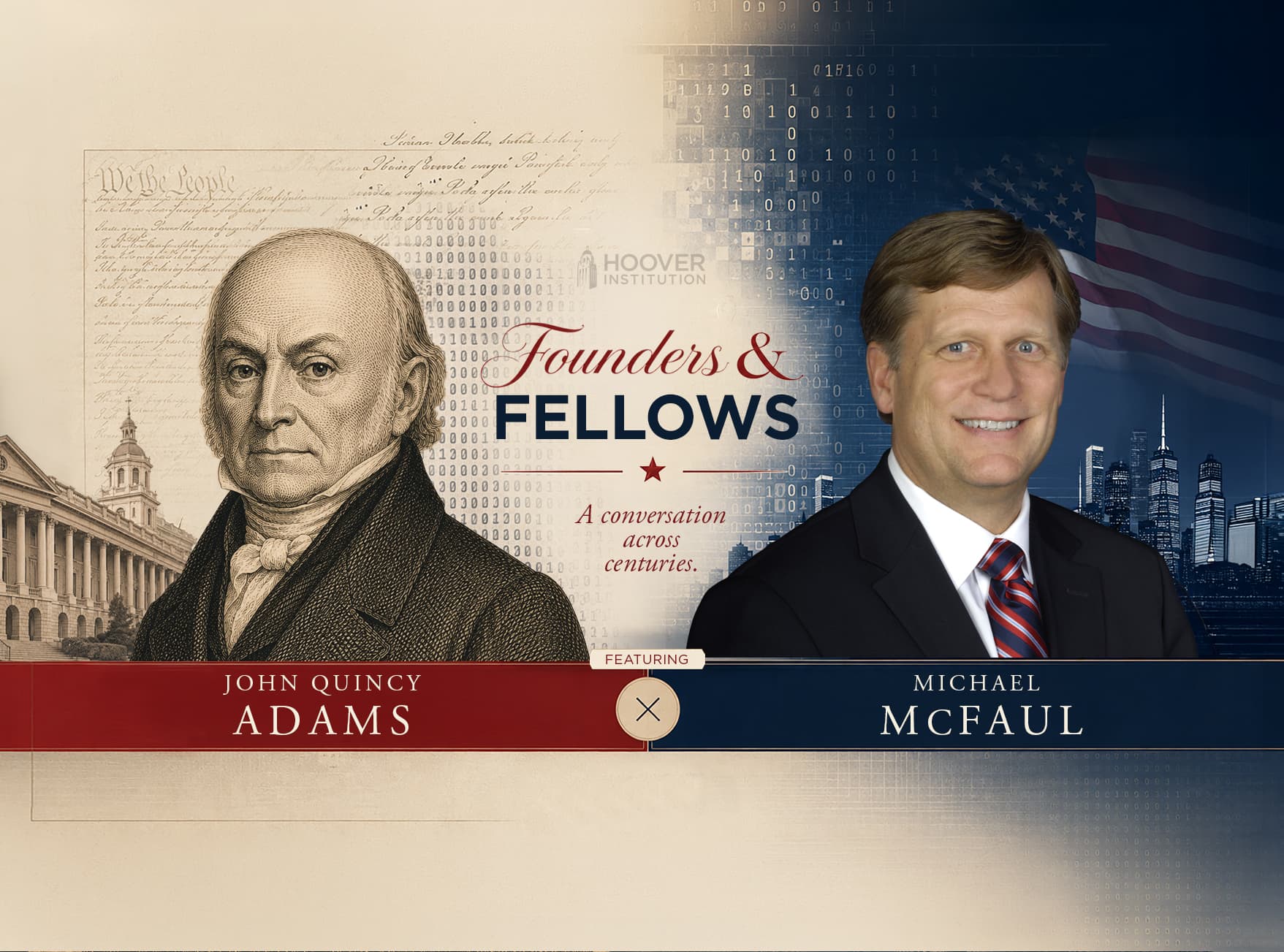
John Quincy Adams is considered a “founding son,” not a founding father. Nonetheless, as the first US minister to Russia (a post that was later renamed and reclassified as ambassador in 1898), he played a pivotal role in securing recognition for the newly established United States of America, long before he rose to prominence as secretary of state and president. Having served as the sixty-fourth or sixty-sixth US ambassador to Russia, depending on how you count, I have a particular interest in this chapter of our founding history. In fact, each morning I arrived to work at the US Embassy in Moscow, I passed a statue of John Q. Adams.
Today, the United States is one of the most important actors on the global stage. During Adams’s service as a diplomat, the great powers of that era barely noticed our existence. Our founding fathers declared independence on July 4, 1776. But it was only in 1809 that the Russian tsar established diplomatic relations with the United States and accepted Adams’s credentials as the first US minister to his court. (In China, it took even longer: it was not until 1844 that the Qing dynasty established diplomatic relations with us.)
At the time, declarations of independence were rare. Most great powers had colonies or had conquered and annexed territories of smaller ethnic groups. Why, therefore, would they want to recognize those seeking to break away? That might encourage similar behavior in their own empires. Equally threatening, the American rebels aspired to create a new system of government based on republican and democratic principles—the opposite of how kings and tsars governed their empires. So, obtaining recognition and respect from a great power like Russia for such a revisionist new country was not easy.
But that was Adams’s paramount assignment in St. Petersburg in dealing with Tsar Alexander I and his government. Adams did not promote human rights or democracy inside Russia—the core American values we are celebrating this year—nor did he seek to attract admirers of our new system of government. Instead, he downplayed the revolutionary, revisionist nature of the United States, only cautiously and occasionally identifying with the alleged “liberal principles” Alexander championed at the time. It was fortuitous for American recognition that a more reformist tsar was in power at the time.
Adams also made a case for win-win outcomes in bilateral relations, especially regarding commerce. That approach resonated with Alexander I, who in 1809 declared, “There should not be any conflicting interests or reasons for the rupture between the United States and the Russian Empire, while the trade between the two countries could be mutually beneficial.” Of course, the United States then did not have much to offer by way of trade. With time, however, that dimension of US-Russia relations grew. The approach paid off. In his diaries, Adams recorded Alexander’s own acknowledgment that “a republican form of government, if it was competent and just, was as respectable as any other.”
Adams also tiptoed into great-power politics, suggesting that a stronger, more independent United States would weaken England. At the time, the Russian Empire was a central player in Europe, expanding its presence in Asia, where its imperial reach often clashed with British colonialism (in the “Great Game”), and even had a foothold in North America, with a settlement as far south as Fort Ross in Northern California. Adams gently floated the idea that any action that weakened Great Britain benefited Russia, including the loss of its North American colonies. For the next century, US-Russia relations were mostly cordial.
Strikingly, Russia sold Alaska to the United States and did not fight to keep its territory as America’s southern neighbors did. Russia also remained neutral during the American Civil War. In gratitude in 1863, US Supreme Court Justice Oliver Wendell Holmes declared Alexander II to be “our friend when the world was our foe.” In 1905, the United States had the chance to return the favor: President Theodore Roosevelt mediated the end of the Russo-Japanese War on terms favorable to St. Petersburg.
Human rights issues—in particular the Russian Empire’s treatment of Jews in the late nineteenth century—gradually complicated bilateral ties, but it was only after the Bolsheviks seized power in 1917 that relations broke off completely. More than a decade later, in 1933, Stalin and President Franklin D. Roosevelt re-established diplomatic relations, but the United States and the Soviet Union never enjoyed the close relationship that Adams had helped to nurture with tsarist Russia.
Adams’s work demonstrated the true value of talented ambassadors and diplomats in advancing our national interests. In the early years of our republic, some of our most gifted leaders served in diplomatic posts abroad, among them Benjamin Franklin, John Jay, Thomas Jefferson, James Monroe, and John Q. Adams’s father. John Quincy Adams exemplified that tradition of the best and brightest serving in important diplomatic posts. We should return to it. The interests of the American people would be better served by having more talented ambassadors in the field, especially in countries with complex, consequential relationships, such as Russia. Today, we have no US ambassador in Moscow. That is a mistake.
Some argue that technological advancements, especially in communications, have diminished the value of ambassadors today. Who needs an ambassador when the president or the secretary of state can pick up the phone or get on a Zoom call with counterparts anywhere in the world? Having participated in high-pressure and high-stakes diplomatic negotiations, I can assure you that nothing can substitute for direct conversations between heads of state. But the president and the secretary of state cannot do everything, especially in large, complex countries like Russia, where the agenda of bilateral relations is large. That’s why we still need ambassadors, especially ones with close relationships to the president.
In addition, good ambassadors make their leaders back home smarter. Adams was praised for his careful reporting about domestic developments and foreign policy thinking in Russia at a time when other sources of information were scarce.
The reporting role of ambassadors is one of the least understood yet most important functions in shaping US foreign policy. Unlike journalists, ambassadors have unique access to senior government officials but can also meet nearly anyone in business, civil society, local government, or the arts. I valued such contacts when I served as the US ambassador to Russia, which helped my team and me write cables to Washington that our leadership could not have gotten elsewhere. Appointing a new US ambassador to Russia would help the Trump administration better understand the Putin government and Russian society.
American ambassadors in the twenty-first century also play an essential role in educating the societies where they are posted about our country. It’s called public diplomacy. Adams did little of this. He represented an upstart nation with a short history and few established cultural traditions. Public diplomacy was also not a common practice back then. Today, the opposite is true. It’s a vital function of embassies, and we Americans have a lot of great culture, values, and history to promote. We also want societies, not just their governments, to understand us.
We need more ambassadors and diplomats, not fewer, to perform this essential role of projecting American power. Vladimir Putin and the Russian people will not agree with the United States on everything, but we should not allow our disagreements to be based on misperceptions or misunderstandings.
Adams refrained from championing American values because the United States was too fragile and weak to do so. This is not the case today. Instead, American diplomats must lean in to upholding the values of democracy, freedom, and liberty that were so vital to the founding of our Republic. Public opinion polls show that the ideals embedded in the Declaration of Independence remain popular around the world. In our own era of great-power competition—Autocrats vs. Democrats, as I call it in my new book—those values constitute one of our most powerful instruments for competing effectively with Chinese and Russian autocrats.
Out of necessity, Adams prudently limited references to the ideas that animated the founding of the American Republic. Today, the United States is the most powerful country in the world and is no longer concerned with just survival. American ambassadors today, including future ambassadors to Russia, can play a very different role from Adams’s in championing the ideas that define a free society.
I did as the US ambassador in Putin’s Russia. My favorite day of the year in Moscow was the July 4 reception at the embassy, when I had the chance to speak about the power of the Declaration of Independence—not only for America, but for the world, Russians included. Putin and his inner circle may not have appreciated those remarks. Thousands of Russians did.
As our late Hoover colleague George Shultz used to say—and always practiced as secretary of state—we can engage with autocrats on issues of mutual interest without checking our values at the door. Adams did not represent a country powerful enough to practice that wisdom. Future US ambassadors to Russia do.
Michael McFaul is the Peter and Helen Bing Senior Fellow at the Hoover Institution, a professor of political science at Stanford University, and a senior fellow at the Freeman Spogli Institute for International Studies. From January 2012 to February 2014, he served as the US ambassador to the Russian Federation.