 Powered by
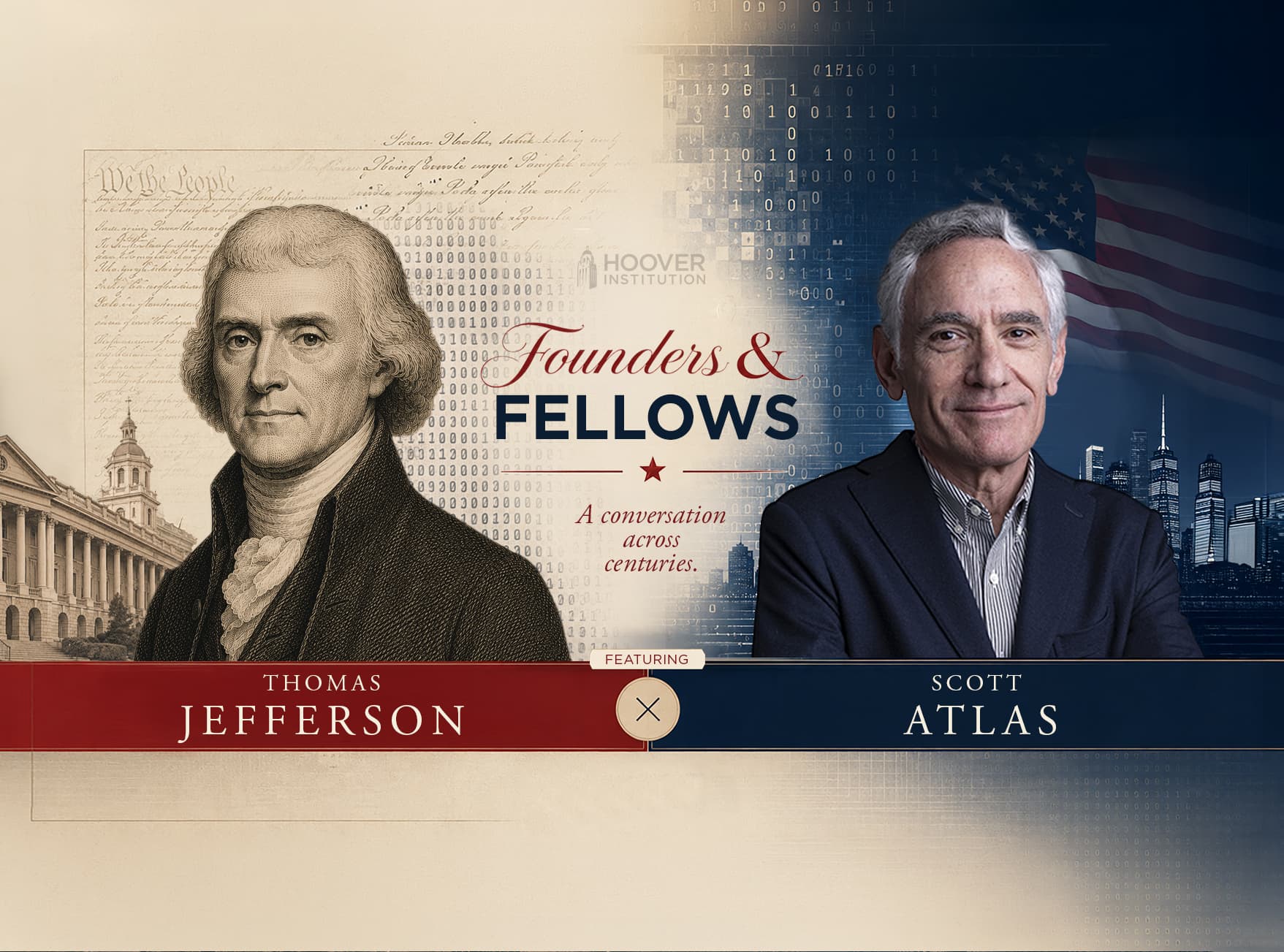
The founders of the American republic were not a monolithic group. They disagreed sharply about human nature, the dangers of concentrated power, and what self-government required of its citizens. Among them, Thomas Jefferson stands apart—not because his biography is the most heroic, but because his vision of what would sustain the republic across generations was the most far-reaching, and may be the most damaged today.
Jefferson composed his own epitaph, listing three achievements: author of the Declaration of Independence, author of the Virginia Statute for Religious Freedom, and father of the University of Virginia.[1] He did not mention his two terms as president. Most people find that omission curious. I find it clarifying. Jefferson believed the university mattered more to the republic’s survival than anything he accomplished in office.
Jefferson understood something his contemporaries mostly missed. Declarations and constitutions are necessary, but they are not sufficient. A republic whose citizens cannot reason, evaluate evidence, or resist manipulation is not genuinely self-governing—it is a republic in name only. “If a nation expects to be ignorant and free, in a state of civilization,” he wrote in 1816, “it expects what never was and never will be.”[2] The university was not a cultural amenity or tool of job certification. It was the mechanism by which free government reproduces itself across generations.
From that premise, Jefferson drew a conclusion that put him in direct conflict with Hamilton and Adams. All three were serious men of learning—Hamilton a brilliant legal and political mind, Adams a formidable scholar of history and constitutional theory. But Jefferson stood apart. Five years in Paris made him the most cosmopolitan of the founders—a collector and aficionado of art, architecture, fine cuisine, and wine who moved easily among the intellectual and artistic elite of the Enlightenment—yet that immersion in European high culture led him to the opposite conclusion. Where Hamilton and Adams saw in educated elites the natural governors of a stable republic, Jefferson saw the danger. At the Constitutional Convention, Hamilton proposed a president and Senate serving for life—an elected aristocracy in everything but name.[3] Adams shared that faith in elite governance. Jefferson saw the fatal flaw: power concentrated in a governing class does not merely risk corruption—it guarantees that the powerful become insulated from the information that only a free citizenry can generate. His answer was not a better elite. It was a better-educated people, and that is what the university was built to produce.
What made Jefferson’s vision radical—and what remains underappreciated today—was the seriousness with which he took the university’s moral dimension. He was not describing a credentialing mechanism. He was describing an institution responsible for forming the character and judgment of the next generation. When he drafted the Rockfish Gap Report establishing the University of Virginia, he stated that purpose plainly:[4]
“To develope the reasoning faculties of our youth, enlarge their minds, cultivate their morals, & instil into them the precepts of virtue & order.”
—Report of the Commissioners for the University of Virginia (Rockfish Gap Report), August 4, 1818
The design of UVA extended that argument into architecture. Jefferson placed no chapel at the center of campus, rejecting the ecclesiastical authority that governed Harvard and Yale.[5] The Rotunda housed the library, not a church, because books—not dogma—stood at the center of Jeffersonian intellectual life. Every choice encoded the same conviction: truth is not handed down by those in authority; it is pursued, contested, and revised by minds trained to think freely. Jefferson stated his ambition without apology:
“This institution will be based on the illimitable freedom of the human mind. For here we are not afraid to follow truth wherever it may lead, nor to tolerate any error so long as reason is left free to combat it.”
—To William Roscoe, December 27, 1820[6]
That vision carried a social promise and responsibility of academia, one that American society has honored—and amplified—in the centuries since. University professors are respected and deemed authorities by virtue of their titles—advisers to governments, sources of expertise for media, arbiters of contested questions. Most importantly, they are entrusted with something far greater: the formation of the next generation’s minds. Parents send their children to these institutions believing that the Jeffersonian compact—honest inquiry, civil discourse, the fearless pursuit of truth—remains in force. That trust is the entire foundation on which the university’s social authority rests—and it has been eroding for decades, as campuses drifted toward creating social activists and conformists to a prescribed ideology, marginalizing conservative thought and traditional education about the achievements of Western civilization.
The pandemic made the full scale of that failure impossible to ignore. More than 110 universities had formally adopted the Chicago Statement, the supposed gold standard for campus free expression.[7] But when dissenting policy views emerged, they were suppressed rather than debated—a direct inversion of the university’s stated purpose. Instead of civil discourse, character assassination and even formal censure for publicly challenging the false consensus illustrated the pattern that played out at institutions across the country.[8][9] University leaders abdicated the very role that earned them public trust in the first place.
Whether universities will restore their vital role is one of the defining questions for the next chapter of American self-governance. The affirmative answer, if it comes, will emerge from the students and rising leaders across the country—those who publish unpopular findings, refuse coerced consensus, and insist on free debate, even at personal cost.
The buildings Jefferson built are still standing. The question is who will honor the purpose that inspired them.
Scott W. Atlas, MD, is the Robert Wesson Senior Fellow in Scientific Philosophy and Public Policy at the Hoover Institution.
[1]Jefferson drafted his own epitaph, specifying that it omit his presidency. See Merrill D. Peterson, Thomas Jefferson and the New Nation (Oxford University Press, 1970), p. 1004; Monticello.org, “Jefferson’s Gravestone,” https://www.monticello.org/encyclopedia/jeffersons-gravestone.
[2]Thomas Jefferson to Colonel Charles Yancey, January 6, 1816. The Papers of Thomas Jefferson, Retirement Series, vol. 9 (Princeton University Press, 2012), p. 331.
[3]Hamilton’s plan, presented June 18, 1787, proposed a chief executive and senators serving for life on good behavior. See James Madison, Notes of Debates in the Federal Convention of 1787 (Ohio University Press, 1966), pp. 129–139. Adams expressed related views on natural aristocracy in Adams to Jefferson, September 2, 1813, in The Adams-Jefferson Letters, ed. Lester J. Cappon (University of North Carolina Press, 1959), pp. 371–374.
[4]Report of the Commissioners Appointed to Fix the Site of the University of Virginia (Rockfish Gap Report), August 4, 1818. Reprinted in Roy J. Honeywell, The Educational Work of Thomas Jefferson (Harvard University Press, 1931), pp. 248–260.
[5]Jefferson’s placement of the Rotunda—modeled on the Pantheon and housing the library—at the head of the Academical Village, with no chapel, is documented in his own architectural drawings and correspondence. See Garry Wills, Mr. Jefferson’s University (National Geographic, 2002), pp. 14–30.
[6]Thomas Jefferson to William Roscoe, December 27, 1820. The Papers of Thomas Jefferson, Retirement Series, vol. 16 (Princeton University Press, 2019), p. 571.
[7]Report of the Committee on Freedom of Expression (“Chicago Statement”), University of Chicago, January 2015. As of September 2024, more than 110 colleges and universities had adopted it or a substantially identical version, per the Foundation for Individual Rights and Expression (FIRE). Available at https://provost.uchicago.edu/reports/report-committee-freedom-expression.
[8]The Stanford Faculty Senate censure of the author is a matter of public record. See Stanford Report, “Faculty Senate Approves Statement on Atlas,” November 2020.
[9]Atlas, S.W., Bai, G., Bhattacharya, J., Makary, M.A., Marine, J., & Phan, P. “Physician Autonomy and Free Speech: Essential for Effective Public Health Response.” Health Affairs Forefront, May 5, 2025. https://www.healthaffairs.org/content/forefront/physician-autonomy-and-free-speech-essential-effective-public-health-response