 Powered by


With the debates surrounding the proposed taxes on California’s November 3 ballot and the characterization of California as a high-tax, high-spending, heavy-welfare state, it may seem surprising that this is not what Californians really want.
In fact, Californians’ views on taxes and spending are quite similar to the views of the rest of the country in many dimensions. A careful look at their attitudes towards taxes and spending is necessary, so this month YouGov conducted parallel national and California surveys for us focused precisely on these issues.
Californians aren’t that different
Before turning to taxes, here is some of the evidence that California and the rest of the country are quite similar in how they feel about the future.
Optimism: Californians are 45 percent very or somewhat optimistic, versus 34 percent who are somewhat or very pessimistic. The corresponding figures nationally are 44 percent versus 35 percent. Contrary to conventional media narratives, young adults are the most optimistic, both nationally (48 to 32 percent) and in California (53 to 28 percent). The state’s Democrats are equally divided, as are independents, while Republicans, who comprise just a quarter of California’s registered voters, are overwhelmingly optimistic (67–16 percent). Perhaps this is because they support many of the policies pursued nationally by the Trump administration, which more than offsets their dissatisfaction with state policy.
What kind of economy? When asked about their preferred economic system, 15 percent of Californians say they prefer socialism and 2 percent communism, versus 16 percent and 2 percent nationally. There is a modest difference in that 42 percent of Californians prefer a mixed capitalist/socialist model versus 35 percent nationally, whereas nationally 35 percent prefer a pure capitalist model versus only 25 percent in California.
Interestingly, while no sex, race, or age group favors socialism by more than 17 percent, black Californians favor capitalism least and overwhelmingly favor a mixed capitalist-socialist model, whereas Asians are the least favorable to socialism at 9 percent. While the majority of Democrats in the state favor a mixed system (54 percent), they favor socialism to capitalism by 3 to 1, whereas Republicans overwhelmingly favor capitalism (64 percent to 4 percent for socialism), with independents favoring capitalism by 2 to 1 over socialism (28–13 percent), but a plurality favors a mixed system (43 percent). We prefaced these questions with a series that gave various definitions and features of capitalism and socialism, so the possibility that different groups have different ideas about the nature of each of these systems is somewhat mitigated. At the national level, the results are similar. Notable differences include middle-aged and older respondents being even more favorable to capitalism over a mixed model than in California.
A spending problem: Of those agreeing or disagreeing, Californians are even more in agreement that their state has a spending problem, not a revenue problem, by 48 percent to 20 percent, whereas nationally the figures are 43 percent vs. 19 percent. In both cases, the pattern holds across all ages, but is even more pronounced for older respondents, still more so in California.
Anti-business: One area where California differs is that slightly more Californians think their state is more anti-business than pro-business, with sharp differences by age: the two youngest groups think the state is more pro-business and the two older groups, more anti-business. Politically, Democrats believe the state is more pro-business by 37–14 percent, Republicans lean the other way, more strongly, at 15–56 percent, with independents leaning anti- by 12 points. Nationally, the picture is dramatically different: 41 percent believe their state is pro-business vs. only 15 percent anti-business.
Californians want lower taxes for themselves
It turns out Californians really don’t like high taxes, including high tax rates, especially (unsurprisingly) when they believe they may wind up paying them now or in the future.
Californians believe the federal personal income tax should be reduced: 47 percent want it decreased vs. 16 percent who want it increased (26 percent want it kept the same and 12 percent are unsure). Nationally, the views are even more lopsided: 14 percent would like it increased, 53 percent want it decreased a little or a lot.
Turning to the top federal income tax rate, 37 percent of Californians believe it is too high vs. 15 percent who think it’s too low; nationally the figures are 37 percent vs. 20 percent. Again, contrary to the main media depiction of young adults, in California young adults are even more likely than their older fellow Californians to say the top federal income tax rate is too high (37–8 percent). While they may be frustrated at how expensive it is to buy a home in California, perhaps they retain the ambition to get ahead and see the top rate as a future problem that may well affect them. Nationally, the figures are a much closer 29–22 percent. Even the state Democrats say it is too high by 27–20 percent. Republicans, not surprisingly, are 55–5 for too high vs. too low. Independents are 37–15.
These results may in part reflect the fact that the federal personal income tax is not adjusted for geographic differences in the cost of living. So, people with the same nominal income in California as in, for example, Texas or Florida have a lower real income because of the higher cost of living. Hence, the top federal income tax rate starts to bite Californians at a lower “standard of living” than in almost all other states.
Interestingly, 51 percent of Californians believe the state personal income tax should be reduced a lot or a little, vs. 10 percent who want it increased a little and only 3 percent who want it increased a lot. Nationally, the figures are 53 percent who want their state income tax reduced while only 10 percent want it increased. In both surveys, the results are similar across race, age, and sex. California Democrats also want lower state income taxes (44–16), and Republicans (64–14) and independents (54–9) agree more strongly.
On the top state income tax rate, which in California is the highest in the nation, a plurality thinks it is about right and 28 percent think it is too low, vs. 24 percent who think it’s too high. Nationally, 49 percent believe their state income tax is about right but more think it is too high rather than too low, by 21 percent to 16 percent. Both Democrats (40–11 too low) and Republicans (42–9 too high) have stronger views than their national counterparts.
Interestingly, Californians favor cutting state property taxes, 47 percent to 15 percent, despite the allegations that the 1970s-era Proposition 13 property tax limitation has severely constrained property tax revenue. Nationally, the desire for lower state property taxes is even stronger: 62 percent favor cutting (of which 39 percent favor cutting a lot), while only 10 percent favor an increase. Likewise, Californians favor cutting the state’s sales tax, at 50 percent, vs. only 12 percent who want it increased; nationally, the figures are almost identical (50–9).
Lower taxes for other people? Not so much . . .
What Californians favor—or at least find less objectionable—are taxes they believe are paid by someone else. As the former powerful chairman of the Senate Finance Committee, Russell Long, quipped, “Tax reform means don’t tax you and don’t tax me, tax that fellow behind the tree.”
For example, by 45 percent to 22 percent, Californians favor raising the federal corporate tax; nationally the figures are almost identical: 45 percent to 23 percent. By 47 percent to 22 percent, Californians favor raising the state corporate tax; again, nationally the results are virtually identical: 44 percent vs. 23 percent. Interestingly, when asked the same question about state business taxes—the distinction between business and corporation taxes speaks to the difference between large companies and smaller unincorporated businesses—Californians are equally divided: 32 percent favoring an increase and the same number favoring a decrease. Nationally the numbers are similar: 32 percent increase, 29 percent decrease.
Economists—and official government scorekeepers, such as the Congressional Budget Office—warn that a sizable share of the business tax burden is shifted to workers in the form of lower wages than would otherwise be the case (and perhaps some also onto higher prices for consumers). This admonition appears not to have reached the general public. Nor has the fact that the corporate tax is paid by companies whose shares are held in almost all retirement savings accounts.
Finally, respondents both in California and nationally favor a generic wealth tax on the very rich.
How Prop 40 might break
This brings us to California’s Proposition 40, the so-called one-time wealth tax on billionaires. It seems perfectly suited to this view of taxing the rich, as it will directly apply to only 200 to 300 people. Its proponents undoubtedly designed it for popular appeal, while the UC-Berkeley economists giving it intellectual cover, Gabriel Zucman and Emmanuel Saez, call it “a start” and “an experiment,” respectively. Their arguments, which assume very little incentive to avoid or evade the tax, have been rebutted by the careful research of our Hoover colleagues Josh Rauh and Benjamin Jaros. In fact, the tax is likely to cost the state revenue because of the decline in future income tax revenue from the flight of the wealthy, entrepreneurs, and jobs, and the dubious legality of its retroactive provision and other factors.
Paradoxically, while Proposition 40 is slightly ahead in most polls, it has struggled to get to the 50 percent threshold most political observers believe is necessary in polling for a proposition to prevail on the ballot. Why? Because historically, undecideds tend to break heavily against propositions that raise taxes.
In our polling, we disaggregate voters into six groups. We do this because of the structure of Propositions 40, 41 and 42. Proposition 41 would prohibit new taxes whose revenues are excempted from state spending limits approved by voters, and would require pre-approval and continuing audits. Proposition 42 prohibits new and retroactive taxes on personal property, including retirement savings. Both are designed as potential safeguards against Prop 40 passing, because under California law if either 41 or 42 passes with a larger pro vote than Prop 40, Prop 40 would fail even if it had a majority in favor.
Our six groups are:
Those in favor of Prop 40 and opposed to or undecided on both 41 and 42, at 29 percent of likely voters.
Those who are negative or undecided on Prop 40 and not negative on the other two, at 30 percent of likely voters.
An additional 7 percent who are against all three and hence can be added to the anti–Prop 40 total.
An additional 18 percent who appear conflicted—that is, they are inconsistently yes on Prop 40 but also on at least one or the other of Props 41 and 42.
11 percent who are undecided on all three.
And the remaining 5 percent in an “other” category.
The following table presents these numbers.
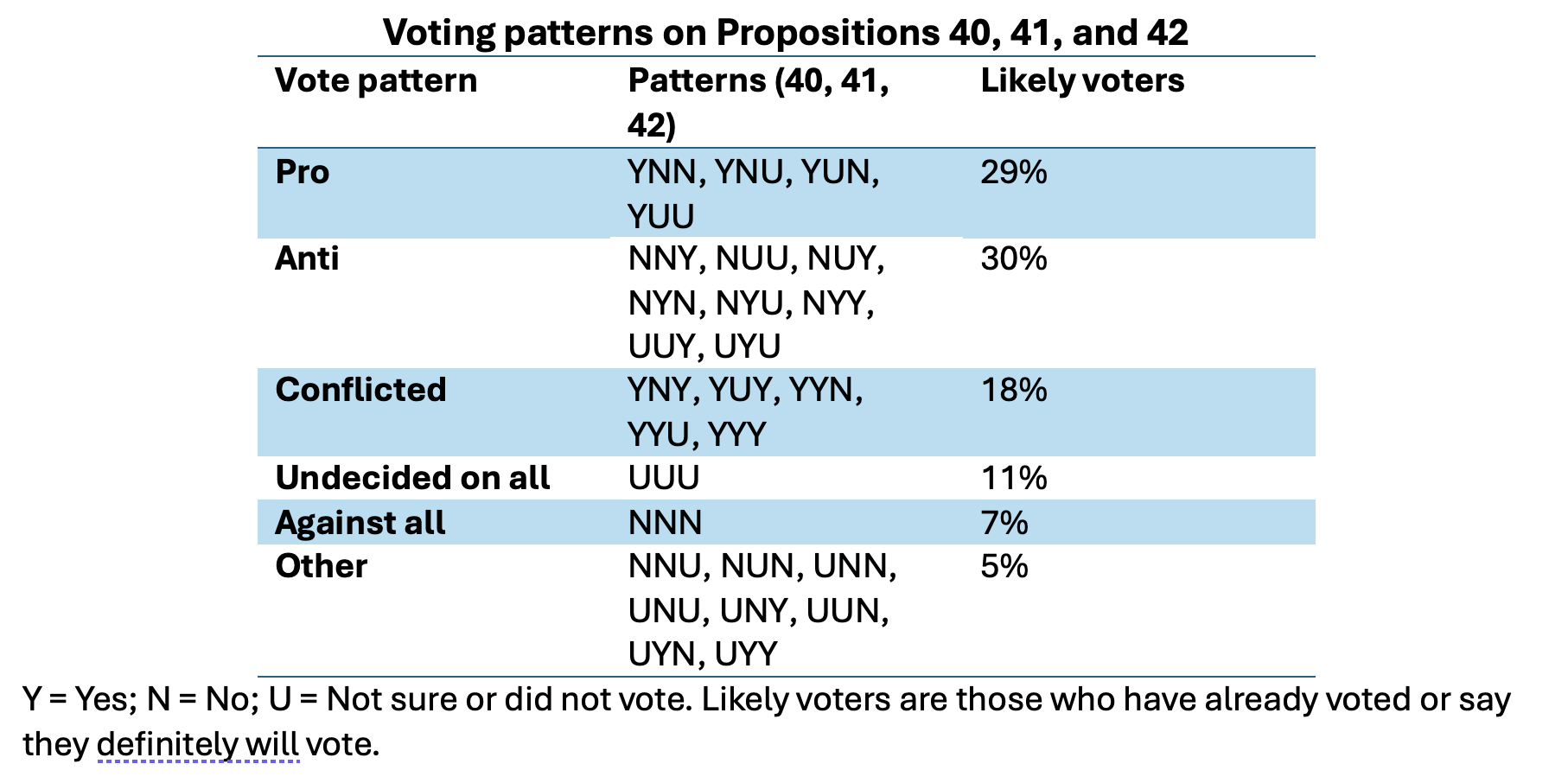
It thus appears the fate of the “billionaire wealth tax” will be decided by two primary factors: whether the undecideds break overwhelmingly against it, as is common on California ballot initiatives, and whether the apparently conflicted and/or confused voters overwhelmingly stay with their yes inclination.
Why the wealth tax is struggling
So why is Prop 40, explicitly designed to focus on “just a few” wealthy Californians, struggling to get to 50 percent? There are at least five reasons.
First, the majority of Californians believe the state has a spending problem, not a tax problem, as described above. Californians also appear to have lost confidence in the state’s ability to manage its finances and its programs competently. By 56–14 percent, they do not believe that the money supposedly raised under the proposition is guaranteed to go as advertised to health care. Nor do they believe that hospitals and emergency rooms will close if it fails (36–27 percent). And, perhaps most distressing for those who believe in honesty and transparency in government, by 3 to 1 (48–16 percent), Californians say it is not believable that this is a one-time tax. Californians are evenly split (51–49) on whether the tax should be levied only when assets are sold.
Second, Californians are pessimistic about the ability to administer a wealth tax; 42 percent believe it’s a good idea in theory but impractical to administer, while 24 percent disagree. Nationally, the corresponding figures are tied at 34 percent each, perhaps because a national wealth tax may be thought easier to administer without capital flight than a state wealth tax. (Difficulty in administering wealth taxes and too little revenue raised are cited as the reasons most European countries, including Sweden and Denmark, which are often cited as desirable models by the progressive left, have abolished their wealth taxes.)
Digging deeper on administering the wealth tax envisioned in Prop 40, our polling data reveal a majority, 53 percent to 47 percent, believe the state will not be able to properly value the assets subject to the tax. The results differ markedly by age: the youngest two age cohorts—those with the least wealth and the least experience with it—are much more confident assets can be accurately valued (72–29 percent for 18- to 29-year-olds) than the oldest two age cohorts—those with much more wealth and experience managing it, who are not confident in accurate valuation (63–36 percent for those 65 and over).
Third, many Californians are confused about what the new tax in Prop 40 actually is and how it will work. Shockingly, barely a majority understand it applies to all assets. Remarkably, almost a quarter believe it is an additional income tax on 2026 income and just over a quarter are not sure. That raises the question of whether anything can be sound policy if almost half the population does not even know what it is.
Fourth, a resounding majority think billionaires will find a way to avoid paying the tax (67–6), with even higher shares among Democrats (72–6) and independents (69–2) than among Republicans (54–11). By large majorities, among all ages, races, sexes, and political affiliation groups, Californians believe it would be a serious problem if many of the state’s billionaires left the state.
Fifth, a host of concerns about deleterious incentive effects counterbalances the belief that billionaires aren’t paying their fair share (we did not ask a question to see if the respondents actually knew how much in taxes is paid by billionaires, although it is widely known in California that the top 1 percent income group pays 40-plus percent of the state income tax, which is the state’s major revenue source). A sizable majority believe a wealth tax would push startups and business expansion out of the state (40–27). Democrats disagree (25–40), while Republicans overwhelmingly (71–7) and independents decidedly (40–22) agree.
On the question of whether the Prop 40 wealth tax would raise or lower the state’s revenue, at the extremes, 10 percent believe it will raise a lot more, 17 percent a lot less; and “somewhat more” outpaces “somewhat less” by 2 to 1 (25–12). Interestingly, only a small percentage say it will raise about the same (around 12 percent). There are sharp differences by age: the youngest cohort believes it will raise more revenue (46–17, although mostly “somewhat more”); the oldest believes it will raise less (38–28).
Democrats believe it will raise more by 49–16 (although again, mostly “somewhat more,” not “a lot more”); Republicans believe the opposite by 55–19, but mostly “a lot less”; independents are about evenly split (33–29 more, although on the “more” side mostly “somewhat more” rather than “a lot more,” and on the “less” side mostly “a lot less” rather than “somewhat less”).
If Proposition 40 does indeed pass, its implementation may well be delayed by lawsuits contesting various provisions, from its retroactivity to its valuation methods to its proposed taxing of worldwide income and attempt to prohibit Congress from allowing a deduction for the tax against federal income taxes under the Commerce, Takings, and Due Process clauses of the U.S. Constitution.
Where attitudes meet policy
Whatever the outcome of the vote, the long-standing Democratic supermajority in Sacramento will continue, as will the likely control of all statewide offices from the governor on down. This means that only time will tell if our snapshot of Californians’ attitudes on taxes and spending will hold up over time and, more importantly, will actually, at some point, affect policy outcomes.
Michael J. Boskin is the Rose and Milton Friedman Senior Fellow at the Hoover Institution and the Tully M. Friedman Professor of Economics at Stanford University. He is a former chairman of the President’s Council of Economic Advisers.
Douglas Rivers is a senior fellow (joint) at the Hoover Institution and the Ward C. Krebs Family Professor in the political science department at Stanford. He is also the chief scientist at YouGov PLC, a global polling firm.