 Powered by
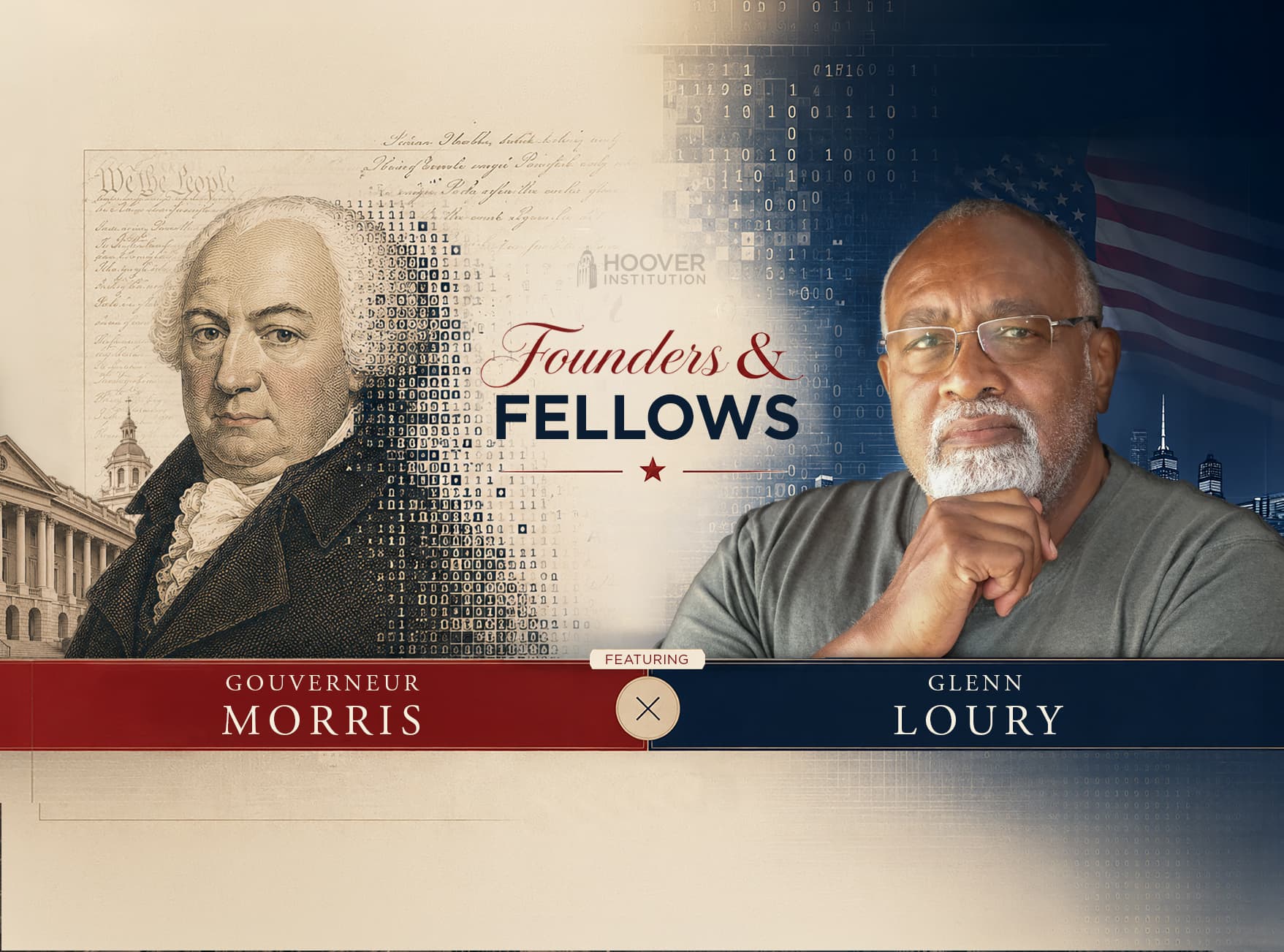
Of all the figures gathered in Philadelphia in the summer of 1787, few would have seemed less likely to speak for “the American people” than Gouverneur Morris. Wealthy, cosmopolitan, and aristocratic in bearing, he was impatient with cant and openly skeptical of democratic enthusiasms. A striking figure who moved through the world on a wooden leg—the result of a gruesome carriage accident years earlier—he retained a caustic wit and an abundance of self-regard. Morris was no plaster saint for schoolbooks. He was vain, rakish, and at times contemptuous of the masses. Yet the delegates entrusted him with the final drafting of the Constitution. Much of its language bears his mark. The most enduring words in the Preamble are unmistakably his: “We the People of the United States . . . ”
This Founders & Fellows essay is part of a series in which Hoover scholars explore the people, ideas, and debates that brought America to life.
Those are radical words, though their familiarity has blunted their radicalism. The Constitution might easily have opened as a compact among sovereign states—Virginia, Pennsylvania, Massachusetts—each jealous of its prerogatives. That phrasing would have ratified the dominant political reality of the day: most Americans at that time thought of themselves first as citizens of their states. Morris made a different choice. His preamble was not mere literary polish. It gave expression to a political idea that was still struggling to become a reality: that Americans were one people.
The ambition embodied in those words was extraordinary then and remains so today. America was never a tribe bound by blood, ancestry, or ancient custom. It gathered people of disparate regions, denominations, interests, and origins. What united them in 1787 was not who they were by birth, but what they undertook together as citizens. This remains the case today. The difficulty, of course, is that human beings are not naturally citizens. They are naturally sons and daughters, neighbors and congregants, members of clans, classes, and peoples. They divide the world into “us” and “them” almost instinctively. Every successful republic therefore must attempt something improbable: it must ask men and women to recognize a wider circle of obligation than the one toward which their affections naturally incline. The American experiment has always depended upon whether this civic identity can remain strong enough to encompass, without erasing, the many particular identities that compose it.
Morris intuitively grasped this truth with unusual clarity. He feared faction—not because disagreement threatened harmony, but because he saw citizens dissolving into rival camps before they could act as a common polity. He saw that while the republic could endure policy disputes, it could not survive if the people in whose name it governed ceased to think of themselves as one people.
No issue has tested this conviction more brutally than slavery. Morris confronted it more directly than most of his contemporaries. On August 8, 1787, in a speech delivered during the Constitutional Convention in Philadelphia, as delegates debated the apportionment of representation in the House (the three-fifths clause and related issues), he denounced the institution in language that still cuts: He never would concur in upholding domestic slavery. It was, he declared, a “nefarious institution,” and “the curse of heaven on the States where it prevailed.” He rejected the three-fifths compromise not merely on moral grounds but on civic ones. How could a republic profess to govern in the name of “the People” while reducing millions of people to subjects—property rather than citizens? How could it grant extra political weight to those who tore human beings from their families and damned them to bondage, thereby outvoting the free citizens of Pennsylvania or New Jersey? Slavery did not merely oppress; it corrupted the very reciprocity that republican government demands.
Morris did not escape the compromises of his age. As the Convention’s most frequent speaker—he addressed it 171 times, more often than any other delegate—and lead draftsman on the Committee of Style, he made subtle but consequential changes that strengthened national authority, protected property, and quietly undermined slavery’s constitutional legitimacy—removing language that might have implied moral approval of the institution. Yet in the end, having lost the argument over the three-fifths clause, he ultimately accepted a document that tolerated slavery’s continuation. Like the republic itself, Morris contained contradictions.
The struggle to define who belongs within the constitutional “we” did not end with the abolition of slavery. Reconstruction, immigration, women’s suffrage, the civil rights movement, and the continuing expansion of equal citizenship can all be understood as efforts to make the constitutional promise more fully real. Yet each success also posed a new question: would Americans understand these achievements as enlargements of a common citizenship, or as victories of one group over another?
So, that old tension between factions and “We the People” persists today, though in altered form. Our contemporary politics increasingly speaks the language of groups: racial, ethnic, religious, ideological. Public life has become a contest over the representation of these groups—does this legislature mirror the population’s demographics? Does every constituency receive its proportionate share of power and recognition? I acknowledge that these questions arise from genuine histories of exclusion, of course. They are not frivolous.
But Morris would have seen this subtle danger: When the units of democratic legitimacy shift from individual citizens to collective identities, the language of citizenship erodes. The Constitution he helped draft does not speak in the name of races, regions, or ethnic blocs. It speaks of citizens—equal before the law, bearing reciprocal obligations, and capable of self-government. Its premise is not that groups must be proportionally represented as such, but that persons stand as equal members of a single political community: We the People. Contemporary voting-rights controversies often reveal this slippage. Democratic success is increasingly measured by whether electoral outcomes reflect the demographic composition of the population. Yet the constitutional ideal was never proportional representation of groups. It was the equal citizenship of persons.
A republic requires more than procedural rights or interest-balancing. It demands attention to how its citizens are formed—to the slow work of cultivating their character, trust, shared narrative, and the habit of seeing political opponents as compatriots. Valuing diversity does not suffice; nor does the celebration of difference. Without a primary commitment to common citizenship, the “We” in “We the People” gives way to a politics of competing group claims. Again, the danger is not that Americans belong to tribes. The danger is that they may forget that they also belong to one another.
Gouverneur Morris deserves remembrance not because he was flawless—he was not—nor because he resolved the founding’s contradictions. He did not. He deserves it because he perceived an enduring truth with uncommon force. A free people cannot be held together by coercion, nor sustained indefinitely by mere mutual advantage. They must believe that, despite their manifest differences, they belong to one another as citizens of the same civic enterprise.
The opening words of the Constitution describe an aspiration that each generation must struggle to realize. “We the People” invokes less a settled fact than an imperative—an invitation extended across the generations. Whether we can make it real remains the American question. The legacy of Gouverneur Morris—that improbable penman with the wooden leg and the sharp tongue—still presses this question upon us.
Glenn C. Loury is a distinguished visiting fellow at the Hoover Institution and the Merton P. Stoltz Professor of the Social Sciences, Emeritus, at Brown University. He is also host of The Glenn Show, a popular podcast and newsletter, and author of the memoir Late Admissions: Confessions of a Black Conservative (W.W. Norton, 2024) and, most recently, Self-Censorship (Polity Press, Cambridge, 2025).