 Powered by

As the United States approaches the 250th anniversary of its Declaration of Independence, we would do well to remember that history rarely announces itself as history. In 1776, the future of a fledgling republic was anything but inevitable. What altered the course of human events was not destiny, but choice—bold ideas matched by determined action.
Today, we face another hinge-of-history moment. Breakthroughs in artificial intelligence, biotechnology, quantum science, advanced materials, and space technologies are reshaping economies, societies, and geopolitics at breathtaking speed. Never before have so many technologies advanced so quickly, or with such far-reaching consequences. The question before us is not whether these changes will occur. It is whether they will unfold in ways that strengthen or undermine freedom, security, and human dignity.
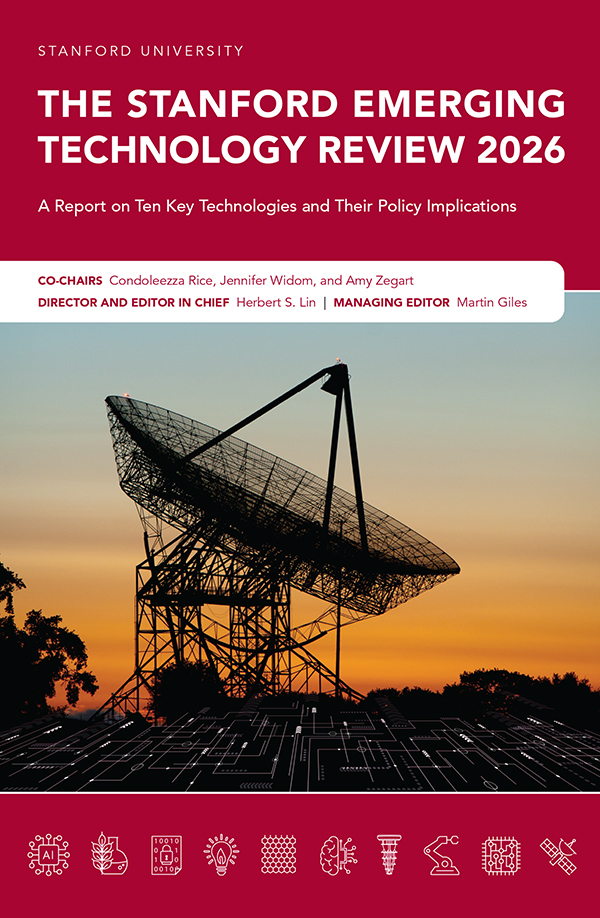
This is the central motivation behind the Stanford Emerging Technology Review (SETR): to help decision-makers better understand the technological landscape taking shape and make wiser choices as a result. In an era when technology, economics, and geopolitics have become inseparable, technological literacy is no longer optional for leaders in government or business. It is essential.

This work embodies the core mission of the Hoover Institution. At Hoover, we strive to bridge rigorous scholarship and public policy by translating deep expertise across disciplines into clear, nonpartisan insights that help leaders safeguard American innovation, strengthen democratic values, and navigate moments of historic change.
For much of the postwar period, America’s innovation leadership rested on a powerful three-pronged partnership: government, the private sector, and research universities. That model firmly established the United States as the world’s technological leader, yielding breakthroughs—from the internet and GPS to MRI machines and modern AI—that transformed daily life. But today that model is under strain.
America’s research universities remain unparalleled engines of discovery, yet the foundations beneath them are weakening. Federal investment in basic research has declined sharply as a share of the economy. Talent flows that once reliably favored the United States are no longer assured.
In the field of AI, the most advanced research capacity, and some of the talent that sustains it, sit largely inside a small number of private companies, rather than universities. This shift brings real benefits, but it also carries risks. Universities are uniquely positioned to pursue fundamental research—work that often takes decades to mature and frequently fails before it succeeds—without regard to immediate commercial return. Without that long-term investment, the breakthroughs of tomorrow may not materialize. There is no Plan B to the foundational research model that has sustained the independent inquiry and innovation of the past eighty years.
At the same time, the global context has changed. China is not simply competing with the United States; it is investing heavily in basic research and emulating the core structural features of the American innovation ecosystem, including talent concentration, and the central role of research universities that have historically driven US leadership. While China may seek short-terms gains through intellectual-property theft, espionage, and the export of repressive technologies, there is one thing that will hold it back. This is the deeper truth that innovation flourishes in freedom. Democracies provide a better environment for discovery precisely because they allow dissent, reward transparency, and tolerate failure.
This is why American innovation leadership matters, not only for our prosperity and security, but also for the character of the global technology ecosystem itself. It matters whether that ecosystem is shaped primarily by democracies or autocracies.
The values embedded in technology are rarely neutral.
The United States cannot meet this moment alone. International collaboration with allies and partners remains critical, just as it was during the Cold War, when scientific cooperation helped reduce the risk of catastrophic conflict even amid intense rivalry. Today, shared challenges from AI-enabled risks to instability in space demand similar cooperation grounded in trust and shared values.
None of this suggests easy answers. The pace of technological change often outstrips the capacity of governments to respond. Policymakers struggle to keep up. Innovators struggle to reconcile commercial breakthroughs with national and global responsibilities. Universities face internal challenges that must be addressed if they are to retain public trust and fulfill their mission of serious inquiry.
What is required now is not panic or complacency but renewal. Renewal of America’s commitment to basic research. Renewal of the partnership between government, industry, and academia. Renewal of the idea that technological leadership and democratic values are not in tension but are mutually reinforcing goals.
By design, the Stanford Emerging Technology Review does not offer policy prescriptions. Instead, it seeks to inform. It aims to illuminate how emerging technologies work, where they are headed, and why they matter. In a world awash in opinions, informed understanding is in short supply.
The promise of emerging technologies is boundless. But realizing that promise will require choices worthy of a nation that once dared to replace a king with a bold experiment in self-government. History will judge not only what we invent, but how and why we chose to do so.
As before, the future remains open. And as before, human agency will make all the difference.
Click here to learn more about the Stanford Emerging Technology Review and download the 2026 report.
Condoleezza Rice is the Tad and Dianne Taube Director of the Hoover Institution. A renowned scholar, educator, and practitioner of international relations, Dr. Rice was America’s 66th secretary of state from 2005 to 2009 and national security adviser from 2001 to 2005. She is the author of several bestselling books, including her memoir of service to the nation, No Higher Honor.