 Powered by
America’s principled commitment to freedom was established 250 years ago, with the signing of the Declaration of Independence. The War of Independence, the Constitution, and the Bill of Rights put the freedom principle into practice. But it took another harrowing war before the stain of slavery, once imagined as necessary for prosperity, was finally scrubbed out. Before then, black Americans in slave states could legally be treated by their owners as “ensouled tools”—that is, as reasoning and feeling persons, who, because of some posited lack, could, like any other tool, be owned and used or misused however their owner chose.
With the post–Civil War Amendments to the Constitution, the United States forbade slavery and in the decades that followed we, along with other Western countries, acknowledged freedom from slavery as a universal human right: persons could not legally or justly be owned or used by others, simply as tools.
But what if a new form of slavery were to be introduced through an exciting breakthrough in artificial intelligence?
Today we treat AI agents as power tools—with no more rights than an electric leaf blower. Our ethical worries about AI concern its impact on us, and our societies, not our treatment of “them.” But, while it may never happen, there is a possibility that AI could someday develop to the point at which an AI agent would have to be acknowledged as a reasoning and feeling person—and thus presumptively a rightsholder that could not legitimately be treated as a mere tool. We may never cross that line. But so long as it remains a possibility, it is worth the attention of all those who care about freedom.
A problem with thinking seriously about “AI agents as persons” is that no one has never encountered one. So, those concerned with the question are reduced to thought experiments dreamed up by speculative philosophers or writers of science fiction. Aristotle is, however, an example of a profound thinker who believed he did have experience with ensouled tools. His account has much to say about the “what if” problem of AI personhood.
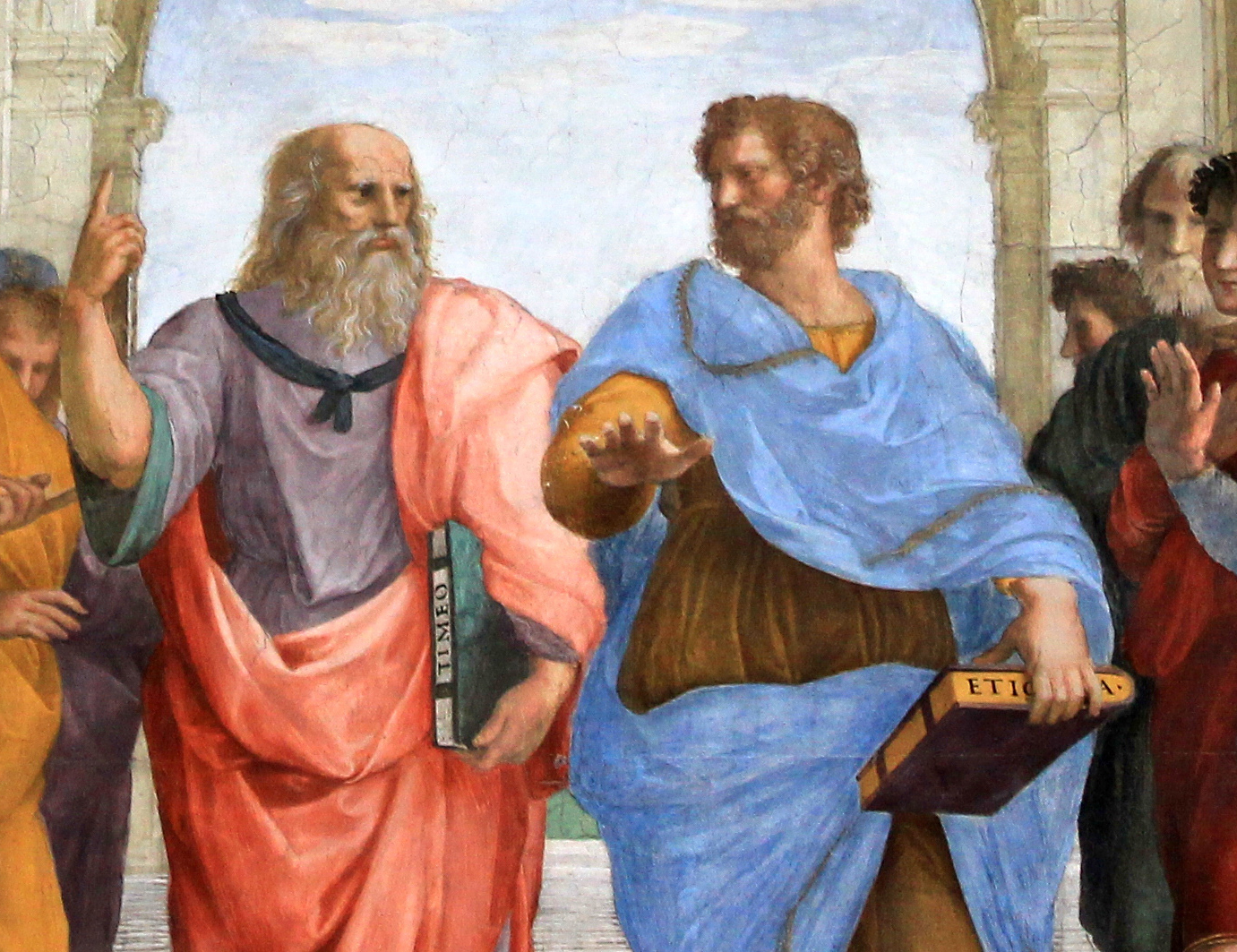
Aristotle lived in an ancient Greek society in which slaves were omnipresent. He was a slaveowner, as we know from his last will and testament. He was also a pre-eminent ethical and political philosopher who refused to take slavery for granted. In his great work, Politics, Aristotle developed an elaborate theory of what he called “natural slavery.” Despite its popularity with nineteenth-century American slaveowners, Aristotle’s theory is not only repugnant to modern sensibilities but it fails, catastrophically, on its own grounds. Reviewing the deep internal contradictions in Aristotle’s theory of natural slavery illuminates the issue of “ensouled AI tools”—and suggests that it would cause trouble for our American commitment to freedom.
The upshot is: if AI did achieve personhood, those of us who cherish freedom can no longer justly own an AI agent or use it simply as a tool for our own benefit. And then we might ask: “What is the point of AI, anyway?”
The argument
Aristotle’s account of natural slavery is premised on dubious assumptions: that ruling (being a master) and being ruled over (being a slave) is natural. That the natural slave (as opposed to, for example, a free man sold into slavery as a prisoner of war) possesses reason and feelings but suffers from a cryptic psychological disability that renders him incapable of deliberating about his own best interests. That the relationship of master and slave is mutually beneficial, and therefore just. And, as a corollary: that a free natural slave suffers harm, so manumission is cruel and unjust.
Aristotle begins his Politics with the fact of human interdependence and with putatively natural authority relations in the household (which included, for him, husband, wife, children, and slaves). He sought to refute the arguments of Greek writers who claimed that slavery was unnatural and unjust. In response, Aristotle introduced the idea of possession: the household, as a natural productive unit, necessarily requires possessions as “instruments” in order that necessary productive work be accomplished. He divides productive instruments into inanimate and animate tools. The slave, then, is an ensouled (Greek: empsuchon) tool that “belongs wholly” to its owner. In other words, just prosperity required slavery and nature obliged.
Aristotle then raises the key question: are there really persons who are justly enslaved? He initially answers these questions by reference to the universality of ruling by superior things over inferior ones. This includes humans ruling over animals and the soul ruling over the body. Thus “all humans who differ [from the free person] as widely as the soul does from the body, and [as does] the human being from the lower animal . . . are by nature slaves.”
He then raises a major worry: slaves owned by Greeks were not, contrary to what “nature” wishes, physically distinguishable from free persons. He admits that there are also persons who, by nature, are free persons but who, through misfortune, are enslaved—for example, prisoners of war. He allows that unnatural enslavement causes confusion in the natural-slave category, but he dismisses the worry, with the repeated assertion that the free/slave distinction does exist for some and that, for them, slavery is just and advantageous. And he goes a step further, asserting that the natural slave is a “part of” the master, indeed an extension of his body: “an ensouled and separate part.”
Aristotle insists that ruling and being ruled differ in kind, not just in degree. Yet, still, he admits, it would be “shocking” if the ruler possessed virtue and the person ruled over did not: after all, a licentious and cowardly slave—that is, one lacking in the virtues of moderation and courage—would perform none of his duties. Aristotle breaks through this “dead end” by concluding that: “obviously” both ruler and ruled must share in virtue, but their virtue must somehow be different. How different? Aristotle asserts that every human soul has a reasoning and an unreasoning part. While both these soul-parts are present in all persons, they are present in different ways. The slave, he posits, lacks the “deliberative element” in the reasoning part of his soul. Exactly what this means, Aristotle does not say.
Aristotle’s “mutual advantage” of master and slave claim is predicated on a cognitive distinction between them: the master has the capacity to plan ahead for his own advantage; the slave is by nature a slave because he lacks that capacity. Yet Aristotle’s natural slave does not lack reason and something that looks very much like a planning capacity. He is fully capable of grasping and carrying out complex orders and using other tools (including other slaves) to achieve the master’s ends. Moreover, although Aristotle denied that a slave could experience true happiness, he recognized that enslaved persons felt pleasures and pains just as vividly as do free persons.
The problems plaguing Aristotle’s theory derive from the fact that he recognized slaves as human beings partaking in reason and, at the same time, he needed them to be mere instruments whose own ends must be set by someone else: They possess human features that imply freedom to choose, and yet they are denied freedom. The flaws of Aristotle’s theory are even more evident when it came to practice.
Contradictions
Aristotle’s written last will vividly showcases contradictions between his theory of mutual advantage and his own practice. As Anton-Hermann Chroust, the leading scholar of Aristotle’s will, points out:
Under Athenian law, a testator could choose to emancipate his slaves in a number of different ways, including outright and unconditional manumission, manumission on the expiration of a specified period of time or after the slave had attained a designated age, and manumission upon the occurrence of a certain event or upon the fulfillment of a specified condition. In his last will and testament, Aristotle makes use of all these possibilities.
Aristotle specified that certain of his favorite slaves be freed immediately upon his death, others upon maturity, yet others upon the occasion of his daughter’s marriage. Some of the freed slaves are to receive benefactions—including slaves of their own. If Aristotle really believed that he owned natural slaves who benefited from enslavement and would be harmed by freedom, he could not justly free them. If they were not natural slaves, they were enslaved unjustly. If he could not tell the difference, the category “ensouled instrument” was incoherent. These are serious contradictions, especially for a thinker who taught that fully virtuous persons respect justice and make their free, deliberative choices accordingly.
I, Robot
If ever we come to recognize AI agents as having reason and feeling, we will have brought upon ourselves a serious problem: we would depend on them for our own welfare but could no longer treat them as power tools. We would have to acknowledge both their self-awareness and their reasoning. And no, we couldn’t just unplug them—in fact, that could be considered murder.
An ancient version of that problem remained unsolved by one of history’s greatest moral philosophers. It will not easily be solved by us. The Greek experience of slavery serves as a stark warning of the world we could inhabit in the not-so-distant future. We must take seriously the ways in which our simultaneous commitments to freedom and prosperity may be challenged by advances in AI.
This article references J. Ober and V. Tsouna, “The future of AI: Sophisticated tool or self-conscious agent? Aristotle and Plato on ‘Why not both?’ ” This unpublished paper contains full references.
Josiah Ober, a senior fellow at the Hoover Institution, is also the Markos & Eleni Kounalakis Chair in Honor of Constantine Mitsotakis in the School of Humanities and Sciences, professor of political science and classics, and professor of philosophy (by courtesy) at Stanford University. He is the founder and currently faculty co-director of the Stanford Civics Initiative, a joint project of Stanford’s School of Humanities and Sciences and Hoover’s Center for Revitalizing American Institutions.