 Powered by
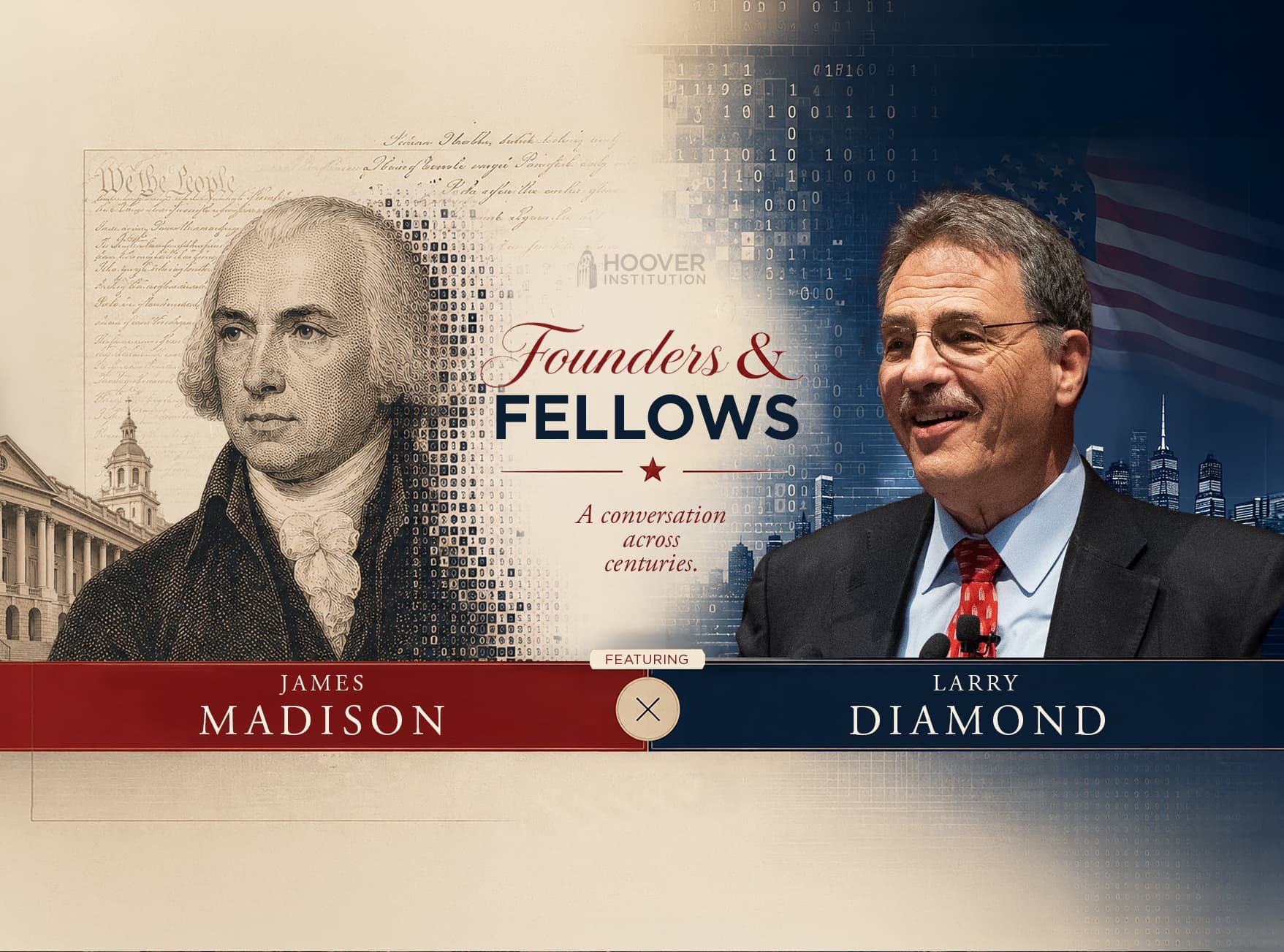
More than any other individual, James Madison shaped the Constitution that has undergirded the American democratic experiment. A lucid writer and forceful debater, he brought the compelling logic and moral reasoning of the Scottish Enlightenment to American constitutional debates. His visionary ideas and tireless advocacy earned him the sobriquet “Father of the Constitution.”
During the heated debates of the Constitutional Convention (May to September 1787), Madison appealed for the Virginia Plan of separated powers and a bicameral Congress (which he authored with Edmund Randolph and George Mason). Then, in a series of newspaper articles published from October 1787 to May 1788 (along with Alexander Hamilton and John Jay), he made the public case for the new framework to replace the impossibly weak Articles of Confederation.
The genius of Madison’s Constitution was to join a strong national system of government authority to multiple constraints on that authority: the federalist system of shared powers with the states; the checks and balances emerging from the independent powers of the executive, legislative, and judicial branches; and the strong protections for individual rights in the Bill of Rights, which Madison also authored. These principles now seem so natural and necessary that it is difficult to appreciate how radical they were in application—for the first time in history—to a nation-state.
The Federalist Papers have long been considered one of the most important works in democratic political theory. Their enduring impact—and particularly that of Madison in his twenty-nine essays—lies in their deep insights into human nature and their farsighted wisdom in reconciling the fundamental dilemma of governance: to maintain order, promote commerce, and mobilize resources to advance development, a country needs a state with authority to tax and spend, and to make and enforce laws. But how can a people give government that much power without risking a descent into tyranny?
Thus, Madison, stated in Federalist no. 51:
If men were angels, no government would be necessary. . . . In framing a government which is to be administered by men over men, the great difficulty lies in this: you must first enable the government to control the governed; and in the next place oblige it to control itself.
Madison recognized that no government could be relied on to control itself through moral discipline alone—even if the law and the Constitution codified that morality. For what would keep an aspiring tyrant at the helm of government from violating those laws, or a power-hungry legislature from overawing the executive? Governmental self-restraint was only possible with different branches of government checking one another. In one of the most memorable sentences of the constitutional debate, Madison declared (again in Federalist 51), “Ambition must be made to counteract ambition.”
Popular control of government through regular contested elections would serve as “the primary control on the government.” But he cautioned, “experience has taught mankind the necessity of auxiliary precautions” against the abuse of power. Thus, he urged giving to the leaders of each part of government “the necessary constitutional means and personal motives to resist encroachments of the others.” This required real and distinct powers for each branch, such as the presidential veto, the Senate’s power of confirmation, and congressional control over taxing, spending, and impeachment.
At the time, Madison was most worried about an overzealous legislature. Thus, he and his colleagues designed a bicameral legislature with “different modes of election and different principles of action” as a “further precaution.” The House, directly elected and for shorter terms, would represent popular interests and passions. The Senate, indirectly elected, with longer terms and a stronger bent for deliberation, would check the potential for rash action by a temporary House majority.
In addition, the Constitution’s federal nature offered a “double security” for the rights of the people. First, it divided “the power surrendered by the people” between the federal and state governments, and then it further “subdivided” (among separate branches) the powers allotted to each level of government.
Like George Washington, Madison worried deeply about the problem of “faction”—a political group, whether majority or minority, pursuing its interests at the expense of the rights of other citizens or of the common good. This, he explained in Federalist 10, argued for a republic, in which elected representatives would filter the raw passions and transitory preferences of the people, fashioning them into a more just and prudent rendering of the popular will.
There were, however, many challenges that Madison did not foresee.
Early in the life of the new republic, factions crystallized into political parties, and at times these enabled the dominance of one party or severe polarization between them in ways that have tested American democracy.
Second, Madison did not anticipate that the core principles of natural rights and political equality would compel ever-wider political inclusion, eventually producing a universal franchise and direct elections for the Senate.
And third, he did not envision how the complexity of government and economic life would generate the need for additional independent institutions to control corruption and ensure good government. The United States has many of these, such as the Federal Reserve, the Federal Trade Commission, and the Government Accountability Office, but it lacks others that have become common in democracies, such as a national anti-corruption agency.
Today, severe partisan polarization—factionalism on steroids—has enabled an unprecedented challenge to American democracy: a president who has defied the Constitution, the laws, and the ethics of good government, but one the Congress has failed to check because he was able to crack the whip of personal and party loyalty to deter his party members from constraining his actions or removing him through impeachment. Until we solve this problem by creating a pathway for members of Congress to win election without having to capitulate to a narrow, militant faction of party primary voters, our democracy will remain at risk.
The most promising reform to address this pathology is the combination of ranked-choice voting and nonpartisan primaries. As now happens in Alaska, there would be a first-round “blanket” primary among all candidates, with the top four (or three or five) advancing to a general election using some form of preferential voting that requires a majority winner. The ideal form would be “consensus choice” voting, which elects the candidate who defeats all rivals in head-to-head pairings.
I believe Madison would embrace this reform if he were with us today, because it offers the best prospect of controlling the pernicious effects of faction and choosing leaders and representatives most likely to serve what he called “the public good.”
Larry Diamond is the William L. Clayton Senior Fellow at the Hoover Institution, the Mosbacher Senior Fellow in Global Democracy at the Freeman Spogli Institute for International Studies (FSI), and a Bass University Fellow in Undergraduate Education at Stanford University. He is also professor by courtesy of political science and sociology at Stanford.