 Powered by
As we ponder the founders, we wonder: Would we have their wisdom and courage? Would we believe that winning independence from the greatest power of the time was even possible? Would we endorse the revolutionary idea of a republic, given how many republics had disintegrated from internal quarreling or the external pressure of empires? Would we endorse democracy with fellow citizens as quarrelsome and headstrong 250 years ago as they are today? Facing revolutionary mobs, might we have followed Mather Byles, who preferred to be ruled by “one tyrant three thousand miles away” rather than by “three thousand tyrants not a mile away’’?
The founders stand out in their concern for the future. Though the republic was barely born and facing innumerable trials, they considered each act for its precedent, how it would contribute to a well-functioning government that could last centuries, more than its immediate advantage to one interest or another. How many of our politicians, thinking about, say, the size and powers of the Supreme Court, the rules and laws surrounding elections, the limits of executive power, or the Senate filibuster, think foremost about how these rules of the game will play out over decades as each faction takes power in turn, rather than about how it plays to immediate partisan advantage?
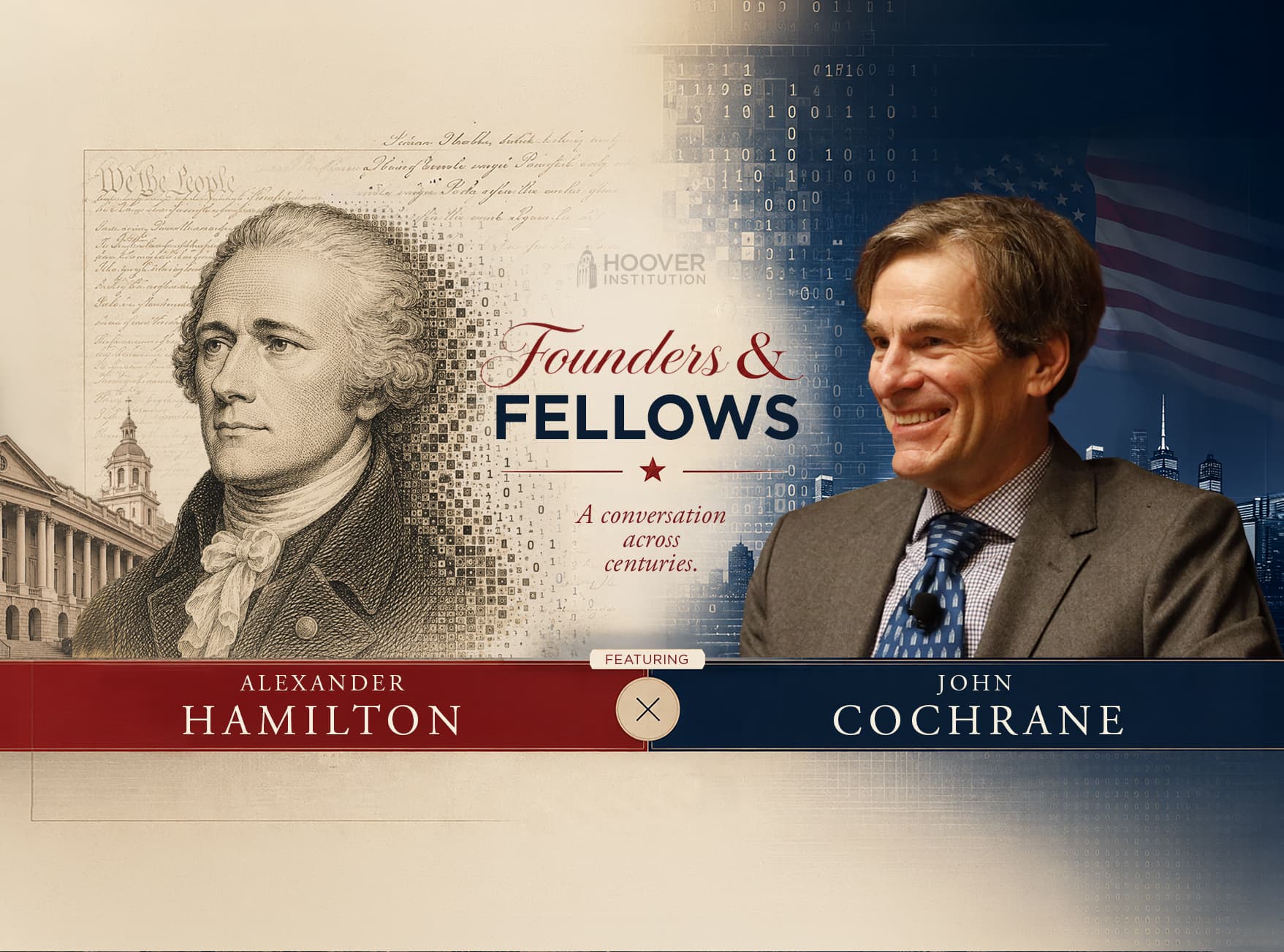
Alexander Hamilton exemplified both characteristics. As a financial economist, his prescient financial wisdom stands out to me.
Hamilton faced a situation that echoes today: The United States had a large debt after the Revolutionary War. How would the United States pay off that debt? Would it do so? We have a large debt today, after the war on the financial crisis, the war on COVID, and (to stretch the metaphor) the War on Poverty—expensive social programs all, each fought with prodigious borrowing. How will the United States pay off this debt? Will it do so? Hamilton’s thoughts bear on today’s issue as well.
Hamilton’s 1790 First Report on the Public Credit made the ultimately successful case that the United States should assume from the states and repay Revolutionary War debts. This farsighted and expensive act gave the US the ability to borrow later, enhanced our standing abroad, and inaugurated the financial foundations of our prosperity.
Hamilton starts by arguing that well-managed public debt can be a public benefit—so much so, indeed, that he might have had the government issue debt even if it did not need to do so. That’s a hard proposition even today. Many conservatives would like to see the debt paid off entirely.
It is a well known fact that in countries in which the national debt is properly funded and an object of established confidence, it answers most of the purposes of money.
How is government debt like money? For example,
Trade is extended by it [debt]. . . . the merchant can at the same time afford to trade for smaller profits as his stock, which, when unemployed, brings him in an interest from the government, serves him also as money, when he has a call for it in his commercial operations.
A business needs money. If money pays interest and is also a savings vehicle, the merchant can run his business more efficiently, not scrambling for cash, and at lower cost.
I thought Hamilton’s view a bit nutty when I first read the Report. Government debt is money? Hamilton was 250 years ahead of me. Today’s economists are rediscovering the proposition. US debt is a tremendously useful security. Today’s “dollar dominance” and “safe asset” is much to the benefit of the country. Government debt underlies our vibrant financial system.
Hamilton’s view was visionary. I do not believe it was “well known” then. I suspect he was underplaying its novelty to gain acceptance. Government debt at the time was risky, frequently defaulted, and was hard to buy and sell. The French Revolution going on at the same time was sparked by a grand default on government debt. Safe and money-like government debt as Hamilton envisioned developed in the nineteenth century, not the eighteenth.
Hamilton’s vision is even more astounding given the situation: Who is going to pay for the huge debts run up during the Revolutionary War? Why are we waxing on about debts that function as money when paying any of it back is the urgent problem?
Governments are always tempted to repudiate debts. New and financially strapped governments are especially tempted. Theoretical economics offers support for the idea in the form of a “just this once” repudiation. That theory is a little hazy on how “never again” is then credible. (California’s proposed billionaire tax is stated as a “just this once” tax, which nobody believes.) Hamilton went the other way. The United States will repay the debt. It will stand by its promises. And doing so will give the United States standing in the world, not least the ability to borrow at good terms in the future. Hamilton is thinking about the future, not about the current crisis. As ever.
Need America pay all of her debts? How about debt bought by a speculator at a deep discount, from a poor Revolutionary War soldier in need? Surely speculators should not profit. Even the redoubtable James Madison thought so. But maybe the seller just didn’t have faith in the United States. Maybe the speculator was a patriot, taking on a huge risk and helping the government by propping up the market. Trying to distinguish the moral worth of creditors is a fraught business—advice politicians might heed today.
Questions of this sort, on a close inspection, multiply themselves without end, and demonstrate the injustice of a discrimination even on the most subtle calculations of equity, abstracted from the obligation of contract.
“The obligation of contract.” The debt was issued with a promise it could be sold and bought. And the point: this nation honors its contracts and does not rewrite the terms after the facts. Even when it’s really hard.
It is agreed on all hands that that part of the debt which has been contracted abroad, and is denominated the foreign debt, ought to be provided for according to the precise terms of the contracts relating to it. The discussions which can arise, therefore, will have reference essentially to the domestic part of it, or to that which has been contracted at home. It is to be regretted that there is not the same unanimity of sentiment on this part as on the other.
Would today’s Congress prioritize repaying foreigners? Does it feel that the nation’s honor is at stake in repaying debts? We seem to rip up a lot of contracts these days with little concern for our honor. It would be wise to listen to Hamilton. In debt-ceiling controversies, for example, I wish Hamilton’s successors in office would say that the United States pays principal and interest on its debt ahead of anything else. They do not do so.
Hamilton was visionary, not clairvoyant, and not so pure. Arguably, he could not be. The United States could not repay all the Revolutionary War debt. The United States did discriminate between claimants, and did repudiate some debts. It let the Continental dollar inflate to nothing, along with bills of credit, essentially paper money issued by the states. The United States built a distinct reputation for repaying long-term interest-bearing debt, but not for repaying paper money. Paper money that holds its value is also a useful financial innovation, but it took another century to realize that.
Famously, Hamilton understood that federal assumption of state debts meant that the federal government would have to have the authority to raise taxes to repay debt. Also, assumption would create a class of bondholders interested in sound federal finances.
If all the public creditors receive their dues from one source, distributed with an equal hand, their interest will be the same. And having the same interests, they will unite in the support of the fiscal arrangements of the government.
We shall see if bondholders remain powerful enough to ensure sound finances and debt repayment from our government. Current political thought disdains political influence of wealthy security holders. Europe wishes to issue eurobonds without eurotaxes. They should read Hamilton.
Hamilton understood that debt can be dangerous:
(T)hese good effects of a public debt are only to be looked for when, by being well funded, it has acquired an adequate and stable value.
“Well funded” means the government reliably can and will repay the debt with tax revenues in excess of spending.
Persuaded as the Secretary is that the proper funding of the present debt will render it a national blessing, yet he is so far from acceding to the position . . . that “public debts are public benefits,” a position inviting to prodigality and liable to dangerous abuse.
Today’s “debt doesn’t matter,” “we owe it to ourselves, don’t worry,” and fellow travelers have a long pedigree, inviting our current prodigality and dangerous abuse.
[Hamilton] ardently wishes to see it incorporated as a fundamental maxim in the system of public credit of the United States, that the creation of debt should always be accompanied with the means of extinguishment. This he regards as the true secret for rendering public credit immortal.
“The means of extinguishment” means specific tax revenues or other institutional designs to guarantee repayment.
And he presumes that it is difficult to conceive a situation in which there may not be an adherence to the maxim.
Just wait 250 years. “If you can keep it,” a remark by another favorite founder, may apply to our financial as well as political future.
John H. Cochrane is the Rose-Marie and Jack Anderson Senior Fellow at the Hoover Institution. An economist specializing in financial economics and macroeconomics, he is the author of The Fiscal Theory of the Price Level. He also publishes a popular Substack called The Grumpy Economist.