 Powered by
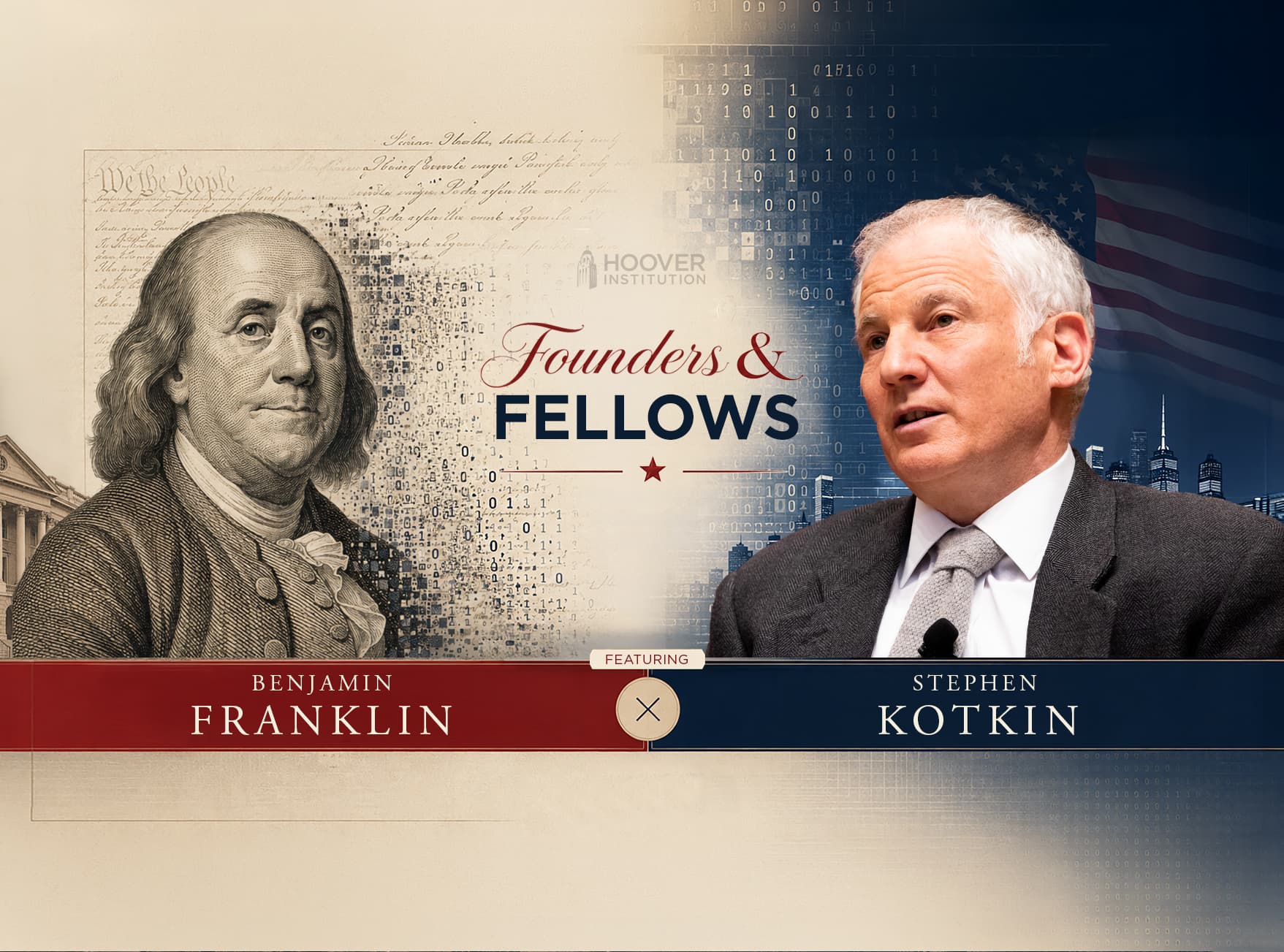
Benjamin Franklin turned 320 in January 2026. He was never president—and never aspired to be. That already makes him special among the founders.
He was the only founder to sign not just the Declaration of Independence but also the Treaty of Paris, which officially ended the Revolutionary War, and the Constitution, all three founding texts. A two-part documentary by Ken Burns (2022) called him “the most compelling personality in America in the eighteenth century.” I agree.
Entrepreneur, civic leader, writer of wit, scientist-inventor, diplomat—Franklin uncannily combined so many of the pursuits behind America’s success in his lifetime and ours.
This Founders & Fellows essay is part of a series in which Hoover scholars explore the people, ideas, and debates that brought America to life.
A Bostonian by birth, Franklin was his father’s fifteenth child (of seventeen, from two marriages). Constrained finances meant he had a mere two years of formal schooling, but he read everything he could and educated himself. He went on to invent bifocals, so that people could see both near and far—and academics could look the part.
His likeness graces the $100 bill, fitting for a man who started life in business, as an editor and printer, and became wealthy, thanks in part to the phenomenal success of his Poor Richard’s Almanack, which contains such examples of eternal wisdom as “Early to bed and early to rise makes a man healthy, wealthy, and wise.”
Writing came naturally to Franklin, perhaps because—believing in the health benefits of cold drafts while putting pen to paper—he sat naked in his room in front of a window, which he dubbed taking “air baths.”
He did go on to hold public office: he was an elected member of Pennsylvania’s colonial assembly and then of the Continental Congress, de facto governor of Pennsylvania, the first US postmaster general, and the first US ambassador to anywhere (to France, America’s first ally). Franklin embodied American soft power, three centuries before the term was coined.
His civic achievements are unmatched. He established the colonies’ first post office—to this day it’s the only one without an American flag, because it predates the United States; the first fire department; the first hospital; the first subscription library, which later served the Continental Congress and Constitutional Convention; and a school for teaching both practical job skills and traditional classical arts. The latter would become the University of Pennsylvania, the first in America to be called a university.
Franklin owned slaves, as servants and assistants, although he became president of an abolitionist society and asked the first Congress to end slavery. His request failed.
Among his many inventions was the glass harmonica, which involves producing ethereal tones by touching the edges of spinning glass bowls with dampened fingers. Franklin’s contemporaries Mozart and Beethoven composed music for it.
He practiced the scientific method. “There’s nothing more important than experimentation, observation, verifiable analysis,” he wrote. Contrary to popular lore, he did not discover electricity, but he did prove that lightning was electrical by flying a kite during a storm. So, Franklin was not risk averse, unlike all too many politicians today (they too gauge the wind, but with their fingers).
Franklin had a sense of humor. The story goes that when Edward Gibbon, the English author of The History of the Decline and Fall of the Roman Empire (6 vols., 1776–88), had refused Franklin’s invitation to dine, on the grounds he could not break bread with a rebel against his king, Franklin offered to forward Gibbon source material for a sequel: The Decline and Fall of the British Empire.
Despite his advanced age through the latter of these trips (the last when he was seventy-nine), Franklin crossed the Atlantic eight times, a journey of six to eight weeks on the high seas—and that was only to get to Europe’s coast. From there, he typically took a long, herky-jerky carriage ride to Paris, where today one can find his bronze statue on Rue Benjamin-Franklin.
When in his seventies, Franklin persuaded the French to provide guns and money to support the American rebels against the British, helping George Washington and the Continental Army triumph. During peace negotiations with the British, Franklin repeatedly tried to acquire Canada. (Everything is unprecedented if you don’t know history.)
President Washington’s 1793 Proclamation of Neutrality voided Franklin’s decisive alliance with France, to avoid US involvement in France’s Revolutionary Wars, and three years later, upon relinquishing the presidency, Washington warned against foreign entanglements. In the fullness of time, Franklin won the debate over the value of alliances.
Franklin exemplified virtue not only in politics but also personal habits. He extolled and practiced moderation in eating and alcohol consumption, the health value of drinking lots of water, the benefits of exercise (he was inducted into the International Swimming Hall of Fame), and a disciplined sleep regimen. “Be always at war with your vices, at peace with your neighbors, and let each new year find you a better man,” his almanac advised.
Franklin fell short as an exemplar in family life. As a bachelor, he got a woman pregnant (history does not know her name), then found a common-law wife, Deborah Read, who accepted his bastard son William and soon gave birth to Francis “Franky” Folger Franklin. In a time of recurring smallpox epidemics, Franklin supported inoculation, which was widely opposed as the devil’s work (even though inoculated people died less often from the disease), but his beloved Franky succumbed to smallpox at four years old. Franklin had not had him inoculated: Deborah opposed vaccines. He appears never to have forgiven her, or himself. He spent nearly two decades of their thirty-five-year marriage living in Europe while she stayed in Philadelphia, and he did not return for her funeral. The daughter she bore him after Franky’s death, Sarah (known as Sally), lived a long life and gave birth to eight children, providing him with heirs. (William had his own out-of-wedlock son, who in turn fathered illegitimate children, but this line eventually died out.)
At the Constitutional Convention in 1787, three years before he passed away, Franklin warned about an overly powerful executive for the United States, anticipating our current debates about the “imperial presidency.”
When a woman queried him about what kind of government they had fashioned at the Convention, Franklin delivered America’s greatest line: “A republic, madam, if you can keep it.”
Stephen Kotkin is the Kleinheinz Family Senior Fellow at the Hoover Institution and a senior fellow at Stanford’s Freeman Spogli Institute for International Studies. He is also the Birkelund Professor in History and International Affairs (emeritus) at the Princeton School of Public and International Affairs (formerly the Woodrow Wilson School), where he taught for thirty-three years.