 Powered by
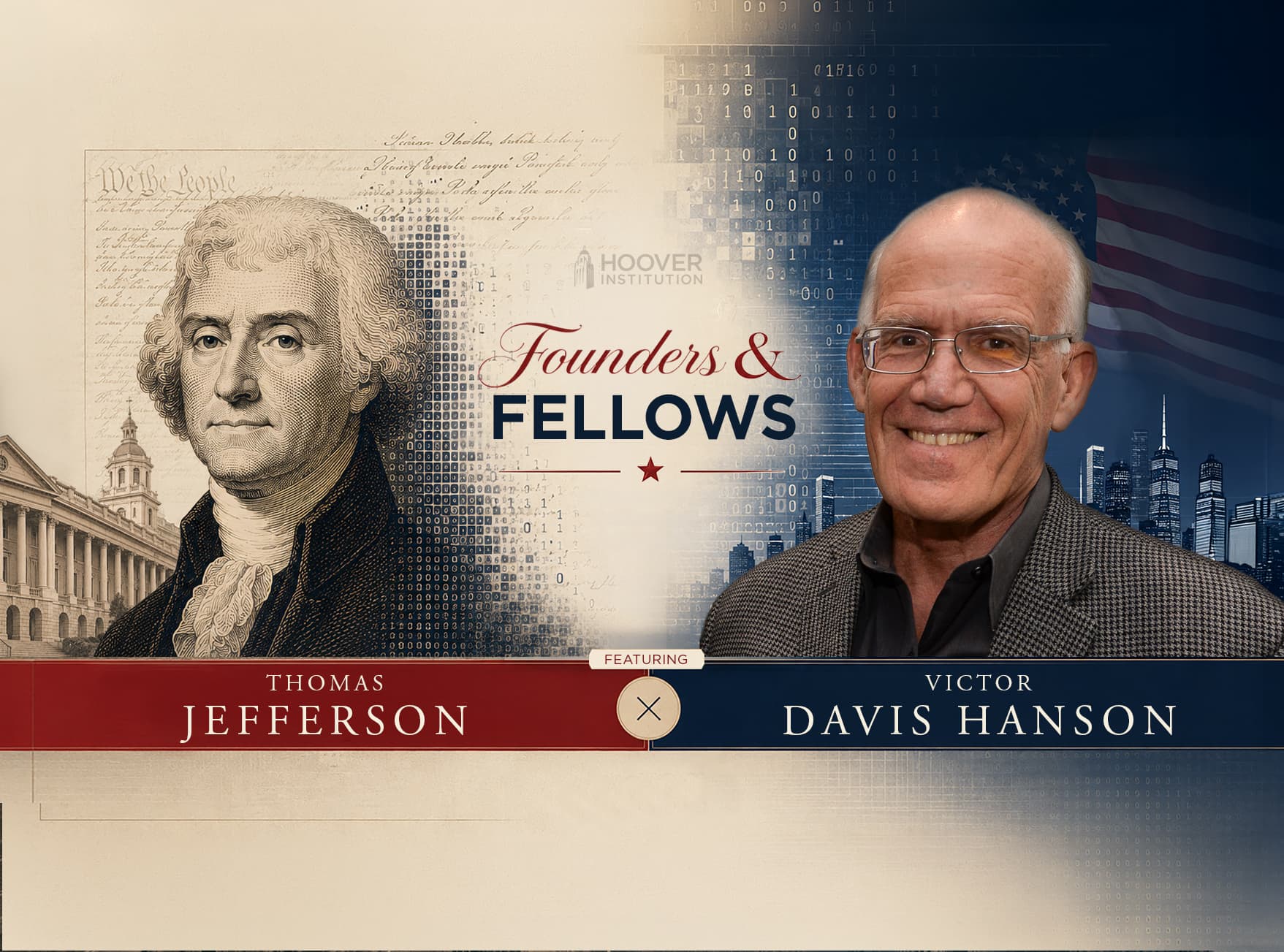
Thomas Jefferson reportedly knew five foreign languages and studied Latin and Greek authors every day. He was widely read in the Enlightenment philosophers of Europe, and a student of ancient and modern constitutional history—knowledge that served as a foundation for his authorship of the Declaration of Independence and his call for the addition of a Bill of Rights to the Constitution.
Even today, conservatives praise his distrust of overweening government, his love of liberty, and his sense of the need to respect states’ rights, while liberals, at least until recently, have seen him as the original defender of free speech and expression, and as the seminal civil libertarian.
Yet if the polymath and renaissance man Jefferson was perhaps the most brilliant of the founding fathers, he was also surely the most complex, conflicted, and controversial.
This Founders & Fellows essay is part of a series in which Hoover scholars explore the people, ideas, and debates that brought America to life.
Jefferson was a theoretical scientist but also a practical inventor. He praised the small farmer, but owned well over five thousand acres—more in the spirit of Roman latifundia than classical yeomanry. Jefferson bitterly resented that some of the Southern founders deleted his condemnation of slavery in his initial drafts of the Declaration of Independence. But he himself, throughout most of his adult life, owned between one hundred twenty and two hundred slaves. Laudator of the independent farmer who worked his own forty acres, Jefferson and his own vast estates were dependent on servile labor.
On the eve of the Civil War, Northerners frequently quoted Jefferson’s preamble to the Declaration as proof that he and the Northern founders always planned to abolish slavery, once the new nation was stable enough to withstand the inevitable rising North-South tensions about the issue.
But even as abolitionists regularly cited Jefferson’s words—“We hold these truths to be self-evident, that all men are created equal, that they are endowed by their Creator with certain unalienable Rights, that among these are Life, Liberty, and the pursuit of Happiness”—later Southern secessionists claimed the Virginian Jefferson as one of their own. They pointed out that he was the original states’ rights advocate, a fellow planter-class slaveowner who—except for two manumissions during his lifetime, and five more after his death—refused to free any of some six hundred slaves he variously owned over his long life.
These same paradoxes characterize his deep love of the land and classical advocacy of agrarianism: the ideal, stretching back to the ancient world, of a large middle class, owning farms of more or less the same size, and serving the state as the moral antithesis to both the absentee estate-owning grandees and the landless and shiftless poor.
From his reading of the works of classical Greek agrarian advocates—ranging from the poet Hesiod’s Works and Days, to Aristotle’s Politics, Xenophon’s Oeconomicus, and Theophrastus’s treatises on cultivated trees and vines—as well as the Latin agricultural works of the Roman republic—such as Cato’s treatise on farming, Virgil’s romantic idealization of rural life in his Georgics, and Varro’s handbooks on cultivation—Jefferson before and during the American Revolution developed a systematic, albeit romantic, portrait of agriculture.
In short, Jefferson believed that farming transcended the critical role of providing food for a new republic. Homestead family farming, in particular, also promoted the nuclear family as a close-knit economic unit. For Jefferson, small farms inculcated values of rural independence, economic self-sufficiency, physical and mental health, and a necessary skepticism—essential for a new America determined to be ruled by a consensual government of its citizens. In his letter to James Madison on October 28, 1785, Jefferson concluded, “The small landholders are the most precious part of a state.”
No other occupation, Jefferson implied, combined muscular action and rational thinking. Abstract theory and speculation were lethal for the farmer unless grounded in pragmatic experience and practical mastery. Those who daily battled unpredictable weather, blights, drought, insect infestation, and animal and human predators developed a realistic view of the world, which left little room for dangerous romantic dreaming when even the best crop year could be ruined by a storm the day before harvest.
Jefferson, at forty-two in 1785, summed up his ideas when he wrote to John Jay:
Cultivators of the earth are the most valuable citizens. They are the most vigorous, the most independent, the most virtuous, and they are tied to their country and wedded to its liberty and interests by the most lasting bands.
Jefferson felt the new republic needed such steady and stable farmers to incorporate the vast new American frontier, and also to serve as outspoken critics of mindless consensus and dangerous groupthink. As gun owners who carved out and protected their own land, they ensured the young republic had solid and reliable soldiers—and were a deterrent to both rabble-rousing insurrections and coups from dictatorial insiders.
At times, the younger Jefferson became such a fervent advocate of rural life and yeoman farming that he romantically and impractically wrote off city life altogether as a corrupting, malignant danger to a young America. Cities, he believed, were unhealthy, created too much dependency when cut off from the agricultural world, were fertile grounds for rumors and mass hysterias, and should be limited in size. In a famous letter from Paris in 1787 to James Madison, Jefferson complained,
I think our governments will remain virtuous for many centuries; as long as they are chiefly agricultural; and this will be as long as there shall be vacant lands in any part of America. When they get piled upon one another in large cities, as in Europe, they will become corrupt as in Europe.
Of course, Jefferson mostly expressed such ideas before the Industrial Revolution was fully under way. His later years, before his death on July 4, 1826, moderated his views. In retirement, Jefferson had digested the latest and incipient technological advances and scientific discoveries at the dawn of the Industrial Revolution, such as electricity, the steam engine, the locomotive, the steamboat, the cotton gin, and advanced firearms with rifling and percussion caps. To Benjamin Austin, Jefferson wrote in 1816:
We must now place the manufacturer by the side of the agriculturist. . . . He . . . who is against domestic manufacture must be for reducing us either to dependence on that foreign nation or to be clothed in skins, and to live, like wild beasts, in dens. . . . I am not one of these; experience has taught me that manufacturers are now as necessary to our independence as to our comfort.
But even earlier, Jefferson had begun to think more pragmatically about farm and city, especially as he became familiar with the course of the Napoleonic wars. He grew to accept the value of the nascent industries and of commercial cities, largely on the grounds that in a dangerous world, the new United States must have ample weapons to defend itself and the economic output to ensure it was not dependent on the opportunistic industrializing nations of Europe.
In an 1804 letter to Jean-Baptiste Say, the now sixty-one-year-old Jefferson had become more open to the possibility of industry and manufacturing as a necessary bookend to agrarianism, even as he remained convinced of agriculture’s uniquely ennobling nature:
The best distribution of labor is supposed to be that which places the manufacturing hands alongside the agricultural; so that the one part shall feed both, and the other part furnish both with clothes and other comforts. Egoism and first appearances say yes. . . . In solving this question we should allow its just weight to the moral and physical preference of the agricultural, over the manufacturing, man.
Already in his first annual message to Congress, on December 8, 1801, a more mature and realistic Jefferson still envisioned agriculture as essential, but now as merely one of four pillars of the American experiment:
Agriculture, manufactures, commerce and navigation, the four pillars of our prosperity, are then most thriving when left most free to individual enterprise.
In his later letters, Jefferson further developed a synthesis in which the cities of the United States would ensure the new nation technological and industrial superiority, while the countryside would offer needed sanctuary and respite for urban dwellers. In sum, farmers would become the backstop for the new America. Rooted in the land, their consistency, common sense, and independence would offer a critical antidote to the dangerous theories and values that inevitably sprang from landless crowds divorced from nature and the soil—but as a complementary, not an antithetical, force to a growing urban America.
Jefferson’s earlier life is often at odds with many of his later views, well beyond agriculture. As he aged, his youthful idealism and exuberance faded into a more circumspect pragmatism. He no longer publicly called for the immediate abolition of slavery because of his growing fear of a looming civil war. In his post-presidency retirement, he questioned the president’s vast executive powers, which he had often employed while in office, as he focused even more strongly on restoring power to the individual states. In that slow metamorphosis from radical to pragmatist, Jefferson also began to see agrarianism more as a needed balance to urban life and industry, and no longer romanticized America as an idyllic rural Arcadia.
It is difficult to know what Jefferson would make of today’s America, where farmers represent somewhere between only 1 and 2 percent of the current population of 340 million and agriculture has become predominantly corporate in nature.
But the early Jefferson’s romance with agrarianism still resonates with the American people—whether typified superficially by Super Bowl commercials portraying noble farmers at work, by the propensity of politicians to wear flannel and Caterpillar hats when visiting rural voters, or by collective national pride that America is not only self-sufficient in food production but remains the greatest exporter of agricultural commodities in the history of civilization.
And when polls appear that rank American professions in order of virtue and importance, farmers are consistently among the most highly esteemed—a finding that Jefferson would appreciate, 250 years after our founding, in which he played so central a role.
Victor Davis Hanson is the Martin and Illie Anderson Senior Fellow at the Hoover Institution. A scholar of classical antiquity and military history, Hanson is a bestselling author, penning more than two dozen books, including The Land Was Everything: Letters from an American Farmer and Fields without Dreams: Defending the Agrarian Ideal.