 Powered by

By Sarah F. Anzia
Local governments are some of the most important governments we have. America’s cities, counties, school districts, and special districts provide critical public services, including safety, education, roads, sewers, and libraries. They are also responsible for land use regulation, local economic development, and a host of other services that affect American quality of life. Today, however, local governments’ capacity to provide these services is declining.
The decrease in capacity has mostly happened gradually, and so it has largely escaped public attention. Specific policy decisions that have contributed to the trend seem unremarkable when considered in isolation, such as a slight reduction in police staffing in a particular year, delaying the repaving of a road, or shortening the hours of the local library or public pool. The full magnitude of the shift is also hard for the public to appreciate because decisions of this kind have been happening over many years in thousands of local governments, each one far smaller than the federal government, and each one managing its budget pressures in slightly different ways.
But one especially important reason for the low visibility of this issue is the low visibility of one of its main causes: the rising costs of state and local government retirement programs, especially public pensions.
State and local public employee pensions were created many decades ago to attract, retain, and protect government employees—and thus to increase state capacity. Today, however, because of decades of political mismanagement (among other reasons), they are also eroding it. As consequential as public pensions are for the American political economy, moreover, the problems associated with them remain little discussed and poorly understood. Most voters and taxpayers are in the dark about what has been happening with public pensions, so they also have little awareness of how local public service provision has been changing as a result.
The politics of public pensions
Nearly all people who work for state and local government are eligible for a defined-benefit retirement plan, or a traditional pension. When they retire, they receive an annuity, a set amount of money for as long as they live, usually subject to cost-of-living adjustments. Public pensions are supposed to be prefunded: government employers and employees make regular contributions while the eligible employees are working. Those contributions are pooled and invested, and the resulting funds are used to pay benefits to retirees. To determine what has to be contributed each year to fully fund these benefits, plan managers and actuaries make a number of actuarial assumptions, including employee life expectancy, how participating governments’ salaries and employment levels will change, and the appropriate rate for discounting future liabilities (because a dollar paid in the future is worth less than a dollar paid today).
Today, almost all the largest state and local plans in the United States are underfunded, meaning their assets are insufficient to pay for the benefits that have been promised. A variety of decisions made in the past created this problem: for example, policymakers increased pension benefits, adopted overly optimistic actuarial assumptions like high discount rates that kept “required” contributions lower than they should have been, and contributed less than was required even with the rosy actuarial assumptions baked in. Furthermore, in most states, pension benefits are backed by strong legal guarantees, so when there is a shortfall, government employers usually have to make up the difference. Once promised, retirement benefits are very hard to change.
The main reason so many state and local pension plans have deviated from sound management comes down to politics. Pension benefits are valuable to government employees, and in most parts of the country, local government employees are well organized into unions. When policymakers increase pension benefits, government employees—and thus public-sector unions’ members—benefit in a large, direct, material way. The costs of those benefit increases, however, are diffuse. While government employees do make contributions themselves, a much larger share of the contributions comes from their government employers, and thus taxpayers. Public-sector unions follow public pension policymaking closely—and in many ways are directly involved in fund management—but the average taxpayer does not.
Furthermore, for a long time, policymakers keen to be responsive to public-sector unions by increasing benefits could hide the true cost of those decisions from the public. Paying less than the required amount or taking “pension holidays” was one way of punting the costs into the future. Another was assuming high discount rates. Because plans use an expected rate of return on investment as the discount rate, moreover, they could justify those higher discount rates by making riskier investments, even though the pension benefits must be paid even when investment returns fall short.
Most of those paying attention had their needs met by this arrangement. Government employees had good pensions, and some local government money was still freed up for other union priorities, including increasing salaries and expanding employment. Local and state government officials, both Democrats and Republicans, kept the unions reasonably happy and still could keep some public funds available for expanding government programs or cutting taxes. On the surface, it looked as if all was well.
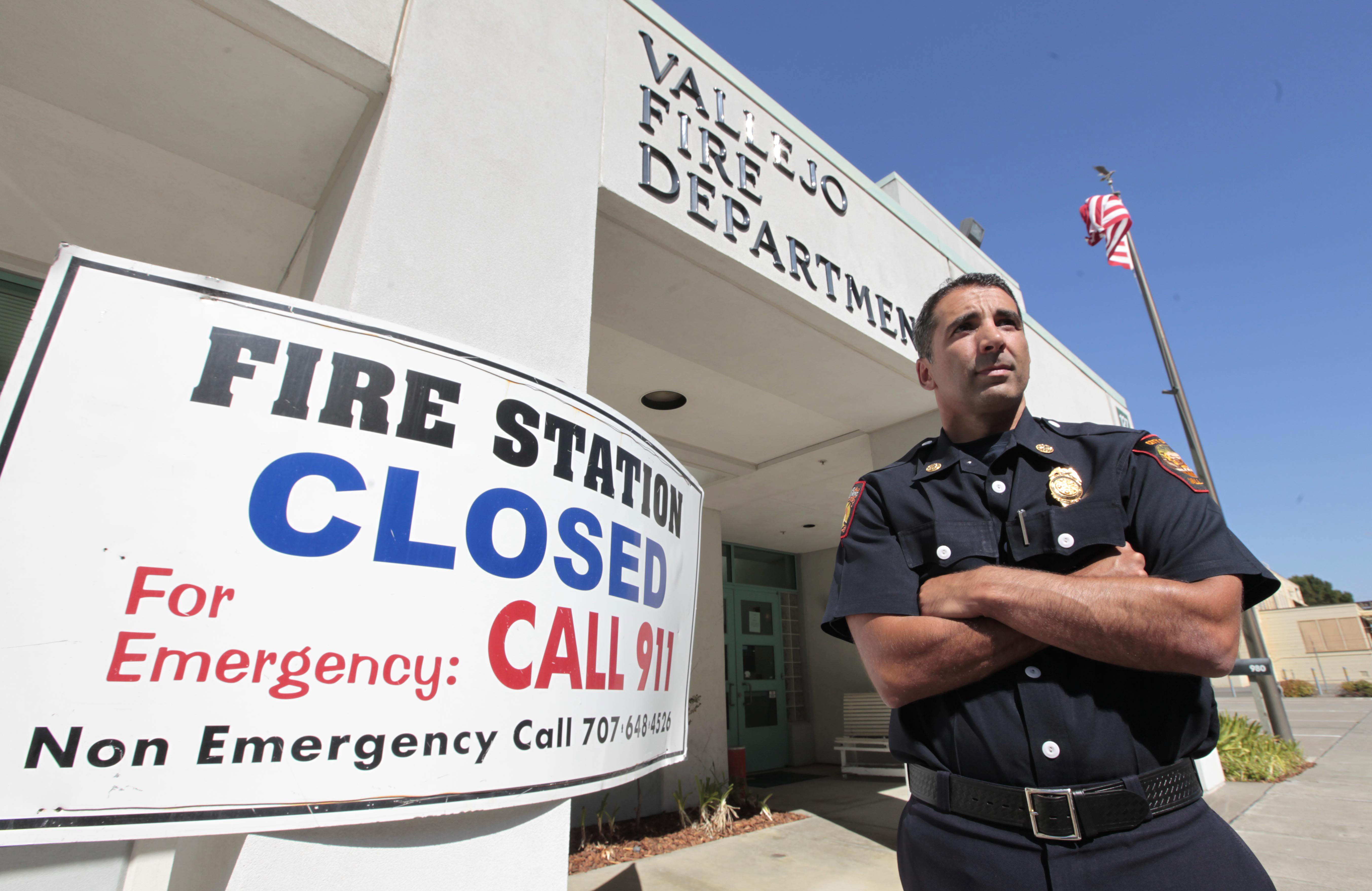
The financial downturn of 2007–8 shattered that illusion. Because public pensions were heavily invested in equities, their asset values plummeted with the stock market. Detroit, Stockton, and Vallejo went bankrupt, in large part because of pension obligations. During the few years of crisis that followed, there was much more attention to the problematic governance practices of public pensions, and a wave of reform swept state and local governments across the country.
During the early to mid-2010s, for example, most plans lowered their discount rates. As a result, governments were required to make larger contributions to “fully fund” their pensions. Policymakers have also been much more reliable in paying the required amounts since the Great Recession. Most experts view these changes as necessary corrections and a much-needed shift toward sound management.
Many experts also think the post–Great Recession reforms did not go far enough. After all, most pensions remain underfunded. Some of the boldest reforms attempted at the time were scaled down or overturned in court. Plan managers have also not taken advantage of the strong investment returns of recent years to reduce risk in their portfolios. To the contrary, most plans have increased their investments in private equity, real estate, and other alternative assets, which means that the next economic downturn could be especially devastating to pension funds. Riskier still, some state and local governments have used financial leverage, issuing pension obligation bonds. Some have also continued to find ways to lower their current pension contributions to deal with budget deficits and pursue new programs.
Great Recession–era efforts to rein in pension liability growth were also limited. In many states, policymakers are legally allowed to reduce pension benefits only for new hires—not for anyone who already works for government, even for years they have not yet worked. To constrain benefits without breaking this so-called “California Rule,” most states created new “tiers” with lower benefits for newly hired employees. But the cost savings from these changes were limited in the short run simply because at first there were not many employees in the new tiers.
As imperfect as they were, however, the reforms adopted during the early 2010s were highly contentious and took substantial political capital from those who led the efforts. After policymakers took action, moreover—after they did something (or tried to do something and failed)—the issue mostly went back under the radar, and the brief period of higher visibility ended.
The on-the-ground experience of local government
The budgetary consequences of all this started to hit local governments in the early to mid-2000s but intensified after the Great Recession. After years of steadily increasing benefits and pushing the costs into the future, plans’ unfunded liabilities grew, and that translated into higher contribution requirements from local and state governments—both to pay for the more expensive benefits and to reduce the shortfalls. The pressure on local governments only increased when unfunded liabilities ballooned during the financial crisis. Then, when plans decreased their discount rates, government employers’ required contribution rates increased even further.
The upshot is that a major category of local government spending has been steadily increasing, and not to pay for more services today, but to pay for benefits provided in the past.
My analysis of data from the financial statements of more than 400 cities and counties between 2005 and 2016 showed that 88 percent had had their pension contributions increase in real terms over the twelve-year period. The median increase was 56 percent, and over a quarter of the local governments saw their pension expenditures double. The same trend was visible in a national sample of school districts I analyzed. More recently, Gregory Kearney and Joshua D. Rauh collected data from a much larger set of school districts and found that by 2023, pension expenditures accounted for an average of 10.57 percent of associated expenditures on education—an increase of 2.1 percentage points since 2015. Thus, a larger and larger share of local government spending is going toward pensions.
Some local governments have been softening the blow to their budgets by increasing taxes, such as sales taxes. But their ability to defray the new costs with tax increases alone is limited for both legal and political reasons. The reality is that most local governments have been dealing with pension expenditure growth by cutting spending in other areas.
The easiest way to see what has happened is to look at local government employment levels. Most of what local governments spend money on is paying people to provide services. Realistically, moreover, most of them can’t save money by lowering salaries or limiting salary increases, especially during this era of high inflation. In most states, public employee salaries are decided in collective bargaining, and increasing salaries is usually a top priority of the unions in those negotiations. Thus, one of the few levers local governments can pull to meaningfully cut spending is to trim staffing levels. Most of the time this doesn’t happen in the form of mass layoffs but rather by gradually eliminating unfilled positions and not replacing people who retire.
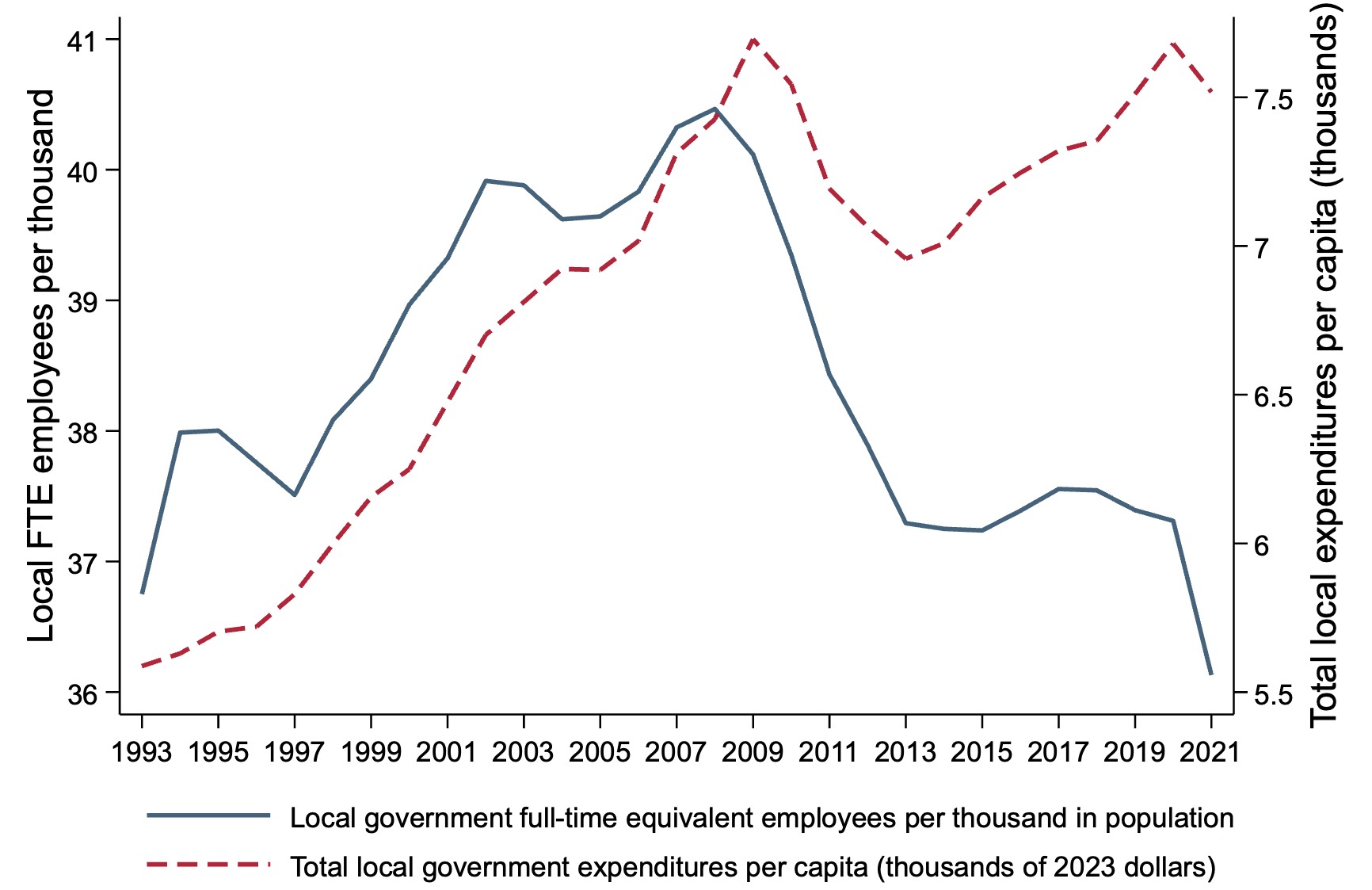
Figure 1 captures the overall trend using data from the US Census Bureau. Total spending by local governments per capita (in thousands of 2023 dollars) increased steadily from the early 1990s until the Great Recession, dipped downward until 2013, and then rose again through 2021. Local government employment per thousand residents, in contrast, started to decline in 2009 and then kept on declining.
Figure 1: US local government expenditures and employment, 1993–2021
This is only one indicator of local government capacity, of course, but it is meaningful given that so much of what local governments do involves people like police, firefighters, teachers, and bus drivers providing services to constituents. Lowering employment can even make the pension problem worse over time, since failing to hire new employees means that fewer active employees are paying into the system.
Naturally, pension expenditure increases are not the only reason for this. But several studies have concluded that public pension expenditures are an important driver of this trend. In my studies of school districts, cities, and counties, I found that larger pension expenditure growth is associated with greater reductions in public employment. Analyses by Equable, Pivot Learning, and Kearney and Rauh at the Hoover Institution document how retirement costs are squeezing public education and limiting the extent to which taxpayer dollars reach kids in classrooms today.
A blind spot in the American political economy
All of this is happening within a blind spot of the American political economy. The technical nature of the issue surely contributes to that—most people are not all that interested in pension fund accounting, smoothing, amortization, and discount rates—but so does the nature of how the public experiences the costs.
Most of the decline in local government capacity has been gradual. Many people do not notice when there is a slight reduction in the number of instructional aides or police officers, nor are most aware when a city decides to postpone repaving a few street segments. Over time, these changes add up, but even if some constituents do start to notice a difference, it is virtually impossible for them to attribute the changes to decisions about pensions made by policymakers many years ago.
The American system of state and local pension governance is also so complex that even the best informed, most engaged citizens would have a very difficult time knowing whom to hold accountable. Policymaking authority on pensions in the United States is spread across more than one hundred state plans and thousands of local plans. Their benefits, contributions, and investments are determined by a mix of actions by legislatures, governors, other executive branch officials, courts, agency staff, and governing boards—sometimes more than one per plan—comprised of representatives of various constituencies, including government employees and their unions. Decisions made by these entities usually seem minor and technical even though in the aggregate, over time, they are consequential. Tracing the small decisions made by thousands of different officials and entities would be a monumental task. Holding government accountable in such a system is difficult to impossible for most Americans.
This allows the system’s central political dynamics to continue even as the problems get worse. Most voters are not paying attention. But legislators and other policymakers in most state and local governments continue to feel political pressure from government employees, retirees, and public-sector unions.
Political party competition, which can sometimes elevate issues and inform the public, is also minimal when it comes to pensions. Both Democratic and Republican officials have incentives to be responsive to government employees like firefighters, police officers, and teachers, who have a presence in every electoral district, whether represented by a Democrat, Republican, or an independent. Both parties also have incentives to keep government pension contributions low, either to free up money for tax increases or for spending on government programs.
They also have little to no incentive to cast a spotlight on the erosion of local government capacity. That might make them and their own party look bad. Also, there aren’t any politically attractive solutions that can appeal to voters and make for a winning campaign. Letting local government capacity slowly erode probably is the politically expedient “solution” given the legal, political, and financial constraints. The alternatives are massive tax increases, holding down salaries and other benefits (which usually isn’t possible), and hoping that pension managers earn very high returns on investments (which is out of their control). At the local government level, the best many can do, politically, is let staffing slowly shrink and not draw attention to it.
Meanwhile, media coverage of local and state politics has declined, and pensions usually do not make for click-worthy stories. Today, there is sometimes coverage of the budgetary challenges of individual local governments or states, but very rarely do those stories connect those problems to pensions and other retirement costs.
There is also a class of experts who do focus on pensions, including municipal finance analysts, consultants, and actuaries, but it is not their job to evaluate the big picture of how the thousands of local governments across the country are having to adjust to higher pension expenditures, nor is it their responsibility to demonstrate to the public how these adjustments are affecting the taxes paid and services received by the American public.
The continuation of the political status quo—a lopsided interest group structure combined with low public visibility—has also bolstered efforts to increase pension benefits in recent years. In the first years after the wave of reform, there were few employees in the lower benefit tiers. Now, more than a decade later, there are more of them, and they have been in their jobs longer, make up a larger share of union members, and receive lower pension benefits than their senior counterparts. In recent years, state legislatures have come under growing pressure to increase the benefits of these lower tiers and undo key reforms of the Great Recession era. Most legislators still feel compelled to vote “yes,” even though it will very likely accelerate the erosion of local government capacity, because the unions are attentive and the broader public is not.
Attention and transparency
For any of these dynamics to change, public attention to the issue has to increase. The issue needs more media coverage, greater transparency, and more experts speaking out to explain what is happening. Absent this, it will take the next economic downturn for the issue to increase in salience again.
In the meantime, policymakers in some places are still considering more benefit increases. The benefit reforms of the early 2010s were not perfect, and understandably, many view them as either unfair to newer hires or insufficient in dealing with the problems. However, achieving those reforms took a devastating recession and an enormous amount of political capital. Undoing them now would only increase the erosion of local government capacity.
Casting a spotlight on the very real fiscal tradeoffs state and local governments confront is critical to the longer-term future of American governance and state capacity. In the short run, it might give elected officials more reason to keep the broader public interest in mind as they make these important public policy decisions.
Sarah F. Anzia is a senior fellow at the Hoover Institution and Chancellor’s Professor of Public Policy and Political Science at the University of California, Berkeley. She has published widely on the politics of public pensions and is author of Local Interests: Politics, Policy, and Interest Groups in US City Governments as well as Timing and Turnout: How Off-Cycle Elections Favor Organized Groups (The University of Chicago Press).