 Powered by
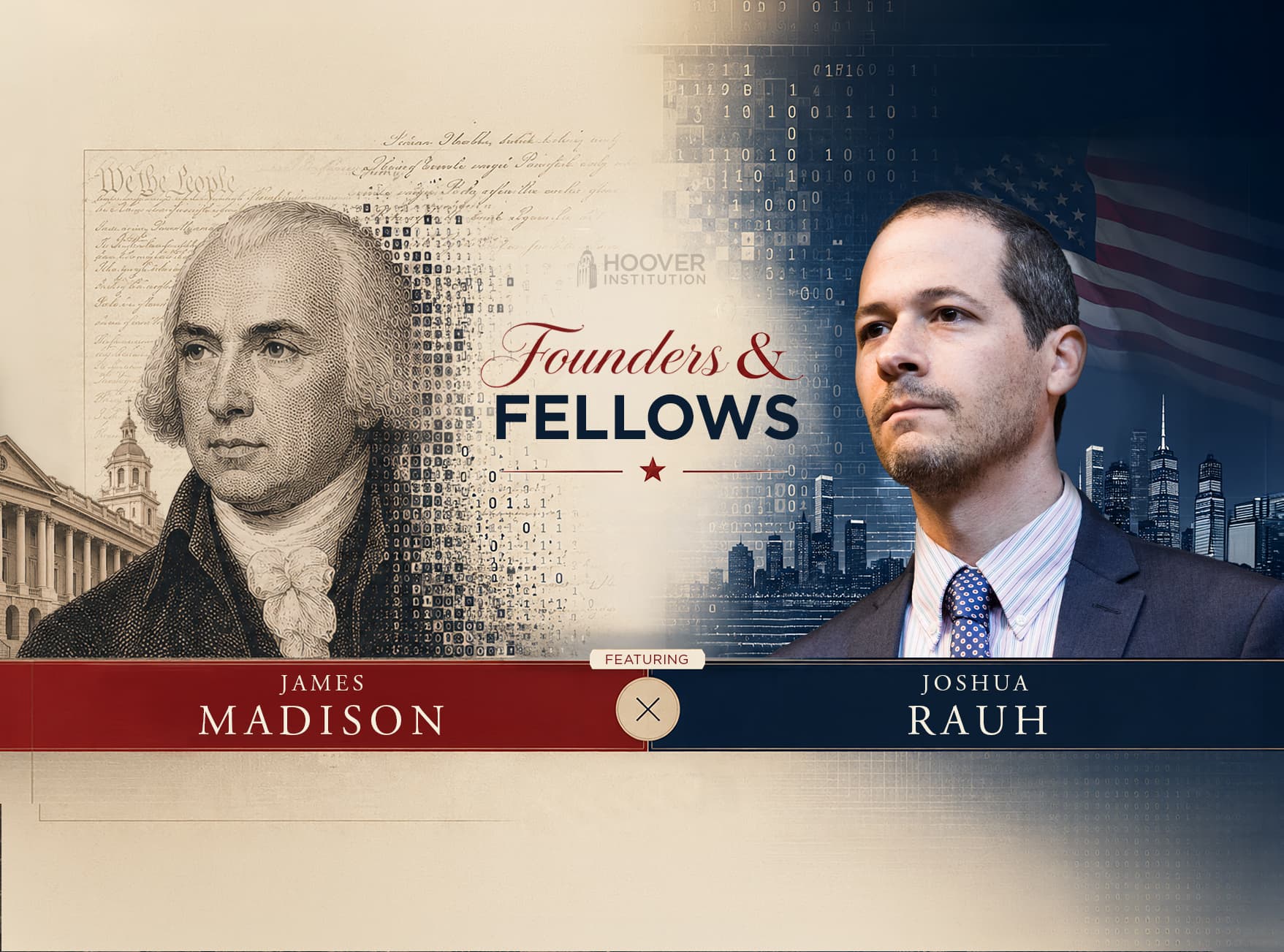
With America’s 250th birthday fast approaching, there is a great deal for which to be thankful. We are governed by the oldest standing written constitution, we live in the most prosperous era in human history, and we are fortunate to call home the most powerful country in the world. Yet for all the good news about the state of our republic, its fiscal affairs are in dire straits, and one founder would have a great deal to say about both our predicament and the way out of it: James Madison.
Today, we are more than $39 trillion in debt, we carry unfunded obligations for Social Security and Medicare that, measured over the next 75 years, exceed $78 trillion in present value, and for the first time in our history, the interest we pay on our debt exceeds what we spend on national defense. State and local government budgets face serious challenges of their own, as unfunded pension liabilities are over $4 trillion.
What initially began as a government with limited powers during Madison’s time has now become an engine of massive transfer, with trillions redistributed each year through multiple large-scale entitlement programs that constitute the largest single function of the federal state. This transformation would be completely disorienting to Madison, and as the country’s bills come due, the favored policy solution of the moment—to tax wealth and expand the programs the US government funds—is precisely the kind of solution that Madison would have viewed with deep skepticism.
This skepticism was fundamental to Madison’s view of the government’s role in protecting private property rights. He knew that the unequal distribution of property was a feature, not a bug, of any free society, and he traced its origin to differences of human ability, “the diversity in the faculties of men, from which the rights of property originate.” Thus, because protecting those faculties necessarily protects the unequal property they produce, securing these rights, in his words, was “the first object of government.” A government that abdicated this responsibility would hand the voting majority the means to use the government as an instrument of plundering their fellow citizens of what their own abilities had rightfully earned.
But this did not make Madison completely indifferent to questions of fairness. Five years after writing Federalist no. 10, Madison wrote the essay “Parties,” which was about the reality of political parties in any political society, and the responsibilities that come with their existence. One of those responsibilities included “the silent operation of laws, which, without violating the rights of property, reduce extreme wealth towards a state of mediocrity, and raise extreme indigence towards a state of comfort.” Thus, even to the extent the state plays some role in ameliorating economic inequality, it must not come at the expense of individual’s private property rights. Furthermore, most of the essay focused on the “unmerited” accumulation of riches that emerged from political favoritism rather than through the honest efforts of citizens.
Needless to say, it should be clear that a wealth tax —such as that being determined through a ballot initiative in California this coming November—would not meet this condition. The notion that a simple majority of voters could vote to seize 5 percent of a minority of taxpayers’ wealth would have offended Madison, even if it were supposedly to improve inequality.
Taxation is a particular area in which a majority might be most tempted to abuse a minority population. In Federalist no. 10, Madison wrote that apportioning taxes across different kinds of property “seems to require the most exact impartiality,” yet there is “perhaps no legislative act in which greater opportunity and temptation are given to a predominant party to trample on the rules of justice. Every shilling with which they overburden the inferior number, is a shilling saved to their own pockets.” A wealth tax would be precisely the sort of act of self-interested overburdening that concerned Madison, as it is confiscation dressed in the language of fairness.
Still, Madison’s fundamental concern about property cut in more than one direction. Just as the majority could not justly vote away the property a man had earned, a government could not walk away from debt it had incurred. During Madison’s time, there was no clearer case of this problem than that of the Revolutionary soldiers who had won the nation’s independence and were looking to be paid for the blood they had spilled.
During the Revolutionary War in 1780, the Continental Congress promised its officer corps a half-pay lifetime pension if they decided to serve out the war to its very end. However, by 1783, with the war won and the treasury empty, this promise became unrealistic. The notion of some permanent class of officers drawing on the public purse for life struck many as the very sort of privileged class that they had just fought to abolish. Beyond this, Congress had no way to pay for it. Still, Madison felt the government could not walk away from its promises to the men who had served to the very end. In 1783, it was settled: There would be a buyout. The lifetime pension was “commuted” into full pay for five years, using interest-bearing government certificates. In modern language, it was a lump sum settlement of a lifetime obligation, discharged as an IOU.
This arrangement makes complete sense when you consider Madison’s theory of prudential governance. The government manages to honor the debt while avoiding an open-ended, lifelong claim on future taxpayers.
What followed is worth remembering. The certificates, like all the young government’s paper, soon lost most of their value, and many desperate soldiers ultimately sold them to speculators for as little as a quarter of their face value. Soon after many sold their certificates in 1790, Alexander Hamilton proposed to fund the debt at full value, paying whoever held the paper at that moment, which proved to be a windfall for the speculators who managed to buy up all the certificates during the soldiers’ distress.
Madison was frustrated with this result. He instead argued for a middle course of action: Repay the current holders only what they had paid, and pay the balance to the original soldiers at no added cost to the government. He ended up losing 36 to 13, as Hamilton’s argument carried the day, and despite Madison’s good intentions, it was the right one. Public debt is only an asset if it can be freely traded, and no one will buy paper if they fear the government may later redeem it in another’s name. On the design of the obligation, Madison was right. However, on the treatment of speculators and soldiers, Hamilton was.
A similar trail of events could play out domestically in the coming years. For example, imagine that California soon finds itself in a fiscal crisis, unable to pay the pensions it owes its retired teachers and police. Rather than default, the state decides to act in the same manner as Congress did in 1783, converting each pension into an account holding special state bonds—showing a balance of, say, two million dollars and accruing interest—but redeemable only once the state recovers.
This would mirror Madison’s structure of the war pensions almost exactly. The retirees, having lost their monthly checks, sell their claims for whatever cash they can get (e.g., perhaps twenty-five cents on the dollar to speculators, like many did after the Revolutionary War). Then the state, restored to solvency, pays the bonds in full to whoever holds them. In this case, the speculators would triple their money, while the teachers and police would be left with a fraction of their grievance.
Would Madison side with the retirees, as he did with the soldiers in 1790? More likely, having learned from experience, he would keep the lump-sum arrangement but make the IOUs only partly transferable, preserving some claim for the pensioner who would have sold under duress.
As it relates to Social Security and Medicare at the federal level and those obligations, this scenario would present Madison’s wartime pension dilemma on a vast scale. These are genuine obligations promised to the entire citizenry across their working lives; however, they are structured as open claims on future taxpayers without their consent. A Madisonian reform would likely follow a similar pattern, as it would likely cover some portion of the obligation while severely reducing the future of the entitlement into something finite, funded, and fixed, so that the claim would close rather than compound for future generations. This is unthinkable given our current politics, but it is the only solution that manages to keep faith with the beneficiary while not bankrupting the republic.
This habit of reason is worth rediscovering as the country’s bills come due. Madison’s approach was never a fixed answer, as he had varying concerns about what was promised to the citizenry. Does the policy response honor what was truly promised? Does it close the claim, or does it allow for an unending run on future generations? Does it respect the property of those who must pay for it?
We seem to not be short of plans to tax, spend, and promise our way through the many fiscal problems ahead. However, we are short of the discipline to ask, before we adopt them, what precedent each will set for future generations of the republic.
Joshua D. Rauh is the George P. Shultz Senior Fellow in Economics at the Hoover Institution and the Ormond Family Professor of Finance at Stanford’s Graduate School of Business. He leads Hoover ‘s Fiscal Policy Initiative and its State and Local Governance Initiative. He formerly served at the White House where he was principal chief economist on the Council of Economic Advisers.
Gregory Kearney is a senior research analyst with the State and Local Governance Initiative at the Hoover Institution. He has previously worked as a research economist at the Council of Economic Advisers at the White House. His work has focused on domestic, financial, and economic questions surrounding public pension financing, state tax policy, and infrastructure investment.