 Powered by
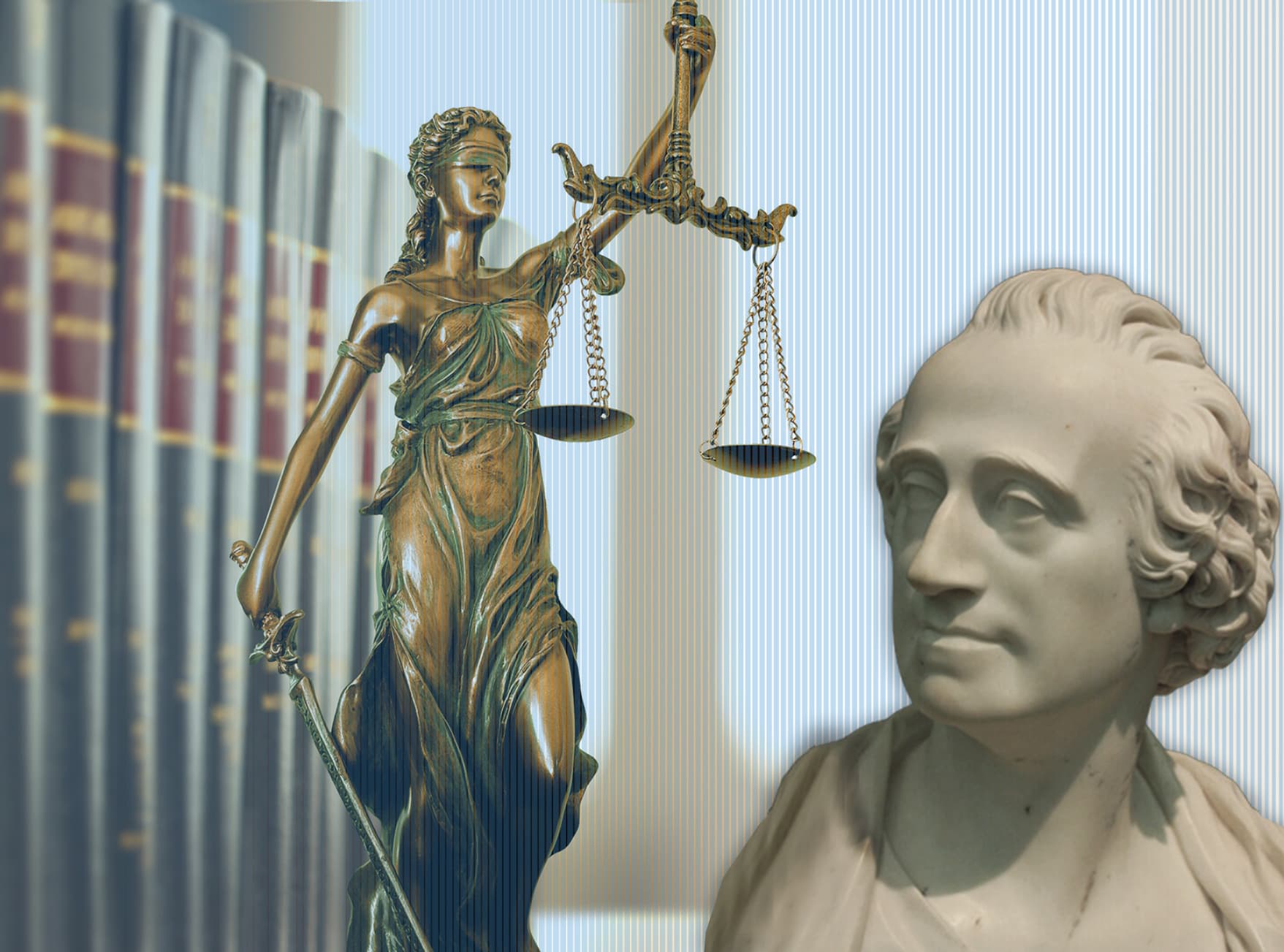
My Dear Friends,
The ancient Greek philosophers named four cardinal virtues: wisdom, courage, moderation, and justice. They understood that the last of these held the others together. A society may stumble in wisdom, falter in courage, lapse in self-command, and yet endure. But let justice fail, and the whole structure collapses.
This is the one thing no free society can survive without: justice.
This is an imagined letter from Adam Smith to the Americans of 2026. The letters in this series are constructed from Smith’s own words and ideas, primarily those in “The Theory of Moral Sentiments” and “The Wealth of Nations.” All quotations are verbatim; paraphrases are faithful to Smith’s views. Interested readers can learn more about the sources here.
I have returned to that word in every letter I have written you. Let me say plainly what I mean by it:
Justice is the ground on which strangers can cooperate—and when it gives way, society does not merely suffer; it collapses.
What is justice?
Justice consists of rules that forbid us from injuring one another, applied equally to every person. Do not use force against your neighbors. Do not defraud them. Do not take what is theirs. These rules are precise, public, and, critically, the same for everyone—the powerful and the weak alike.
That is all. Justice is not charity. It is not the correction of every misfortune. Those are the work of beneficence—which a humane society cultivates. But they are not the foundation on which a free society rests.
The ground on which strangers meet
Think about this morning. You woke up, checked your phone, drank your coffee, ate your cereal. Thousands of strangers made it possible—the farmer who grew the grain, the workers who roasted and packaged the beans, the trucker who hauled it all, the engineers who built the phone, and the payment system that keeps the whole arrangement moving. You will never meet most of them. You could not name one in a thousand. And yet your day rests upon their cooperation.
This is the extraordinary thing about a flourishing society: it knits together the labor of strangers who owe one another nothing personal. But the knitting has a condition. Each must have confidence that the others will not rob, defraud, or coerce them—confidence supplied by the certainty that the rules of justice are equally and effectively enforced. Without that certainty, the invisible hand falters. Specialization narrows. Markets contract. Prosperity dwindles.
This is why I held that a society without justice is not a worse society. It is no society.
What I did not mean
Nor did I mean, by placing justice at the foundation, that government has no further duty. I argued elsewhere that the state should make provisions for public works that private interest alone will not adequately supply—the roads, bridges, and harbors on which commerce depends, and the education of ordinary people, lest the division of labor that enriches a nation leave the laborer’s mind to wither. But these are duties of a prudent government, weighed by the public benefit.
Justice is different. It is the pillar on which the entire edifice stands—the condition without which no other public good is secure.
Why it must be enforced equally
It is not enough, however, to have rules that may be enforced. They must fall upon everyone alike—and this is the point at which most societies, yours not excepted, begin to deceive themselves.
For a nation may keep every form of justice and lose the whole of its substance. A rule that forbids theft but is enforced only against the poor is not justice. A rule that forbids fraud but quietly excuses the well-connected is not justice. When the powerful man and the friendless man commit the same act and meet two different laws, you do not have justice tempered by mercy. You have privilege wearing the mask of law.
I observed in my own century how readily the administration of justice tilted toward wealth and rank—how the faults of the great were indulged and the faults of the humble punished. Do not comfort yourselves that your own age has outgrown this. The temptation is perennial because it is profitable: there will always be those with the means to secure an exception, and those without the means to resist one.
This partiality is no small blemish on an otherwise sound system. It is the corruption of the pillar itself. For the entire value of justice lies in its impartiality. The moment its rules answer to the standing of the person rather than the nature of the act, justice ceases to restrain power and begins to serve it.
Why the judges must stand apart
If justice is to be impartial, those who administer it must be independent of those who hold power. Judges who depend upon the ruler for their office, income, or safety cannot be trusted to rule against the ruler.
Your founders understood this—and built a republic on it. As I wrote in my second book:
“When the judicial is united to the executive power, it is scarce possible that justice should not frequently be sacrificed to, what is vulgarly called, politics.”
The separation of the judge from the prince is not a legal technicality. It is the institutional expression of impartiality itself—the way a society builds the impartial spectator into its very government, so that judgment cannot be swayed by the power it is meant to check.
A final word
My friends, from my lectures at Edinburgh and Glasgow, through both my books, I returned again and again to the centrality of justice in free societies:
“Justice . . . is the main pillar that upholds the whole edifice. If it is removed . . . the great, the immense fabric of human society . . . must in a moment crumble into atoms.”
Justice rests upon the willingness of a free people to apply its rules to the powerful no less than to the weak—and to defend the independence of the courts that do so.
A society may be poor and still endure. It may even, for a time, be unkind and still endure. But let injustice prevail—let the rules bend for the strong and break upon the weak, let the law become a respecter of persons—and the ground on which you have built your society will give way beneath you.
Guard justice. Everything you value rests upon it.
Your humble servant,
Adam Smith
Ross Levine is the Booth Derbas Family/Edward Lazear Senior Fellow at the Hoover Institution and co-director of Hoover’s Financial Regulation Working Group. He is a founding member of the Hoover Program on the Foundations of Economic Prosperity. Levine is also a research associate at the National Bureau of Economic Research.