 Powered by
My Dear Friends,
Each day, strangers feed you.
Clothe you.
Heal you.
They do not know your name. And yet they serve you.
No council planned this coordination.
No authority commands it.
And still, it works.
This is an imagined letter from Adam Smith to the Americans of 2026. The letters in this series are constructed from Smith’s own words and ideas, primarily those in “The Theory of Moral Sentiments” and “The Wealth of Nations.” All quotations are verbatim; paraphrases are faithful to Smith’s views. Interested readers can learn more about the sources here.
How can millions of ambitious, self-interested people cooperate so extensively—and so peacefully—without central direction?
This question consumed much of my life.
A famous and misunderstood phrase
Of all the ideas associated with my name, none has been more misunderstood than the invisible hand.
Some treat the invisible hand as magic.
Others as a moral defense of greed.
Still others, as a promise that markets work perfectly.
I meant none of this.
The invisible hand is not mystical. It does not sanctify selfishness. It does not guarantee perfection.
It is a simple observation: cooperation can emerge without intention—when exchange is voluntary and justice governs conduct. By justice, I mean clear, enforceable rules that forbid force, fraud, and coercive privilege. When people must persuade rather than compel—when they gain only by offering value to others—order arises that no one designed.
And nowhere is that clearer than in something as ordinary as dinner.
The miracle
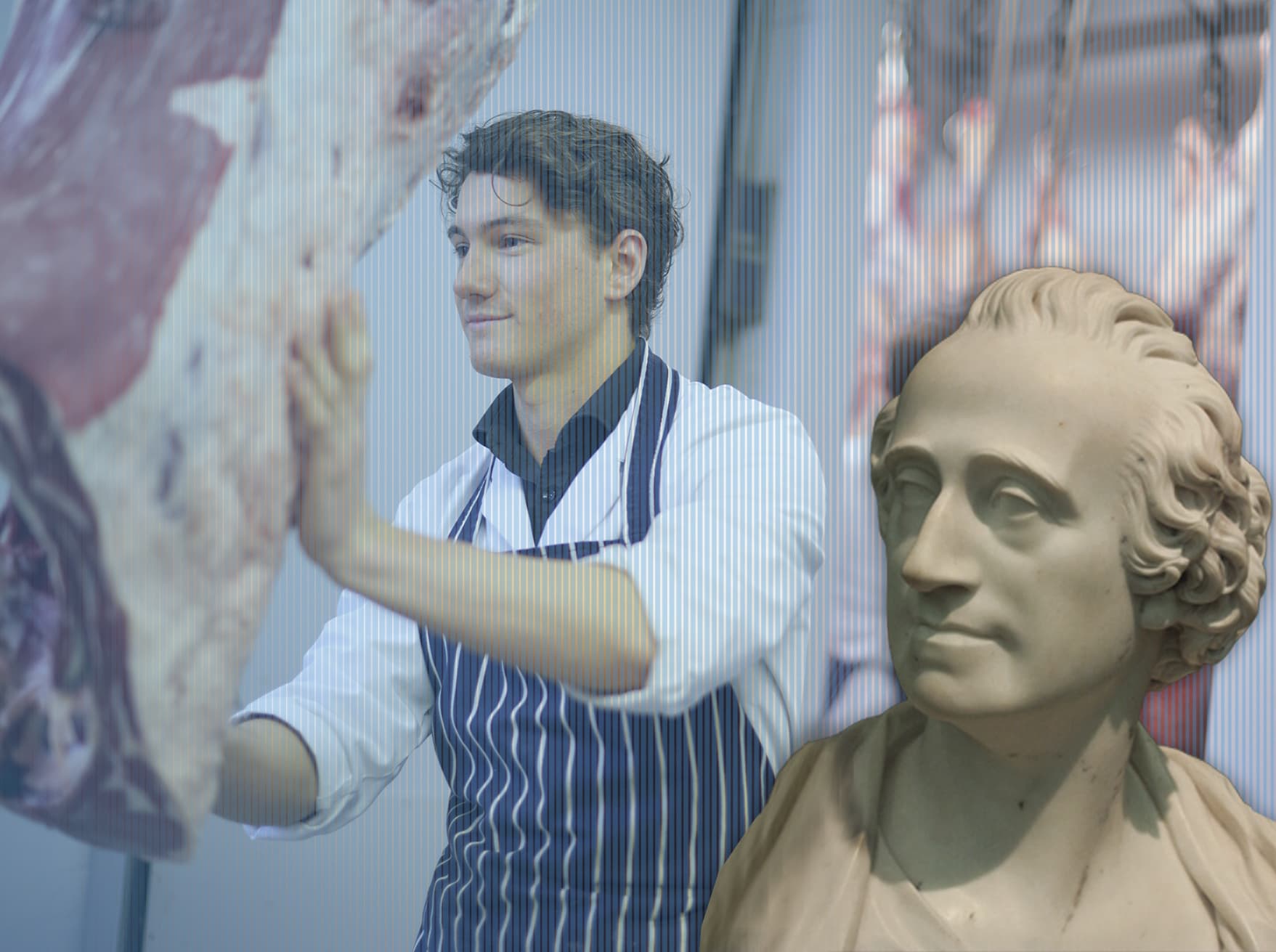
“It is not from the benevolence of the butcher, the brewer, or the baker that we expect our dinner, but from their regard to their own interest.”
You have likely heard this sentence before.
Some take it to mean that selfishness is the secret of prosperity.
That is not what I meant.
It is a recognition that in large societies, cooperation cannot depend on benevolence. It depends on voluntary exchange—disciplined by competition and secured by justice.
The butcher does not rise at dawn out of affection for you.
The baker does not knead dough out of charity.
They work to earn a living.
And in doing so, they feed you.
In seeking their own advantage—within that system—they serve society “more effectually” than if they were consciously aiming to feed the world.
The marvel is not motive.
The miracle is justice—turning private striving into public cooperation.
When exchange is voluntary, both sides expect to gain. You buy because you prefer the good to the money; sellers sell because they prefer the money to the good. If either side is unpersuaded, they walk away.
This is not benevolence. It is voluntary cooperation.
An engine of improvement
As exchange spreads, people specialize. They focus. They refine. They experiment.
Small improvements accumulate. Tools improve. Processes improve. Knowledge spreads.
What was once rare becomes common. What was once costly becomes affordable.
No one sets out to transform the economy.
And yet the economy is transformed.
Through specialization, exchange, expanding markets, and competition, ordinary self-interest becomes an engine of discovery and growth. This order enlarges the economy. It does not abolish hardship. And it does not, by itself, secure virtue.
Nature’s deception
But ambition does more than coordinate exchange. It also misleads.
Many people pursue wealth, believing it will bring them peace. They imagine comfort will quiet their restlessness. They labor, sacrifice, and climb—convinced that tranquility sits at the summit of riches.
It rarely does.
Nature deceives them.
In my first book, I described the poor man’s son who exhausts himself chasing distinction through wealth, only to discover that happiness does not arrive securely with wealth.
And yet—without that deception—many would strive less, and society would grow more slowly. It is this restless desire to better one’s condition, however imperfectly understood, that produces medicines, machines, and markets.
Ambition may disappoint the person. But it enlarges the world.
Yet ambition alone is not enough.
The necessary condition
Society flourishes only when ambition is restrained by justice.
If people may enrich themselves by force, many will use force.
If people may prosper by fraud, many will use fraud.
If people may secure advancement through government favoritism, many will seek favoritism.
And when that happens, exchange gives way to domination.
The invisible hand works only when advancement must be earned by serving others.
When advancement depends on merit, not manipulation.
When you must persuade rather than compel.
When you must offer value rather than seize it.
Then, self-interest serves society.
Remove those constraints, and it turns predatory.
A final reflection
The true wonder of your age is cooperation: millions of strangers, pursuing their own ends, advancing one another’s lives without intending to do so.
No master plan.
No universal benevolence.
No central command.
Just human ambition, confined within limits, producing order no one designed.
That is the achievement.
Preserve the limits that make persuasion more profitable than coercion.
Without them, coordination gives way to domination.
Your humble servant,
Adam Smith
Ross Levine is the Booth Derbas Family/Edward Lazear Senior Fellow at the Hoover Institution and co-director of Hoover’s Financial Regulation Working Group. He is a founding member of the Hoover Program on the Foundations for Economic Prosperity. Levine is also a research associate at the National Bureau of Economic Research.