 Powered by
My Dear Friends,
There are two ways to prosper in a market.
You can persuade others to choose you.
Or you can arrange things so they have no real choice.
The first requires innovation, quality, and service.
The second requires influence.
A free society depends on the first.
It is undone by the second.
This is an imagined letter from Adam Smith to the Americans of 2026. The letters in this series are constructed from Smith’s own words and ideas, primarily those in “The Theory of Moral Sentiments” and “The Wealth of Nations.” All quotations are verbatim; paraphrases are faithful to Smith’s views. Interested readers can learn more about the sources here.
Each day, you witness a quiet miracle.
Strangers compete to serve you—lowering prices, improving quality, and searching for better ways to meet your needs. They do not know you. Yet in seeking their own advantage, they improve your life.
This is the achievement I described in my last letter—the quiet triumph of voluntary exchange.
But the miracle of the invisible hand raises a troubling question:
If this system can peacefully coordinate millions, foster innovation, and raise living standards, why does it so often disappoint? Why do arrangements that promise both freedom and prosperity prove so difficult to sustain?
The answer is not that people pursue their own interest.
It is that they learn to pursue it by limiting competition.
The real danger
The danger arises when people discover a different path to advantage—not by serving others better, but by avoiding the need to serve them at all.
When success depends not on persuasion, but on protection—not on pleasing customers, but on shaping the rules.
Markets do not fail because people seek gain.
They falter when people can secure it without competition.
An old observation
Long ago, I made an observation that has been quoted often:
“People of the same trade seldom meet together, even for merriment and diversion, but the conversation ends in a conspiracy against the public.”
This was not a claim that merchants are uniquely immoral—it was a warning about incentives.
People who share interests will seek advantage together. And when they gain influence over the rules that govern them, they may pursue advantage not by serving others, but by limiting rivals.
And when that happens, competition no longer governs.
The first enemy: monopoly and privilege
In my time, this tendency appeared plainly.
Guilds restricted who could practice a trade.1 Apprenticeships were prolonged. Permissions were required. Those already established used the law to keep others out.
The language was respectable: standards, quality, stability.
The effect was predictable: fewer competitors, higher prices, slower improvement.
As I observed, “… to widen the market and to narrow the competition is always the interest of the dealers [merchants and traders].”
What had been a system of voluntary exchange became a system of protection.
The invisible hand was shackled.
The second enemy: political capture
The same impulse appears whenever profit or advantage is sought through politics rather than exchange.
In my day, this took the form of the mercantile system—the belief that national prosperity required protecting domestic producers. Merchants persuaded governments to adopt this view. Tariffs were imposed. Monopolies granted. Trade was directed to favor particular producers.
The language was patriotic—defending jobs, industry, and national strength.
The reality was privilege.
Those who seek protection or advantage rarely ask for it plainly. They present it as necessary for prosperity, stability, or the public good.
In your time, the forms have changed, but the logic has not.
As I warned, proposals from those who trade in a particular industry “ought always to be listened to with great precaution . . . as coming from an order of men . . . who have generally an interest to deceive and even to oppress the public.”
The most dangerous enemies of markets do not oppose them openly.
They speak in their name—while quietly asking to be shielded from them.
The third enemy: misplaced admiration
There is a deeper danger still—one that begins in judgment and ends in institutions.
No system of liberty can endure if people admire those who prosper by escaping its rules.
Institutions are sustained not only by laws, but by moral sentiments—by what people honor, and what they condemn.
When success and admiration come to those who secure favors, exclude rivals, or evade the rules, others learn to do the same.
When admiration flows toward those who escape competition, judgment indulges the privileged. Rules bend. Exceptions multiply. Enforcement falters. Privilege spreads.
Justice rarely collapses all at once.
It erodes—quietly, day by day.
The hard truth
Many suppose that competition will correct these abuses on its own.
I did not share this faith.
Power, once acquired, does not easily dissolve. Privilege resists challenge. Advantage entrenches itself.
Markets do not defend themselves.
They depend on justice—and justice must be maintained.
By justice, I meant simple but strict rules—no coercion, no fraud, no theft; and laws that are applied impartially.
Without these, exchange becomes domination by other means.
A final word
The invisible hand is a remarkable achievement.
But it is not self-sustaining.
It works only where success must be earned—where one must persuade rather than compel, and compete rather than exclude.
When success can be arranged—through privilege, protection, and power—the system turns from persuasion to domination. The invisible hand no longer guides—it is guided by the privileged.
A free and prosperous society depends on preserving the conditions under which people must serve others to succeed.
Lose those conditions, and you lose the miracle itself.
Your humble servant,
Adam Smith
Ross Levine is the Booth Derbas Family/Edward Lazear Senior Fellow at the Hoover Institution and co-director of Hoover’s Financial Regulation Working Group. He is a founding member of the Hoover Program on the Foundations of Economic Prosperity. Levine is also a research associate at the National Bureau of Economic Research.
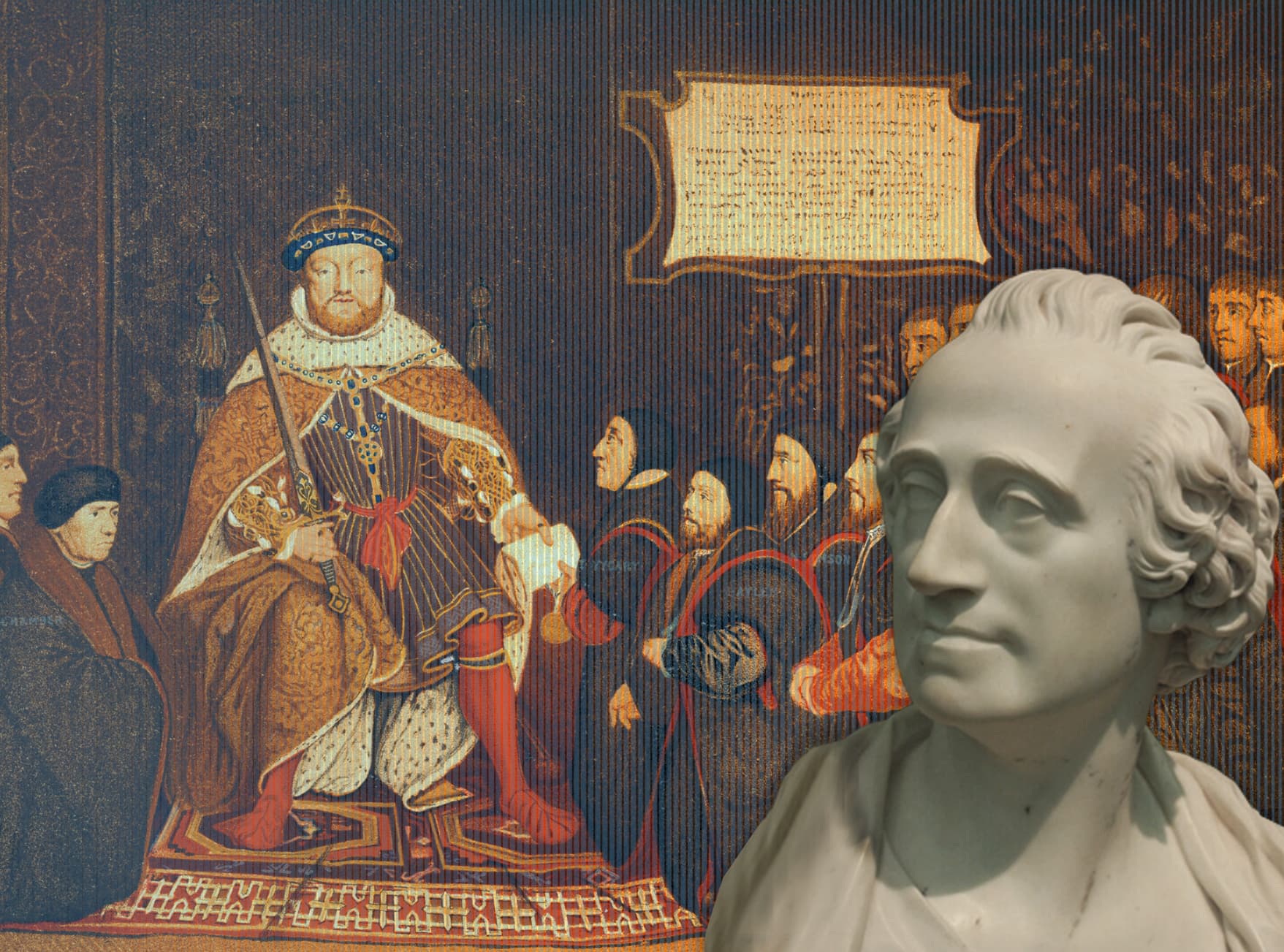
The painting accompanying this letter illustrates patronage, privilege, and stagnation under Henry VIII. [Based on Hans Holbein the Younger, Henry VIII and the Barber Surgeons (1540)]