 Powered by
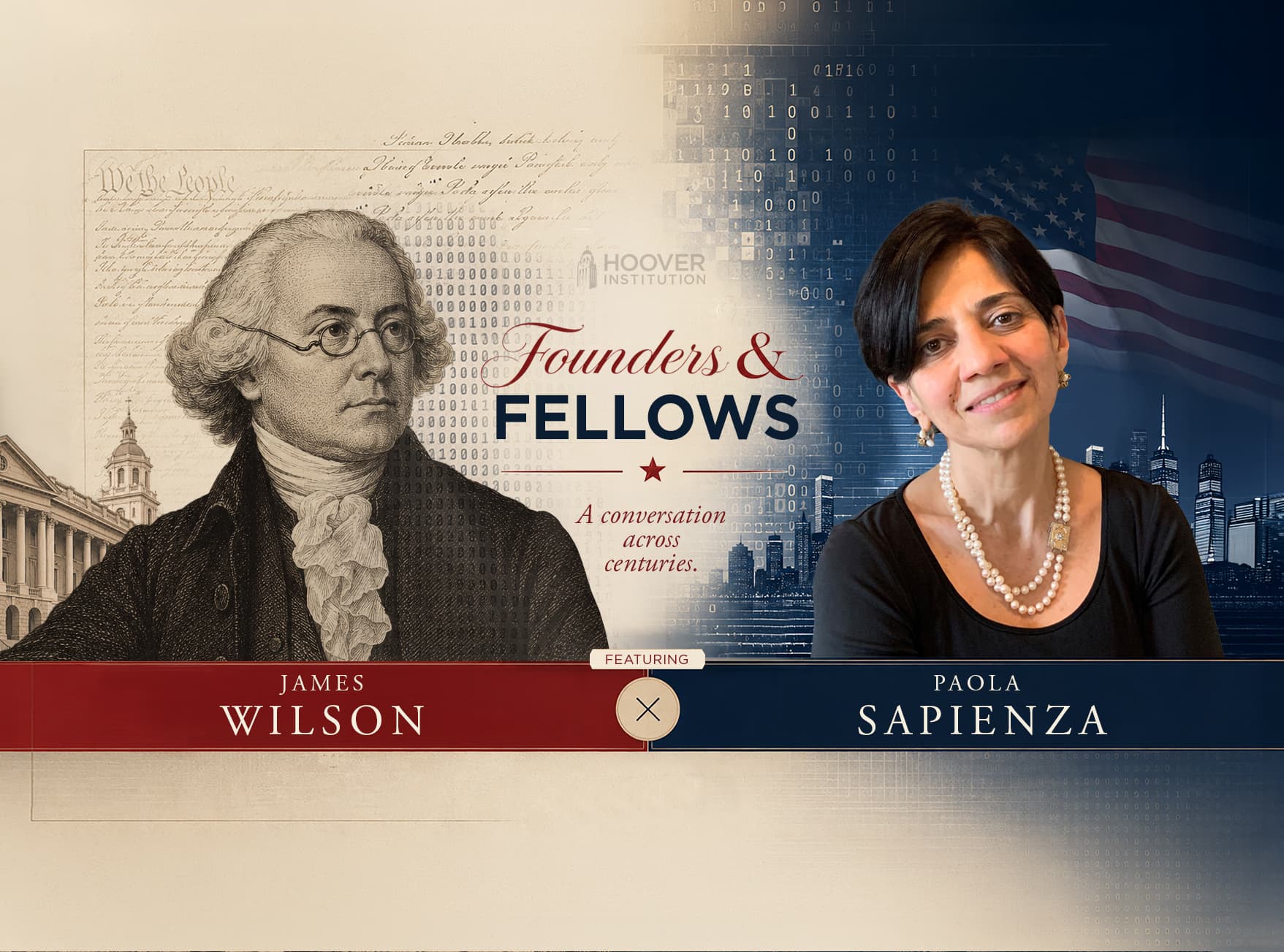
James Wilson crossed the Atlantic with a strong education but little fortune or patronage—and helped shape the founding documents of the country that took him in.
Among the many grievances against King George III listed in the Declaration of Independence, one is rarely quoted today: “He has endeavoured to prevent the population of these States; for that purpose obstructing the Laws for Naturalization of Foreigners; refusing to pass others to encourage their migrations hither and raising the conditions of new Appropriations of Lands.”
The Declaration thus includes British obstruction of naturalization and immigration among the causes of the American Revolution. During this year of the country’s 250th birthday, it is worth remembering that the United States did not merely tolerate newcomers at its founding. It declared independence, in part, to free itself from imperial limits on naturalization and migration.
No founder embodies the promise behind that grievance better than James Wilson—and no founder of comparable stature is more widely treated as “forgotten,” possibly because his imperfect life ended badly: ruined by land speculation, jailed for debt while a sitting Supreme Court justice, he died in 1798 in a North Carolina tavern, hiding from creditors. His record carries a graver mark as well: though he held slavery to be repugnant to natural law, it was Wilson who proposed the three-fifths compromise, counting enslaved people as a fraction of a person.
Wilson was born in 1742 on a farm near St. Andrews in Fife, Scotland, studied at the University of St. Andrews and other Scottish institutions, and sailed for America in 1765 at the age of twenty‑three. He arrived with a solid education, little wealth, and few connections. In Philadelphia he tutored Latin, read law under John Dickinson, and then moved west to build a legal practice on the Pennsylvania frontier.
Within nine years of stepping off the boat, he published one of the more radical pamphlets of the revolutionary era, Considerations on the Nature and Extent of the Legislative Authority of the British Parliament, arguing that Parliament had no legislative authority over the colonies whatsoever—a position many Patriots then considered too bold, and one that foreshadowed the Declaration’s claim that the colonists could rightfully dissolve their political ties to the Crown.
Within eleven years of his arrival, he signed that Declaration. He would become one of only six men to sign both it and the Constitution. And he is the only one who signed these founding documents and served as a Supreme Court Judge.
At the Constitutional Convention in Philadelphia, Wilson spoke more often than any delegate except Gouverneur Morris—well over a hundred and fifty recorded interventions—and recent historians generally rank his influence on the document second only to Madison’s. He served on the Committee of Detail that produced the Constitution’s first working draft. More than any other framer, he pressed the idea that became the Constitution’s central premise: that sovereignty resides not in state governments or legislative bodies but in the people themselves. In an October 1787 speech defending the proposed Constitution, he likened government to a pyramid and said he wanted “to give it as broad a basis as possible.” It was Wilson who most consistently pushed for a direct popular election of the president, though the Convention ultimately rejected it in favor of the Electoral College compromise.
A “mortifying” circumstance
Then, in August of 1787, the Convention turned to a question that was, for Wilson, uncomfortably personal: who may serve in the government of the United States?
Gouverneur Morris moved that senators be required to hold citizenship for fourteen years. Elbridge Gerry wanted to go further, wishing that eligibility be confined to native alone, a permanent bar on any future immigrant. The argument sounds familiar: foreigners, it was said, might retain attachments to their native countries; they might become instruments of foreign influence; they could not be trusted with the affairs of a nation they had merely adopted.
Wilson rose, according to Madison’s notes, “with feelings which were perhaps peculiar.” He reminded his colleagues that he was not a native, and that under the proposals on the table he could be barred from serving under the very Constitution he had helped draft. To be passed over for a particular appointment was of little concern, he said; to be declared incapable of appointment by law was “a circumstance grating and mortifying.”
He was not alone. Benjamin Franklin—who decades earlier had fretted about German immigrants overwhelming Pennsylvania, and had since thought better of it—warned against inserting “illiberality” into the Constitution, recalling the foreign‑born soldiers who had fought faithfully through the Revolution. Madison argued that America should invite, rather than repel, men of merit from abroad.
Wilson’s side largely prevailed. The Convention ultimately settled on seven years of citizenship for members of the House and nine for the Senate and rejected birth requirements for every federal office but one: the presidency. On its face, the Constitution of the United States is a document open to the foreign-born, drafted in part by them.
This openness rested on a theory of what makes a nation. In the world the founders left behind, membership in a political community was typically a matter of blood and birth; one was born a subject and died one. Wilson’s revolutionary idea—the idea he elaborated in his law lectures, which George Washington attended, and in his judicial opinions on the first Supreme Court—was that a free people constitutes itself by consent. If the people are sovereign, then belonging is chosen rather than inherited, and a nation grows by attracting people who want to join it.
Two and a half centuries later, the empirical record has vindicated that intuition. Immigrants now make up roughly one-seventh of the American population, yet account for a far larger share of the country’s patents and scientific output. When collaborations with native-born inventors are included, foreign-born inventors are associated with well over a third of recent US patents and a comparable share of high-impact innovation. Recent studies find that close to half of Fortune 500 companies were founded by immigrants or the children of immigrants, and that most American “unicorn” startups—young companies valued at over a billion dollars—have at least one immigrant founder. The nation that wove openness to talent into its founding charter has become one the wealthiest and most inventing societies in history.
Talent and ambition
Which makes it worth asking how a twenty-three‑year‑old James Wilson would fare at our border today. He would arrive with university study in Scotland but no American degree, little capital, and no family ties in the United States. Our main capped channel for high-skilled newcomers, the H‑1B visa, has become a hard door to pass. Its cap was set in 1990, when the American economy was about a third of its current size, and has barely moved since. Whenever applications exceed the statutory ceiling, as they now do every year, slots are allocated by lottery, largely by chance, with little regard for what each would contribute, and roughly seven in ten applicants are turned away.
The framers imposed waiting periods before immigrants could hold high office; they did not run raffles to decide who could come or stay.
Immigration is often discussed with anxiety, especially in recent times. Wilson would recognize these feelings; he sat through them in Philadelphia and recognized what was at stake. The founders did not open the republic to the foreign-born because they were naïve about foreign influence. They did so because they believed that a nation constituted by consent, and competing for the world’s talent and ambition, would outbuild nations constituted by birth alone.
For two and a half centuries, that bet has paid off. The question the 250th anniversary puts to us is whether we still stand by the wager an immigrant helped write into the Constitution—and whether a young man from Fife, arriving today with an education and not much else, would be let in.
Paola Sapienza is the J-P Conte Family Senior Fellow at the Hoover Institution, where she co-directs the Hoover Immigration Initiative and is a founding member of the Hoover Program on the Foundations for Economic Prosperity.