 Powered by
Christopher Nolan’s hit movie The Odyssey is entertaining, but it’s not Homer. It has as much to do with Homer Simpson or Homer Price as it does with the Greek bard. The film is neither a documentary nor a simple retelling. It is, rather, a riff on the work of the great epic poet, the way John Coltrane’s jazz version of “My Favorite Things” riffs on The Sound of Music’s Broadway original. Some of the story told in the film isn’t even in Homer but comes from other ancient writings, notably Virgil’s Aeneid, a Latin epic. That’s showbiz.
At the heart of the movie is Nolan’s focus on the Trojan Horse and the sack of Troy. He contends that it was “a violation of the law of Zeus,” which today we would call a war crime. The law of Zeus requires hospitality to strangers and guests. Nolan’s Odysseus sins both by murdering the unarmed civilians of Troy and by tricking the enemy with a false gift: the great wooden horse. Nolan’s Odysseus is plagued with guilt, and he comes back from the war with the equivalent of post-traumatic stress disorder.
But was it a war crime? Would the ancient Greeks have considered it a crime? Did Homer’s Odysseus feel guilty? And what would the law say if the Trojan Horse episode had taken place in the twenty-first century?
More than a horse, of course
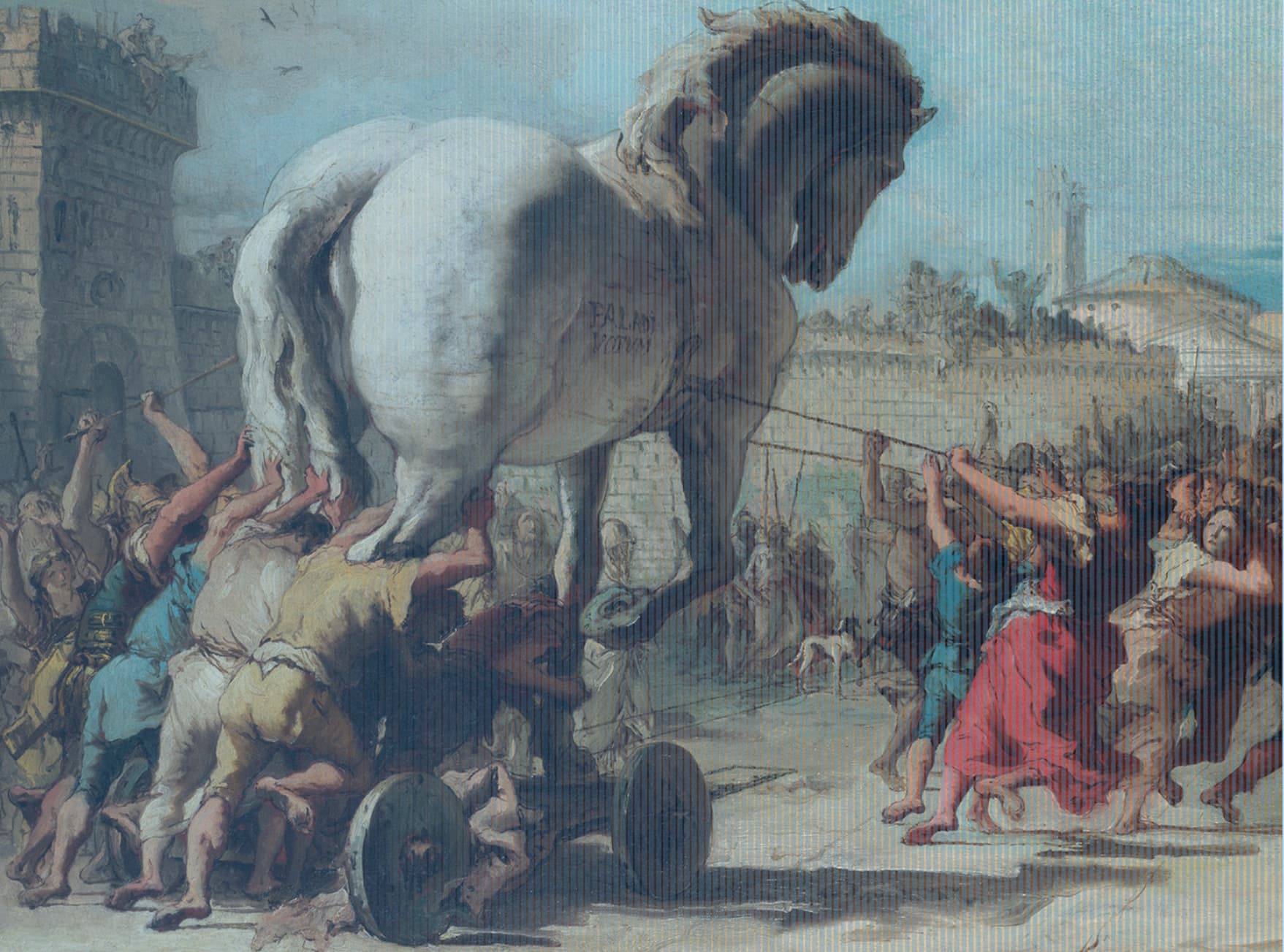
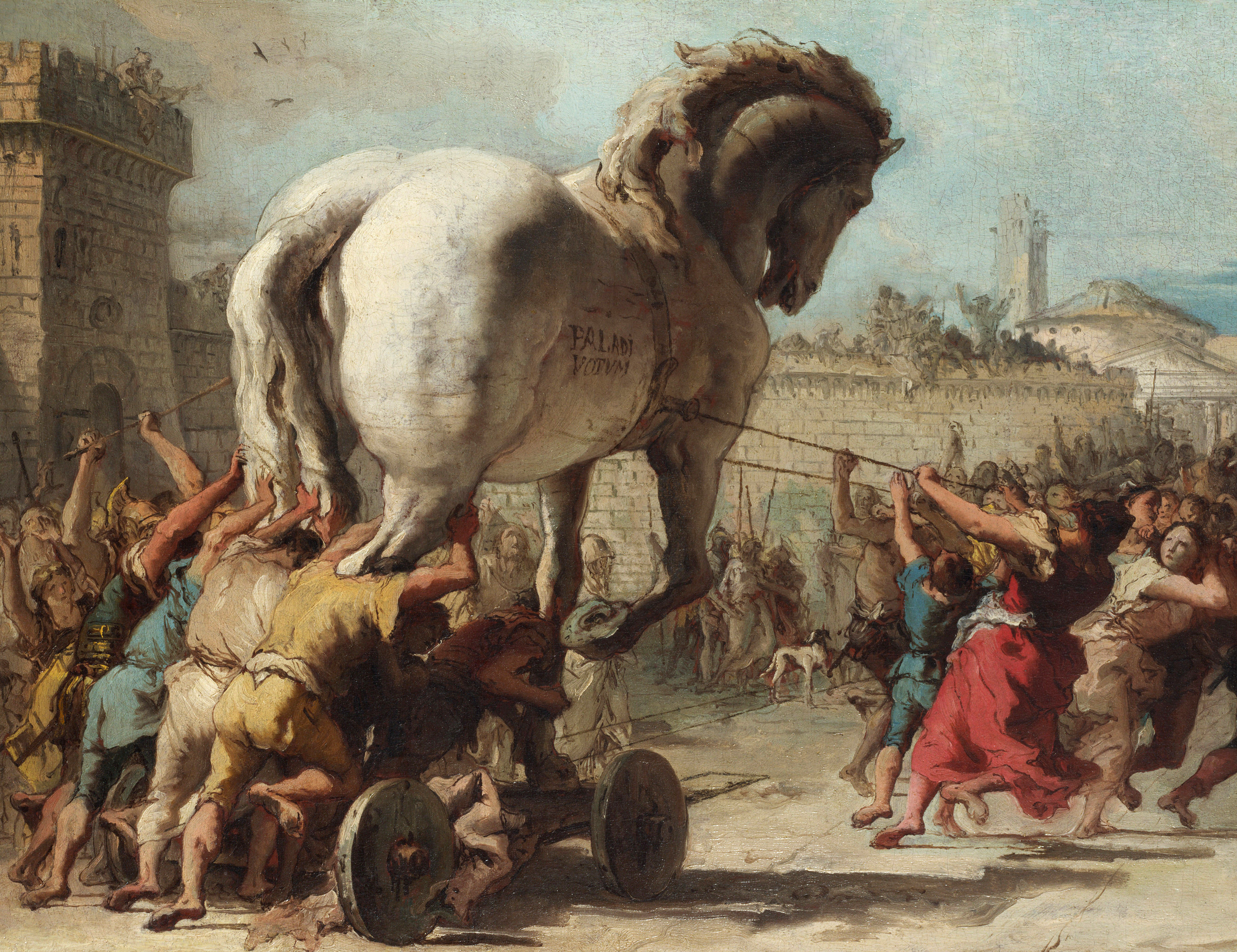
The Trojan Horse is a myth, of course, although some aspects of the story recall genuine ancient military practices. The details in Homer are scanty, so let’s turn to Virgil. As he tells the tale, the “horse” was in fact a three-part military operation.
Part one, the enormous wooden horse filled with Greek commandos, is well known.
The second part was a feigned retreat by the rest of the Greeks. After camping out before Troy for ten years, they packed up, burned their camp, boarded their ships and sailed home. Or so they pretended. They sailed only as far as the nearby island of Tenedos and were poised for a rapid return.
The third part was a false defector, a Greek soldier named Sinon. He claimed to have escaped a Greek plan to make him a human sacrifice to the gods. He threw himself on the Trojans’ mercy and offered supposed valuable information—all lies. He said that the Greeks had gone home and left the horse as a gift to the goddess Athena. They had offended her earlier by stealing her sacred wooden statue from her temple in Troy, during a secret mission behind enemy lines, and now they wanted to propitiate her anger. Sinon also said that the Greeks planned to return to Troy, but if the Trojans brought the horse into their city, the gods would accept the offering and never let the Greeks conquer the city. Persuaded by Sinon, the Trojans brought both him and the horse into Troy.
That night, Sinon opened a trapdoor in the wooden horse and let out the Greek commandos. The intruders came down on the sleeping city. With the help of the rest of their army, which had sailed back from Tenedos, they slaughtered and enslaved Troy’s people and destroyed the city itself.
To Homer, there was nothing unethical about any of this. His characters are proud of what they call a trick and an ambush. One Greek leader speaks admiringly of Odysseus and says, “What a thing was this, too, which that mighty man wrought and endured in the carven horse, wherein all we chiefs of the Argives were sitting, bearing to the Trojans death and fate!”[1] Homer’s Odysseus feels no guilt. No surprise there because in ancient times, if a city under attack refused to surrender, the law of war—unwritten but widely practiced—allowed a victor to sack it and kill or enslave its inhabitants.
Writing several centuries later, however, the Athenian dramatist Euripides begged to differ. In several plays, Euripides condemned Odeysseus as both brutal and immoral. In The Trojan Women, the playwright denounced the sack of Troy and showed sympathy for the victims. Outraged by the violation of their temples, Euripides’ gods decide to punish the Greeks by making their voyage home a disaster. Poseidon, lord of the sea, says, “A fool is he who sacks the towns of men, with shrines and tombs, the dead man’s hallowed home, for at the last he makes a desert round himself and dies.”[2] In Homer’s account, Poseidon punishes Odysseus not because the Greeks sacked Troy but because Odysseus blinds the cyclops Polyphemus, who is Poseidon’s son. Homer reflected the rough-hewn values of early Greece, while Euripides represented a democratic age, when armies might still behave brutally but moralists now condemned them.
Nolan follows Homer by having the blinded cyclops call down his father Poseidon’s vengeance on Odysseus. But Nolan also follows Euripides and goes one better. He has Odysseus suffer not just for sacking Troy and violating temples but also for defeating the enemy through a trick rather than by a fair fight. And he makes Odysseus’s suffering internal, evincing a guilt unknown to the ancients.
Camouflage and deception
What would we say if the Trojan Horse took place today? Does it violate international humanitarian law, which is also known as the Law of Armed Conflict? The law permits “ruses of war” if they don’t otherwise violate international law and if they don’t constitute “perfidy.” The law defines a ruse of war as anything aimed at misleading the enemy if it doesn’t trick him into thinking that he is protected under the law of war. The latter is perfidy. For example, attacking the enemy after either pretending to surrender or faking a wound is considered perfidy. But feigned retreat, such as the Greeks engaged in at Troy, is not perfidious, and is permitted by international humanitarian law.
The Trojan Horse was an ambush by means of camouflage, and both ambushes and camouflage are permitted ruses. Still, the horse was a religious symbol and an unofficial emblem of Troy, a country known for horse breeding and horse trading. The law of armed conflict prohibits the use of a religious symbol in an ambush, but only if it invokes legal protection. Pretending to be a chaplain or hiding soldiers in a religious shrine would violate the law, but offering a false gift to a nation’s god probably would not. International law would probably judge the horse to be a legitimate ruse of war.
It might not give Sinon’s behavior a pass. On the one hand, lies and deception are no violation of the law of war. On the other hand, Sinon claimed to be hors de combat (not to be confused with horse de combat) and a refugee when, in fact, he remained an enemy soldier. The Roman poet Virgil condemned Sinon’s behavior as perjury. Lawyers will disagree, but Sinon might well be judged today to have violated the law of armed conflict.
To sum up, Homer offers no support for Nolan’s notion that the Trojan Horse or the sack of Troy violated a higher law. Other ancient writers, notably Euripides, considered the sack, if not the horse, to be an outrage. The modern law of armed conflict would permit the Greeks’ feigned retreat and the Trojan Horse, but it might condemn Sinon’s deception as perfidy.
On one thing, no one would now disagree: the sack of Troy, and the murder, rape, and enslavement of unarmed civilians, are war crimes.
Spilling so much ink on an ancient myth, a Hollywood movie, and a hypothetical might seem like a waste. But in today’s world of terrorism and the use of hospitals and shrines to house fighters, of missiles aimed at cities, of charges of genocide, of cyberattacks, exploding beepers, and drones hidden in shipping containers, the question of what international law allows is not merely academic.
[1] Homer, Odyssey, 4.271-3, trans. Homer. The Odyssey with an English Translation by A.T. Murray, PH.D. in two volumes. Cambridge, MA., Harvard University Press; London, William Heinemann, Ltd. 1919, https://www.perseus.tufts.edu/hopper/text?doc=Perseus%3Atext%3A1999.01.0135%3Abook%3D4%3Acard%3D265 .
[2] Euripides, The Trojan Women, lines 95-97,in Euripides. The Plays of Euripides, translated by E. P. Coleridge. Volume I. London. George Bell and Sons. 1891, https://www.perseus.tufts.edu/hopper/text?doc=Perseus%3Atext%3A1999.01.0124%3Acard%3D48 .
Barry Strauss is the Corliss Page Dean Senior Fellow at the Hoover Institution and the Bryce and Edith M. Bowmar Professor of Humanistic Studies, Emeritus, at Cornell University. He was awarded the Bradley Prize in 2025. His latest book is Jews vs. Rome: Two Centuries of Rebellion Against the World’s Mightiest Empire.