 Powered by
My Dear Friends,
On the first Monday of September, you set aside a day to honor the people whose labor feeds, clothes, and houses your republic. I approve of the holiday. And I come to it bearing a gift: a test.
This is an imagined letter from Adam Smith to the Americans of 2026. The letters in this series are constructed from Smith’s own words and ideas, primarily those in “The Theory of Moral Sentiments” and “The Wealth of Nations.” All quotations are verbatim; paraphrases are faithful to Smith’s views. Interested readers can learn more about the sources here.
Most remember my Wealth of Nations for explaining how nations grow rich. But open it to the first page, and you will find that my measure of a nation’s wealth was never its treasure. Read it to the end, and it offers a harder test:
To judge whether a nation is flourishing, ask what its economy does for—and to—the far greater part of its people: whether their work lets them live decently, and what that work does to their minds.
The test
I did not hide the test in a footnote. My book opens by measuring a nation’s wealth in terms of the “necessaries and conveniences of life” its labor supplies to its people. And since servants, laborers, and workmen “make up the far greater part of every great political society,” to know how well a nation is supplied, look first to them.
From that arithmetic came a sentence I would set above the door of every ministry of finance: “No society can surely be flourishing and happy, of which the far greater part of the members are poor and miserable.” I chose those words with care. However grand its fortunes, a society that fails the many is not flourishing. But that tells you only when a nation fails.
So what does passing the test demand?
I answered in plain terms: those who feed, clothe, and lodge the whole body of the people “should have such a share of the produce of their own labour” as to live “tolerably well fed, cloathed and lodged.”
But tolerably well, by what standard?
My answer may surprise you: nature alone does not set the standard. I counted among the necessaries of life “whatever the custom of the country renders it indecent for creditable people, even of the lowest order, to be without.” A linen shirt was, strictly speaking, not necessary for survival, yet no creditable day-laborer in my England could appear in public without one or leather shoes.
Custom moves with time and country. A nation never outgrows my test. It only changes what passing requires.
What makes wages rise?
Not riches. Growth.
“It is not the actual greatness of national wealth, but its continual increase, which occasions a rise in the wages of labour.”
The mechanism is a bidding war. Where the funds that employ labor grow, masters must bid against one another for scarce hands, and wages rise. Where those funds stand still, workers must bid against one another for scarce work, and wages sink toward the “lowest rate which is consistent with common humanity.”
From the American colonies, young but growing fast, came reports of free workers in short supply: a “continual complaint of the scarcity of hands.” From China—fertile, cultivated, populous, and yet stationary—came the opposite: artificers roaming the streets, “as it were begging employment.” In recent decades, China grew rapidly: wages surged, and hundreds of millions climbed out of extreme poverty.
The growing state, I wrote, “is in reality the cheerful and the hearty state to all the different orders of the society. The stationary is dull; the declining melancholy.”
The engine has a shadow
That is what growth can do for workers.
Now ask what their work can do to them.
The answer begins with the most famous story I ever told—and this time, stay for the ending.
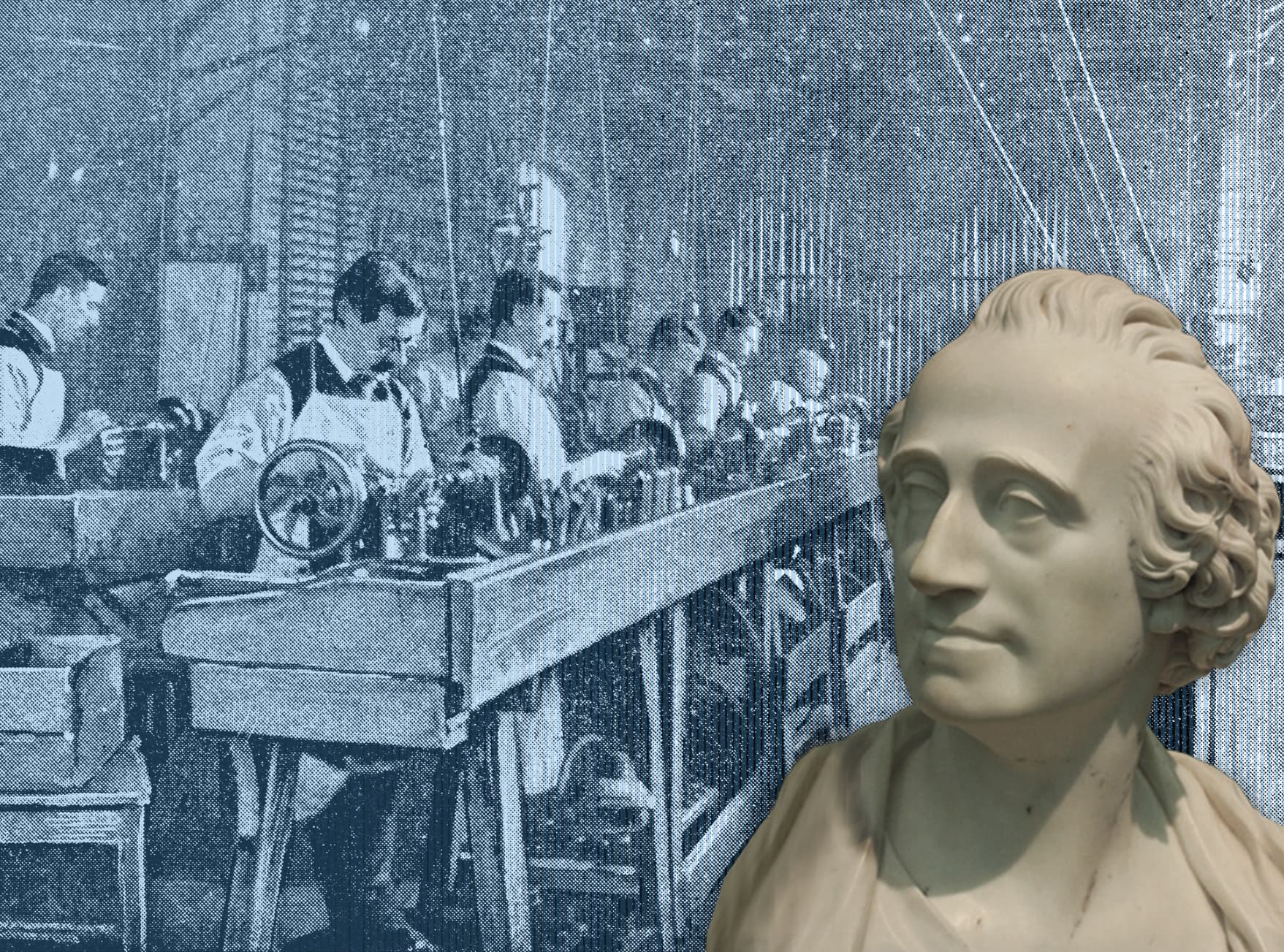
The engine of a nation’s riches is the division of labor. I made a pin factory famous to prove it: one man draws the wire, another straightens it, a third cuts it—“about eighteen distinct operations” in all—so that ten men together make “upwards of forty-eight thousand pins in a day.” Had those same men worked “separately and independently,” untrained to the business, they could not each have made “twenty, perhaps not one pin in a day.”
That is the miracle.
Here is its shadow.
The person whose whole life is spent on a few simple operations “generally becomes as stupid and ignorant as it is possible for a human creature to become.” The “torpor of his mind” leaves him unfit for conversation, judgment, and the duties of a citizen. I did not blame the worker. I blamed the work that asked nothing of his mind.
The same division of labor that multiplies pins can grind down the person who makes them.
What I actually proposed
In every improved and civilized society, I wrote, this is the state into which the laboring poor must fall “unless government takes some pains to prevent it.”
A little school in every district, its master “partly, but not wholly paid by the public.” The essentials—to “read, write, and account”—facilitated, encouraged, and even required. Modest in curriculum, ambitious in reach: a nation that grows rich by narrowing its people’s work owes them the means of keeping their minds whole.
Your machines have changed; the question has not. Wherever work grows narrow, repetitive, and paced by something other than the worker, my warning waits.
The test is yours
So there is my Labor Day gift.
A flourishing nation improves the circumstances of the people who do its work without diminishing the people themselves.
Do not ask only what workers produce. Ask what their work produces in them.
Now apply the test to your nation and your time.
Your humble servant,
Adam Smith
Ross Levine is the Booth Derbas Family/Edward Lazear Senior Fellow at the Hoover Institution and co-director of Hoover’s Financial Regulation Working Group. He is a founding member of the Hoover Program on the Foundations of Economic Prosperity. Levine is also a research associate at the National Bureau of Economic Research.