 Powered by
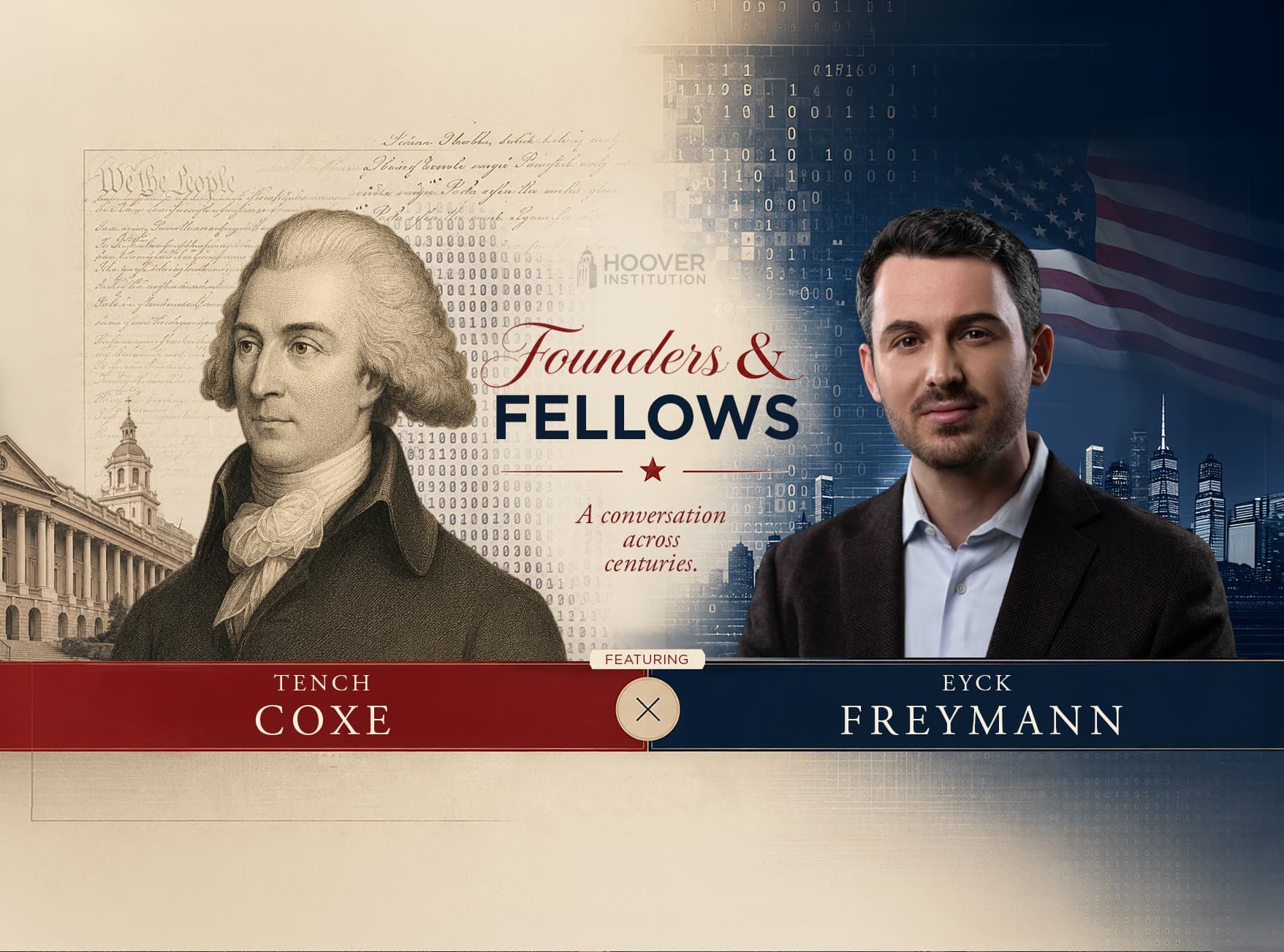
In the autumn of 1787, a man named Andrew Mitchell sailed for England carrying instructions from a thirty-two-year-old American official. His task was to identify British textile workers willing to emigrate to Pennsylvania and to acquire models and drawings of the most advanced spinning machinery in the world, including Richard Arkwright’s water frame. Both objectives were serious crimes under British law, which had banned the export of textile machinery and the emigration of skilled artisans. Mitchell failed. His luggage, packed with plans and models, was seized aboard ship before he could leave; he fled to Denmark rather than face prosecution.
The man who sent him, Tench Coxe, was one of our nation’s most interesting and far-sighted forgotten founders. He spent his career out of the limelight: Alexander Hamilton’s deputy at Treasury, principal drafter of Hamilton’s famous Report on Manufactures, head of the revenue office. He wrote the memos other men signed. He switched parties more than once, beginning the Revolution as a Loyalist before returning to the Patriot cause. His enemies derided him as “Mr. Facing Both-Ways.” His personality did not help. He was arrogant and prickly, the sort of indispensable colleague no one actually liked. When he died in 1824, he had been largely forgotten, a ghost in the halls of a Republican Party that had absorbed his ideas without quite remembering whose they had been.
The founders we canonize are the orators and grand personalities. The founders we forget are the operators. But a republic that builds statues only to its speechmakers is a republic that has misunderstood how it was built.
Coxe’s central conviction, pressed across pamphlets and reports from the 1780s to the embargo years, was that political independence without industrial capacity was a polite fiction. A country that could not weave its own cloth or forge its own iron held its sovereignty at the sufferance of whoever could. The remedy was not autarky, which he explicitly rejected, but the deliberate cultivation of technological innovation and support for domestic industries in sectors where dependence on geopolitical rivals created vulnerability.
This meant tariffs to protect infant manufactures, bounties for skilled artisans willing to defect from Europe, prizes and other inducements to support innovation, federal investment in roads and canals, and a financial system capable of mobilizing capital toward productive ends rather than speculation. And, when the legal channels failed, smugglers to steal foreign technology by all means necessary.
Hamilton would advance this program more famously, but Coxe is interesting because of the political coalition he tried to build for it. Hamilton imagined an urban, commercial republic; Jefferson imagined a pastoral, agrarian one. The debates between them are famous. Coxe imagined something stranger: a synthesis between the two, an industrial agrarianism in which manufactures and farming reinforced one another. American factories would create domestic markets for American flax, hemp, wool, and cotton. American farmers would become customers as well as producers. He was the rare founder who tried to write the synthesis to the Hamilton-Jefferson quarrel. He failed at it for reasons that had less to do with his ideas than with his personality.
Coxe’s synthesis had a dark shadow. He had been an early member of the Pennsylvania Abolition Society, but he ended his career as a cotton evangelist. His vision of industrial harmony required the expansion of slavery, an institution he had once called a stain. He made his peace with this. It was the price, he thought, of binding the agricultural South and the industrial North into a sustainable economic union.
This is the central paradox of his legacy. His program for national independence depended structurally on the denial of independence to millions of its people. Any honest account has to sit with that. It was strategically astute, and it foresaw the economic development of the United States more accurately than either Jefferson or Hamilton. But its tolerance of slavery was also morally abhorrent.
What does Coxe have to say to us today?
First, he would be pleased with how our current debate about economic security is evolving. Washington today is rediscovering, in industrial policy debates over semiconductors and critical minerals, that supply chains are strategic terrain and that markets optimize for cost rather than resilience. Coxe pointed this out in the 1790s. There is a certain irony in watching the modern administrative state try to reinvent tools it used in a pre-steam-engine world. But Coxe would be pleased that our politicians now recognize that a country that cannot make the essential things it needs is a country whose foreign policy is written elsewhere.
Second, he would advise us that economic statecraft requires not just good policy but effective administrative capacity. He would look at the gap between what we now ask our government to do and what it is structurally able to do, and he would worry. The Treasury that Coxe served was small, but it benefited from Alexander Hamilton’s strong and highly capable leadership. The interagency process we have today, Coxe would regard as bloated, fragmented, procedurally choked, and decadent.
Third, he would worry deeply about the seriousness of our elected officials. Coxe’s tragedy was that he was right twenty years too early, and it took the humiliations of the War of 1812 for his peers to recognize that he had been right all along. When the Royal Navy’s blockade cut American exports by roughly 85 percent between 1811 and 1814, it nearly bankrupted the federal Treasury, which depended on customs revenue. The contractor system meant to supply the army with muskets, uniforms, and powder failed to scale. Troops were paid late or not at all, and militias fought in civilian clothes. The American invasions of Canada collapsed as much from poor logistics as from British resistance. The “American System” of tariffs and domestic industry that emerged from the wreckage was substantially Coxe’s program of the 1790s, now adopted because the alternative had been tried and had nearly destroyed the republic.
If Coxe were alive today, he would likely fret that Washington is making the same mistake. He would be frustrated that our elected officials seem incapable of acting decisively to start unwinding the nation’s critical import dependencies on China.
The man wrote no memorable speeches. He smuggled machines, drafted reports, lost the fights that mattered for personal credit, and won enough of the ones that mattered for the country. He showed up, and he kept showing up, and he was largely unloved for it. The republic he helped build still runs, in considerable part, on the arguments he made and the institutions he sketched. That is what a useful founder looks like when you strip away the marble. It is not a bad thing to be reminded of.
Eyck Freymann is a Hoover fellow and leads Hoover’s Allied Coordination Working Group. He is also a non-resident research fellow at Columbia University’s Center on Global Energy Policy, the Institute of Geoeconomics in Tokyo, and the China Maritime Studies Institute at the US Naval War College.