 Powered by

Economists have studied the employment effects of minimum wages for decades. For example, a recent survey of US evidence was limited only to studies published (or forthcoming) between 1992 and 2020 and imposed other criteria for inclusion, and still ended up covering seventy papers. This research amply documents that the strongest evidence of disemployment effects, and the larger effects, appear for the lowest-skilled groups—usually defined in terms of either age or education. The reason, presumably, is that the low wages of these groups make minimum wages more binding, and hence a larger share of these low-skilled workers end up priced out of the labor market when minimum wages increase, because their wages are pushed above their contribution to firm profits.
Read Neumark’s earlier essay: The Minimum Wage Is a Dead End
Curiously, though, we have remarkably little evidence on the differential effects of minimum wages on employment of lower-skilled minority workers, even though minority groups also earn lower wages, making minimum wages more binding for them as well. Moreover, whether lower wages earned by minorities reflect actual lower skills, or “discounting” of their productivity because of discrimination, the prediction is the same: if minimum wages are more binding for minorities, we might expect them to experience worse labor market impacts from higher minimum wages, although we don’t know how much worse.
Nonetheless—and perhaps owing to this dearth of evidence—advocates for higher minimum wages have recently taken up the argument that higher minimum wages will reduce long-standing economic disparities between blacks and whites. This new argument may have arisen because the contention that minimum wages do not lead to job loss—the traditional pro-minimum-wage position—is increasingly contradicted by the evidence. However, the evidence offered in support of the economic-disparity argument focuses only on wages paid to workers: i.e., those with jobs. It ignores the possibility that higher minimum wages lead to more job loss or hours reductions for lower-skilled blacks precisely because minimum wages are more binding for them (the same reason the minimum wage may push up wages of employed black workers more).
Defining the goal as reducing race gaps in wages for employed workers thus provides a biased view, as the minimum wage seems likely to help on this dimension but to cause harm on other dimensions that together could even result in lower earnings for blacks.
No policy shortcut
If minimum wages actually reduce earnings disparities and not just hourly wage disparities, then maybe they are an effective tool for reducing race disparities. Moreover, minimum wages might represent a much simpler and cheaper policy than the tough work of combating discrimination, improving schools, and increasing human capital investment; and minimum wages would certainly be a less-controversial policy than affirmative action.
But do higher minimum wages succeed in reducing race disparities?
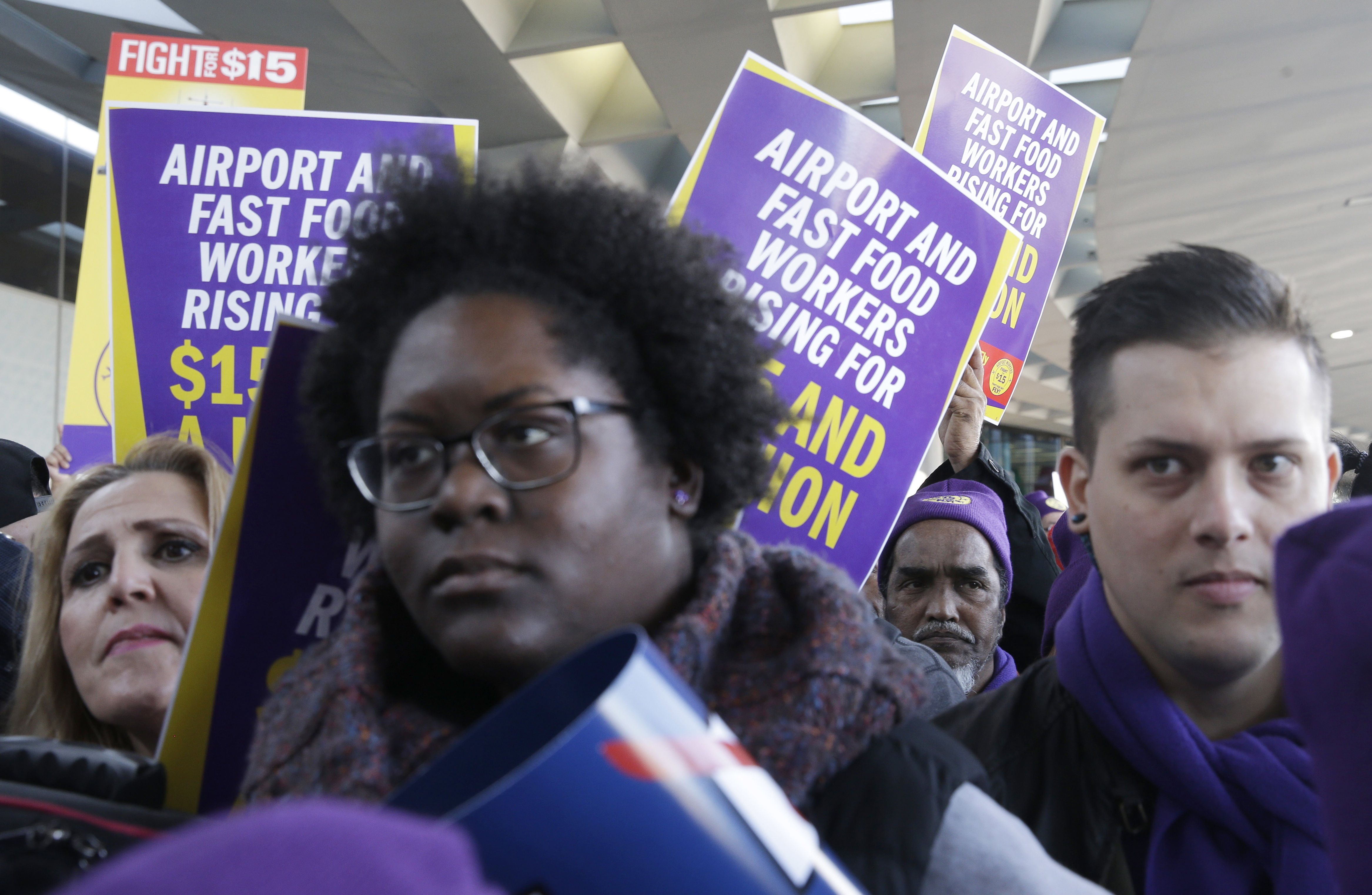
In new research, Jyotsana Kala and I provide a comprehensive analysis of the effects of federal, state, and local minimum wages on blacks, and of the relative impacts on blacks vs. whites. We study not only teenagers—the focus of much of the minimum wage-employment literature—but also broader low-skill groups. We estimate effects on employment, like most of the research literature on the minimum wage. But we also study how wages, hours, and ultimately earnings adjust. We use data from the American Community Survey, which samples roughly three million people per year and hence is invaluable in studying the effects of minimum wages on low-skilled blacks; in contrast, other datasets used to study the effects of minimum wages in prior research often have small numbers of observations on such narrowly defined groups in many states or localities.
I have studied racial, ethnic, and gender disparities my entire research career, with a focus on identifying the role that discrimination plays in the perpetuation of these gaps—which my research, and much other research, says it does. These disparities have persisted, despite some narrowing over the decades, and I view this persistence as one of the great policy challenges facing the United States. I thus wish I had more positive findings to report. However, I don’t. Moreover, the results are surprising. Minimum wage effects not only are ineffective at closing race disparities but they make them worse, as the adverse effects of minimum wages by and large show up only for blacks, and not for whites.
We find that job-loss effects from higher minimum wages are quite evident for lower-skilled black—especially black men—and in contrast are not very detectable for lower-skilled whites. Some of these effects are quite large. For example, the estimated elasticity is −0.295 for black male teens, implying that every 10 percent increase in the minimum wage reduces their employment rate by 2.95 percent. Similarly, we estimate an elasticity of −0.173 for black male high school dropouts, −0.414 for black male high school dropouts under thirty, and −0.493 for black male high school dropouts under twenty-five. These are much larger estimates than other research finds when attention is not focused only on blacks but rather does not distinguish by race or ethnicity—and indeed, in our data the estimated impacts for whites are near zero. We subject this finding to many different types of analyses, including some of the favorite ones of minimum-wage advocates who claim their analyses show that minimum wages do not reduce jobs among the low-skilled generally.
Across all of them, we consistently find that higher minimum wages reduce employment sharply for lower-skilled blacks—especially black men—but not for whites.
The same is true for hours, where there are not detectable declines for whites, but significant hours declines for blacks. If wages were pushed up significantly more for blacks than for whites, higher minimum wages could still reduce earnings disparities. But the wage effects do not differ materially. As a consequence, the job loss and hours declines for blacks predominate, and lead to earnings declines for blacks, especially black men; in contrast, minimum wages are more likely to increase earnings for whites. Some of the estimated earnings impacts for black men are, in my view, surprisingly large, for example: an elasticity of −0.567 for black male high school dropouts under age twenty-five (implying a 5.67 percent earnings decline for every 10 percent increase in the minimum wage); and an elasticity of −0.482 for black male high school dropouts under age thirty.
There is a further negative implication of our findings, which stems from extreme residential segregation by race in the United States. Because blacks are highly concentrated in certain census tracts (as are whites, but in different ones), the race difference in the effects of minimum wages implies that much of the adverse impact of the minimum wage falls on areas with a high black population share. And it is a bit worse even than that because we also find that minimum wages are more adverse for workers in census tracts with a very high concentration of blacks (whether black or white, but most people in these tracts are black). The net result, based on calculations using our estimates, is that high minimum wages could account for a sizable share (perhaps as much as 30-40 percent) of the differences in the employment rates of low-skilled male workers between neighborhoods with a very high concentration of blacks and neighborhoods with a very high concentration of whites.
Given that low employment in a neighborhood could lead to harmful effects for all residents—not just for the workers without jobs—the evidence points to the possibility that the adverse effects of minimum wages spill over onto other blacks aside from the directly affected low-skilled workers.
Blacks bear the labor-market burden
The hypothesis that minimum wages might be particularly harmful to blacks, whether because they have lower skills (for example, less education, or lower-quality education) or because they experience discrimination, is not new. In a provocative 1966 op-ed in Newsweek, Milton Friedman wrote: “I am convinced that the minimum-wage law is the most anti-Negro law on our statute books.” It would be very hard to compare the effects of the minimum wage to other laws that may adversely affect blacks. And I do not believe higher minimum wages are enacted to harm blacks, or with knowledge that the benefits may accrue mainly to whites. But our evidence indicates that when it comes to the labor-market impacts of the minimum wage, blacks appear to bear the cost, while whites bear very little cost and more likely benefit.
There is an important caveat to keep in mind. As I noted at the outset, there is not very much evidence on race differences in the effects of minimum wages. The findings of this research are striking. But in social-science research, drawing strong conclusions, especially on significant, policy-relevant, and controversial topics, should await corroborating evidence from other studies and ideally other researchers. Nonetheless, even at this point this evidence of much more adverse effects of minimum wages on blacks, especially black males, should give policymakers pause in believing that higher minimum wages will reduce race disparities.
David Neumark is a visiting fellow at the Hoover Institution and is distinguished professor of economics and co-director of the Center for Population, Inequality, and Policy at the University of California, Irvine.