 Powered by
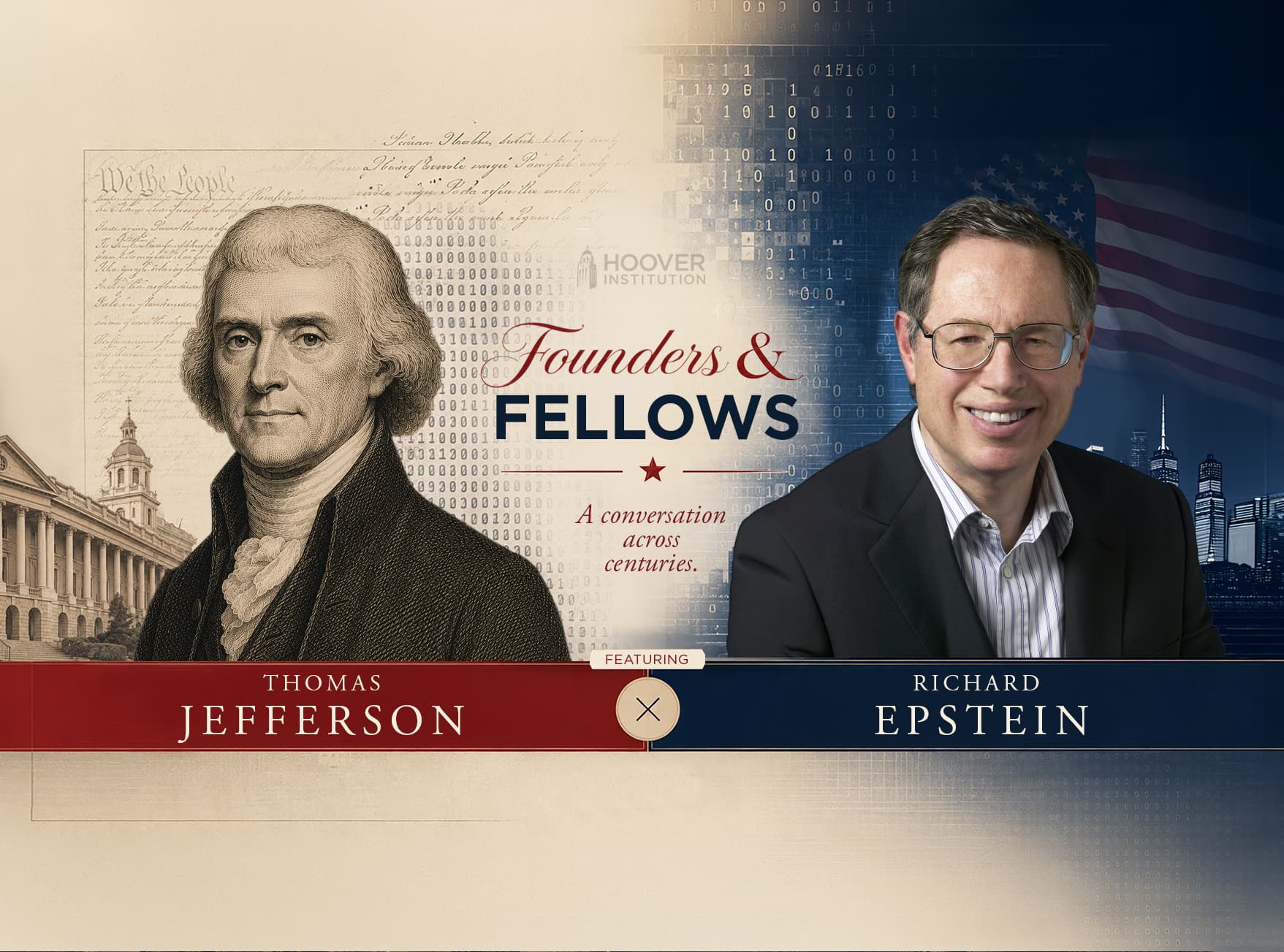
One of the best-known passages in the Declaration of Independence states unequivocally that all men “are endowed by their Creator with certain unalienable Rights, that among these are Life, Liberty, and the pursuit of Happiness.” Yet tucked inside that same document is an obscure passage of startling influence for the future course of the United States: “He [the British king] has endeavoured to prevent the population of these States; for that purpose obstructing the Laws for Naturalization of Foreigners; refusing to pass others to encourage their migrations hither.” And there is, of course, the conspicuous omission of the topic of slavery.
The tensions among warring provisions lasted to and through the adoption of the 1787 Constitution. The first led to the adoption of the Bill of Rights, which in very large measure lasts because it makes concrete many natural-law principles relating to freedom of speech, freedom of conscience, and the protection of private property. But Thomas Jefferson’s position on naturalization, the problem of the second provision, led first to his drafting the 1779 Naturalization Act of Virginia, which began with the words that said naturalization was open only to “all free white persons” who met certain conditions, including residing in the state for two years and renouncing all allegiance to any foreign nation.
The desire stated in the Declaration to populate the states also was made subject to conditions. By design, no person of African or Asian descent could become a citizen of Virginia. That statute was no anomaly: the adoption of the United States Constitution included Article I, Section 8, Clause 4: “To establish a uniform rule of Naturalization,” which, as Alexander Hamilton noted in Federalist no. 32, took all control over naturalization away from the states and vested it exclusively in the federal government.
It should come as no surprise that Jefferson’s influence carried over to the federal government, so Naturalization Acts of 1790 and 1795 transferred that state scheme bodily over to the federal government. And the Declaration that said nothing about slavery paved the way for the three-fifths clause of Article I, Section 2, Clause 3, to deal with matters of taxation and representation and the fugitive slave clause of Article IV, Section 2, Clause 3. The dark side of the Declaration had come home to roost.
The theoretical question is whether these three competing principles could be reconciled.
Jefferson ducked the question of slavery because he had to have known that it was inconsistent with the natural-law framework that insists that all rights are not the function of government but stem from our creator, with its explicit theistic overtone. It took the Civil War to vindicate that promise of the Declaration, which also gains the nontheological support as a universal natural law from Roman times: in the eyes of Justinian, among the core principles that bound all peoples before the creation of the state. The state, of course, relies on the basic principle that the sovereign has a monopoly over the use of force inside its territory, which in turn asks what rules and institutions, if any, should be used to constrain that power towards its members, now called subjects (to a monarch) or citizens (in a republic). For its part, the American Constitution uses both structural devices and the protection of individual rights to counter monopoly power entrusted to the state.
The one question, however, that is not answered by either the natural law or these various protections is who are the citizens of that state. It is not an easy question to answer because national boundaries are far from self-evident, and are capable of shifting either by voluntary actions or those of conquest. But for the American experience, in the former colonies under British control the applicable guide was that all free persons born within that state counted as its citizens.
But the possibility of naturalization, as seen in the Declaration, was built in at the ground floor. So, everywhere the standard solution gave the nation the exclusive power to determine who could come into the country and on what conditions, just as a property owner had the exclusive right to determine who could enter his property. There is, therefore, no logical inconsistency between Jefferson’s two principles of natural law and exclusive rights.
Nor is there any logical requirement that any sovereign attach a racial condition to naturalization. In the United States, the Fourteenth Amendment gave citizenship to all natural-born persons subject to the jurisdiction of the United States, including former slaves and their children. As drafted, Trump v. Barbara, the ahistorical opinion of Chief Justice John Roberts not to the contrary, ignores the explicit command of the earlier naturalization acts.
The tension between the Fourteenth Amendment’s treatment of former slaves and the explicit prohibition against the naturalization of persons of African descent was too painful to last, which is why that racial prohibition was removed by the 1870 Naturalization Act. That act left, however, the ban on the naturalization of persons of Asian descent fully in place, and required all foreigners born on US soil to go through naturalization.
The tension between natural rights and sovereign powers outlasted Jefferson’s Declaration, and it remains with us today.
Richard A. Epstein is the inaugural Laurence A. Tisch Professor of Law at NYU School of Law, where he serves as a director of the Classical Liberal Institute, which he helped found in 2013. He served as the Peter and Kirstin Bedford Senior Fellow at the Hoover Institution from 2000 to 2026 and is now a senior fellow at the Civitas Institute of the University of Texas-Austin. He is also the James Parker Hall Distinguished Service Professor of Law Emeritus and a senior lecturer at the University of Chicago.