 Powered by
By Rose Gottemoeller
The dissolution of the central role of the United States in global diplomacy and problem-solving has been a source of dismay to US allies and friends. Even opponents and competitors must be nonplussed by America’s quick sloughing off of its role in the major institutions created after World War II. Russia and China have no one to pummel in the United Nations Security Council, no reliable counterweight to their initiatives. Maybe they will now actually have to deliver on their promises and proposals.
This issue is relevant not only for US opponents, but also for America’s friends. Without the United States constantly exercising its power to solve problems and find answers, who will make progress on the critical questions of the day? And how? Who will prevent crises from ballooning into conflict, and how?
These are difficult questions across the spectrum of policy issues, but nowhere are they more pertinent than in the realm of existential risks to humanity. The oldest existential risk, nuclear weapons, provides a way to consider the problem.
Nuclear deterrence is evolving as countries react to the current uncertainty. Perhaps nuclear escalation is not such a ready path as it has seemed in the past. Perhaps the nuclear taboo is stronger than has been expected.[1] Or perhaps new entrants to the nuclear game will make the situation even more dangerous and destabilizing than it has been. Or perhaps artificial intelligence and quantum technologies will compound nuclear dangers.
In response to these uncertainties, nuclear diplomacy should likewise evolve.
A natural way for it to do so is to consider the role of other states besides the United States and Russia that possess nuclear weapons. After all, the nuclear weapons states under the Non-Proliferation Treaty—the United States, UK, France, Russia and China—have long had a treaty responsibility to control and limit nuclear weapons, with the goal of moving toward complete nuclear disarmament. India and Pakistan, which deploy nuclear weapons but stand outside the NPT, also embrace some notion of nuclear restraint—at least in their declaratory doctrine.
Up to this point in nonproliferation history, the United States and the Soviet Union, now Russia, have played the pre-eminent role because they were the Cold War arms racers, building tens of thousands of nuclear weapons by the late 1960s—Washington almost 30,000 and Moscow approximately 40,000.[2] The two nuclear superpowers have thus had the greatest amount of work to do and have engaged each other in nuclear arms talks since the Cuban Missile Crisis shocked them to the negotiating table in 1962.
With the United States pulling back from global leadership and Russia embroiled in war in Ukraine, the other nuclear weapon states should embrace the chance to push forward on nuclear diplomacy. They may be uncomfortable in this role—they have been able to duck behind the two superpowers, demanding for fifty years that they make progress first. This moment, when Moscow and Washington are not acting, calls for China, the UK, and France to reconsider their responsibility.
Such an initiative need not require them to reduce and eliminate nuclear weapons, however, for their arsenals are still far below the levels of the United States and Russia. Here are a few examples of how the three smaller NPT nuclear states could take the leadership of nuclear diplomacy:
First, the United States and Russia currently hold 1,550 deployed strategic nuclear weapons each. These are the limits left over from the New START Treaty, which went out of force in February 2026.[3] At the moment, Washington and Moscow are not rushing to exceed these limits, so Beijing, London, and Paris could bolster the status quo by pledging together not to undermine them. For China, which has approximately 620 warheads but is rapidly building new ones,[4] this statement would serve an important function. It would bolster the argument of Chinese experts that Beijing is not rushing to parity with the United States and Russia but is simply strengthening its nuclear retaliatory forces.[5]
For the UK and France, each deploying fewer than 300 warheads, the statement would reconfirm their own emphasis on a nuclear retaliatory doctrine. Like many a good policy initiative, it would serve to strengthen their bona fides, in this case as responsible nuclear powers.
Second, Beijing, London, and Paris are looking on as the conflicts in Ukraine and the Middle East give rise to an extraordinary proliferation of missiles and drones over a broad spectrum of ranges, from a few hundred meters to thousands of kilometers. Although they are not directly involved in the conflicts, they are all involved in supplying the missile programs in Ukraine or Russia and Iran, or elsewhere in the Middle East. They therefore have a responsibility to ensure that the missile buildup under way does not turn into a major new nuclear proliferation headache.
These three countries could accomplish this goal by promoting a ban on nuclear warheads on short- and intermediate-range missiles and drones. In essence, they would be tackling the escalatory pressure of systems that can launch both nuclear and conventional weapons—excluding the nuclear option from the vast majority of missiles and drones.
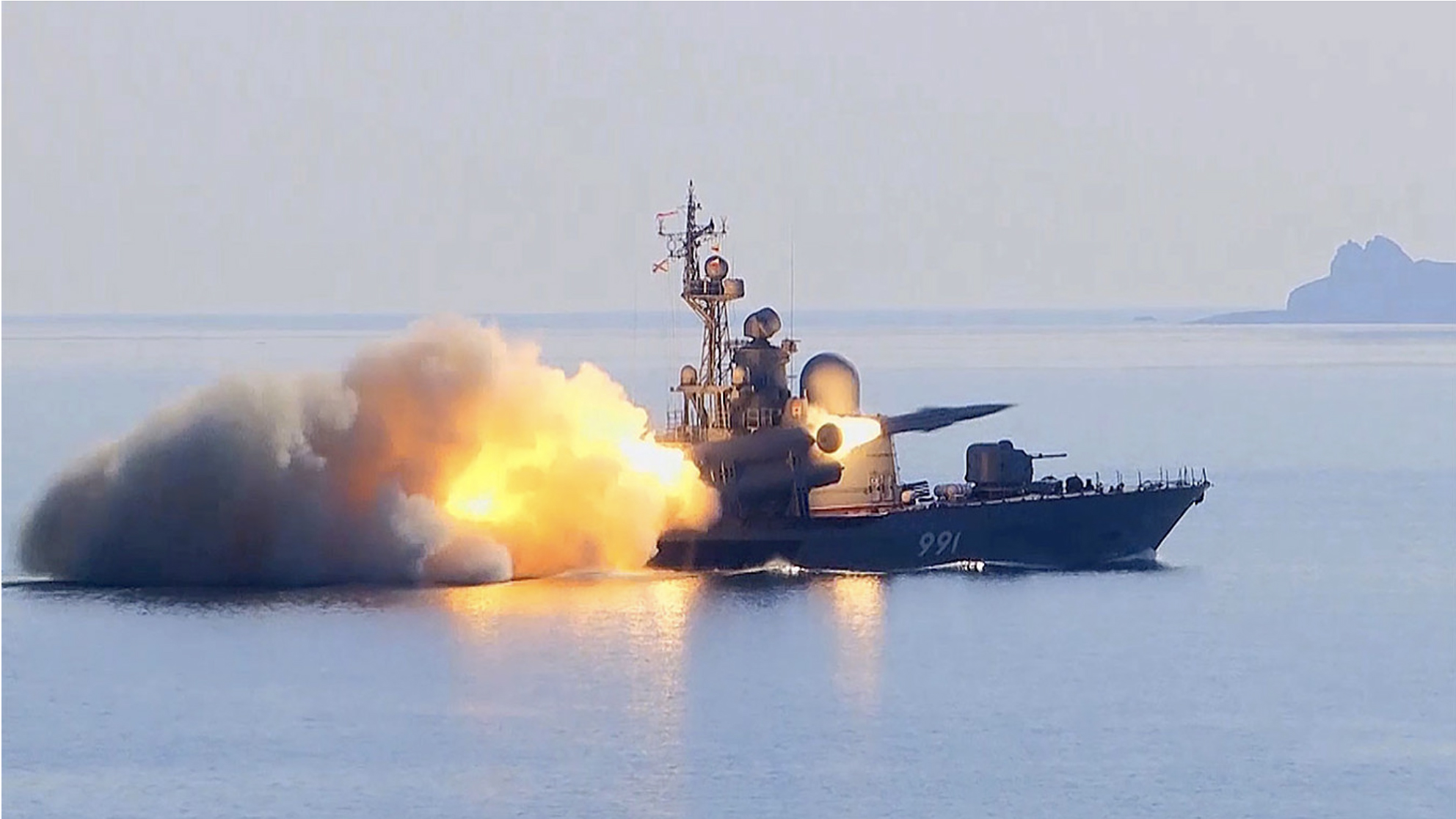
Of course, states possessing nuclear weapons know this issue well. The United States and the USSR banned all ground-launched intermediate-range missiles for forty years, concerned that they could not distinguish between nuclear and conventional variants.[6] Nowadays, China and Russia are deploying dual-capable missiles; so are India and Pakistan. Likewise, the United States, the UK, and France have not shied away from deploying dual-capable air-launched missiles at longer ranges.
The point of a new ban would not to be to deny carve-out options to states that require them. The point would be to ensure that the vast array of short- to intermediate-range missiles now being created and rapidly deployed worldwide generally remain non-nuclear.
All countries, great and small, must be prepared to defend against a multiplicity of missiles and drones, including in the hands of non-state actors. At least they should be certain that they are not nuclear.
These are two ideas about how China, the UK, and France could engage right now on initiatives that would make a real difference to nuclear stability. Of course, they would be strange bedfellows—usually the UK and France “hang out” diplomatically with the United States, and China does so with Russia. However, as this is a moment when the United States and Russia are disregarding their historic leadership roles, Beijing, London, and Paris can bolster their own, and do so while advancing their own strategic objectives.
[1] For a recent consideration of how nuclear deterrence may be evolving, see Rose Gottemoeller, “The Strange Defeat of Nuclear Deterrence,” Foreign Affairs, July-August 2026, https://www.foreignaffairs.com/authors/rose-gottemoeller.
[2] The best public source on these numbers is Hans M. Kristensen, Matt Korda, and Eliana Johns, “Nuclear Notebook,” Bulletin of the Atomic Scientists, https://thebulletin.org/nuclear-notebook/
[3] The status quo limits on the operationally deployed warheads, delivery vehicles, and launchers of the United States and Russia may be found in US Department of State, “New START Treaty,” https://www.state.gov/new-start-treaty.
[4] As of July 2026, China had approximately 620 nuclear warheads and the “fastest-growing nuclear arsenal among the nine nuclear-armed states.” Hans M. Kristensen, Matt Korda, Eliana Johns, and Mackenzie Knight-Boyle, “Chinese Nuclear Weapons, 2026,” Bulletin of the Atomic Scientists 82, no. 4 (2026): 293–322, https://thebulletin.org/premium/2026-07/chinese-nuclear-weapons-2026/.
[5] Tong Zhao, “China and America Are Courting Nuclear Catastrophe,” Foreign Affairs, May 1, 2026, https://www.foreignaffairs.com/united-states/china-and-america-are-courting-nuclear-catastrophe; see also Rose Gottemoeller, “Arms Control Is Not Dead Yet: America Should Pursue Parallel Nuclear Negotiations With China and Russia,” Foreign Affairs, April 15, 2025, https://www.foreignaffairs.com/united-states/arms-control-not-dead-yet.
[6] For a summary on the INF Treaty, see Council on Foreign Relations, “What the INF Treaty’s Collapse Means for Nuclear Proliferation,” August 1, 2019, https://www.cfr.org/articles/what-inf-treatys-collapse-means-nuclear-proliferation. See also Amy Nelson, “The Death of the INF Treaty Has Lessons for Arms Control, Bulletin of the Atomic Scientists, Nov. 4, 2019, https://thebulletin.org/2019/11/the-death-of-the-inf-treaty-has-lessons-for-arms-control/#.
Rose Gottemoeller is a research fellow at the Hoover Institution. She is also a research scholar at Stanford University’s Freeman Spogli Institute for International Studies and its Center for International Security and Cooperation (CISAC).