 Powered by

Stablecoins have moved rapidly from the margins of crypto markets toward the subject of vigorous debates about stability in payments and international monetary power. Their appeal is rooted in the potential to move across borders around the clock, settle quickly, and be embedded in programmable transactions. Some policymakers also see them as a way to reinforce the dollar’s global role and create additional demand for US Treasury securities (Bessent 2025).
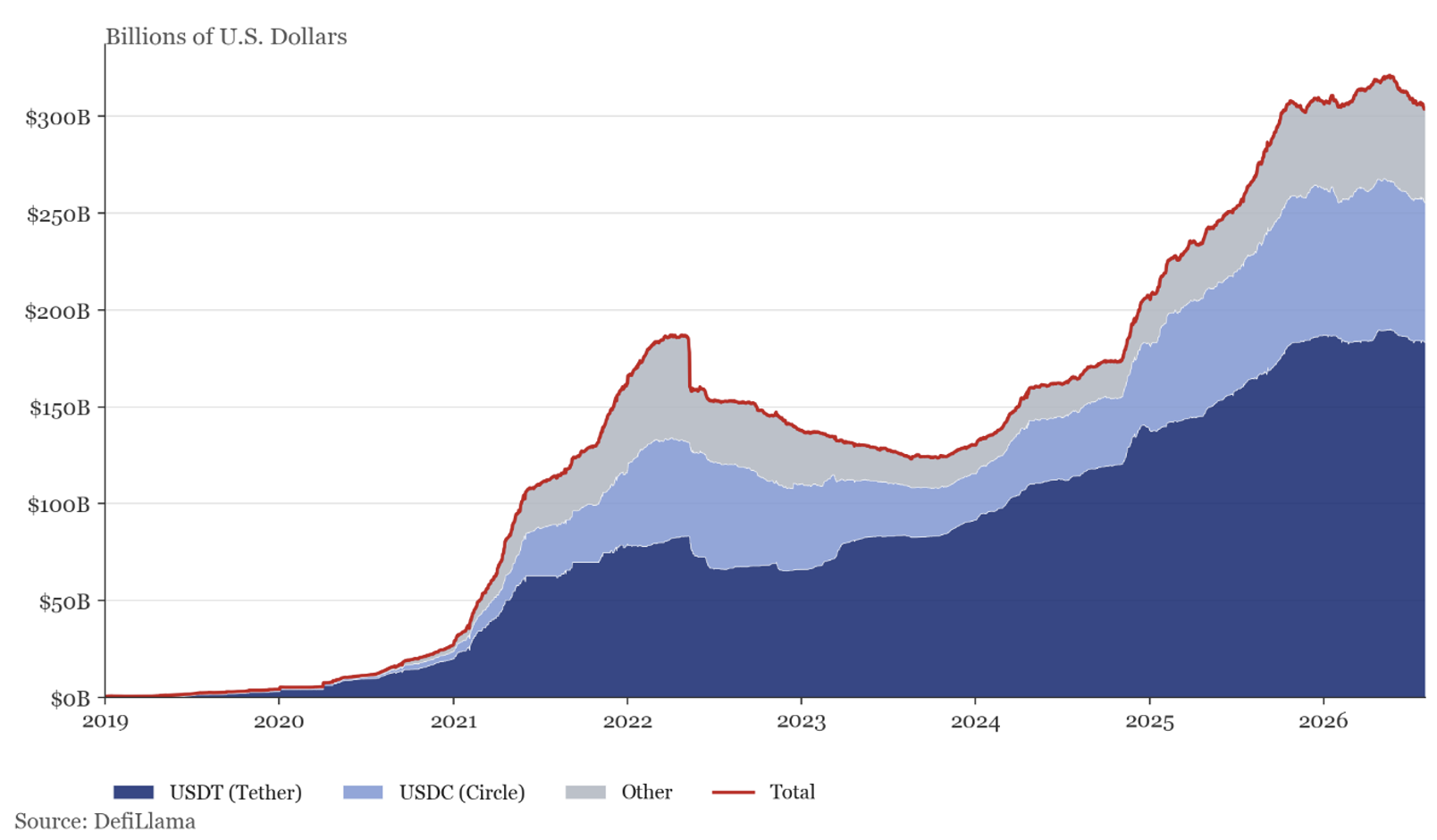
The issue is immediate because stablecoins in circulation have exploded, reaching roughly $300 billion in mid-2026, compared with less than $5 billion at the beginning of 2020. The dollar also enjoys a strong first-mover advantage: about 98 percent of stablecoin value is dollar-denominated (Figure 1).
Figure 1: Stablecoins in circulation by market capitalization
This growth can extend the dollar’s reach through new digital payment and settlement networks. But stablecoins cannot sustain dollar dominance on their own. That depends on confidence in US monetary and fiscal policy, deep and liquid financial markets, legal enforceability and the rule of law, and the capacity to provide liquidity in a crisis (Eichengreen 2011; Rogoff 2025; Blustein 2025).
If those strengths erode, stablecoins will not repair them. They could also become an additional channel for financial instability. Stablecoins are demandable dollar claims backed by reserve assets that may have to be mobilized or sold rapidly to meet redemptions, including Treasury bills and commercial-bank deposits. At sufficient scale, rapid redemptions could transmit stress into the markets on which the dollar system itself depends.
Dollar stablecoins may enlarge the perimeter of dollar use by reaching new users, markets, and platforms, particularly where local currencies are unstable or access to dollar banking is limited (Aldasoro, Frost, and Ito 2026). But a larger perimeter is more difficult to govern and potentially less stable when dollar claims circulate across jurisdictions and issuers that do not share common rules for redemption, liquidity, and loss allocation. Historical experience is particularly useful here because private money has faced these problems before (Bordo and Wilkins 2026).
What history says private money needs
A fiat-backed stablecoin is a privately issued promise to deliver sovereign money at a fixed value, typically at par. The technology is new, but the economic problem is not. Private monetary systems have repeatedly had to answer the same basic questions: Can the issuer make good on the promise to redeem? Will claims issued by different institutions be accepted at the same value? And what happens when many holders want to redeem at once? The institutional answers differed across countries, but successful systems found ways to make redemption credible, impose discipline across issuers, and provide liquidity when the system came under stress.
The American record is particularly instructive. During the Free Banking era, from 1837 to 1863, notes traded at discounts that varied with the quality of the collateral, the reputation of the issuing bank, and the distance to the place of redemption. A banknote was not simply “a dollar.” Its value depended on who had issued it and where the holder tried to redeem it (Weber 2015). The Panic of 1857 exposed one weakness in this system: declines in the value of some of the state bonds used to back notes weakened the collateral of particular banks and contributed to wider discounts.
The National Banking Acts of 1863 and 1864 addressed part of the problem by requiring national banknotes to be backed by US government bonds. Notes became much more uniform, but another weakness remained. Their supply could not expand flexibly when demand for currency rose, particularly during the harvest season. The panics of 1873, 1893, and 1907 showed that better and more standardized collateral had not created an elastic currency or a national mechanism for providing liquidity in a crisis.
Private institutions tried to fill the gap. During panics, clearinghouses issued loan certificates against collateral that member banks could use instead of cash for settlement, conserving cash and reducing forced asset sales. During the Panic of 1907, J.P. Morgan and other private actors coordinated extraordinary support. Their success also exposed the arrangement’s weakness: national financial stability depended on improvised cooperation among a relatively small group of private institutions and individuals. The Federal Reserve Act of 1913 ultimately put on a permanent footing functions that had previously depended on that improvisation (Gorton 1985; Calomiris and Gorton 1991).
Britain faced many of the same problems but arrived at a different institutional structure. England also shows that credibility did not require an inflexible rule. In 1797, amid wartime gold outflows, the Bank of England suspended convertibility. Gold payments were not resumed until 1821, but they were restored at the original parity. A temporary suspension did not destroy the monetary commitment because it was understood to be exceptional and eventual resumption remained credible (Bordo and Kydland 1995).
Other weaknesses became apparent as the banking system expanded. English country banks were restricted to partnerships of no more than six people. They were closely tied to the communities they served, but tended to be thinly capitalized and poorly diversified. In the Panic of 1825, dozens failed (Pressnell 1956; Neal 1998). Parliament responded in 1826 by permitting joint-stock banking outside London, allowing larger banks with more capital and greater geographic diversification (Clapham 1944). Stronger banks, however, did not eliminate the need for systemwide liquidity in a crisis. England increasingly met that need by concentrating reserves and crisis management around the Bank of England.
The Bank Charter Act of 1844 also tied Bank of England note issuance more tightly to gold, strengthening the commitment to convertibility. A stronger commitment to convertibility did not eliminate liquidity crises. In 1847, 1857, and 1866, the government temporarily relaxed the act’s limit on note issuance so that the bank could lend into the panic (Clapham 1944). The rule remained credible because the departures were understood to be exceptional and temporary (Bordo and Kydland 1995).
The historical record points to five conditions that allowed private money to circulate at par and scale: credible convertibility; high-quality and transparent backing; a sufficiently uniform regulatory perimeter; clearing and settlement arrangements that support par exchange; and credible arrangements for crisis management and loss allocation (Bordo and Wilkins 2026). These are the same tests that stablecoins have to pass today.
A new layer on the dollar base
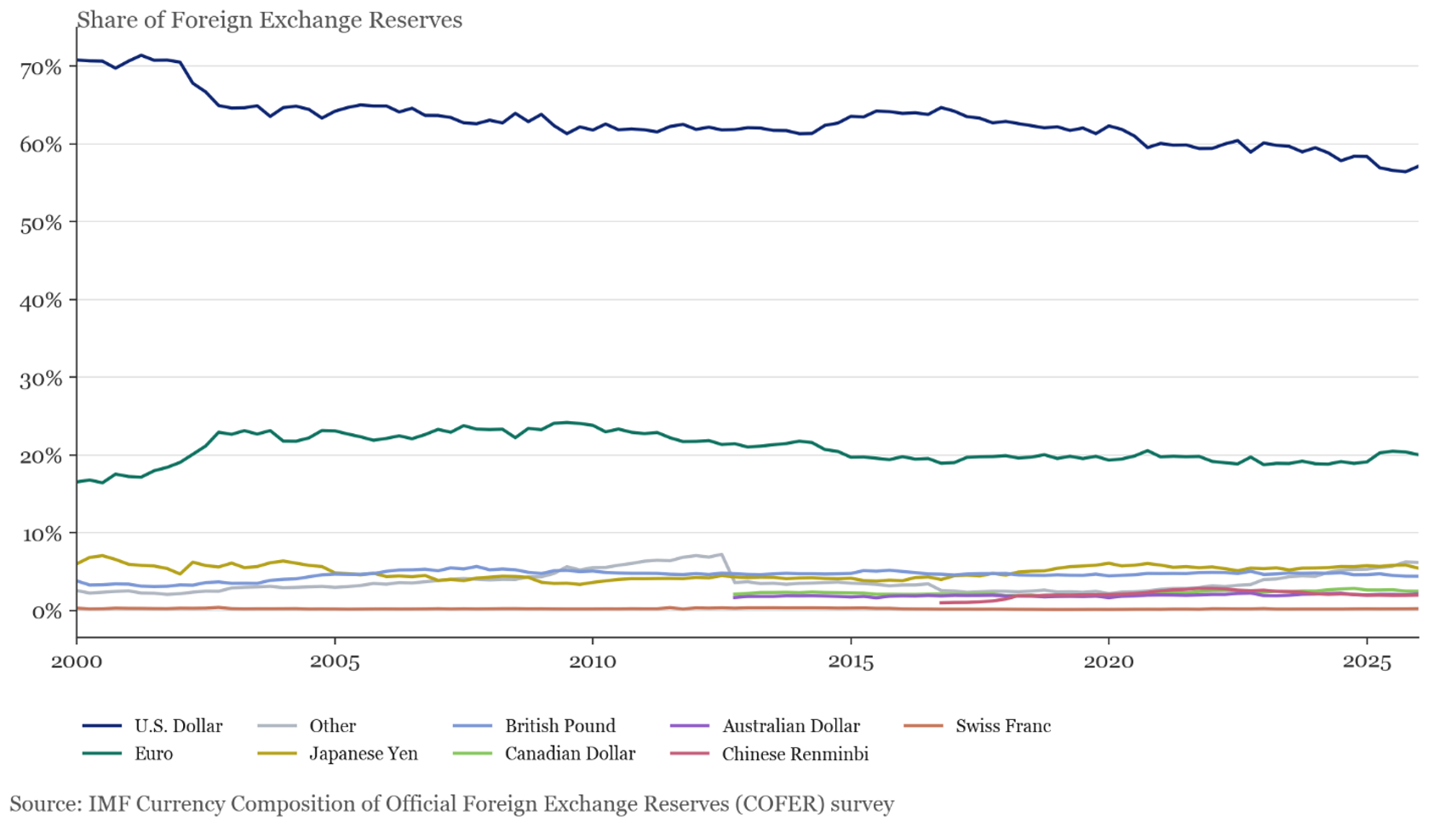
The dollar remains in a relatively powerful position, although it has weakened since the beginning of the century (Liao, Prasad, and Zhang 2026). Its share of disclosed global foreign-exchange reserves has fallen from a little over 70 percent around 2000, but no rival has come close to replacing it. The euro remains near 20 percent, while the renminbi accounts for only a small share (Figure 2). The dollar was on one side of just under 90 percent of over-the-counter foreign-exchange transactions in April 2025 (Bertaut, von Beschwitz, and Curcuru 2025; BIS 2025). US Treasuries remain widely used as collateral, liquid stores of value, and pricing benchmarks. Historically, their safety and liquidity generated a convenience yield of about 70 basis points (Krishnamurthy and Vissing-Jorgensen 2012), although recent evidence finds that this advantage has declined significantly and has become negative at longer maturities (Du, Keerati, and Schreger 2026).
Figure 2: Official foreign exchange reserves by currency
Stablecoins could reinforce these network effects through three channels.
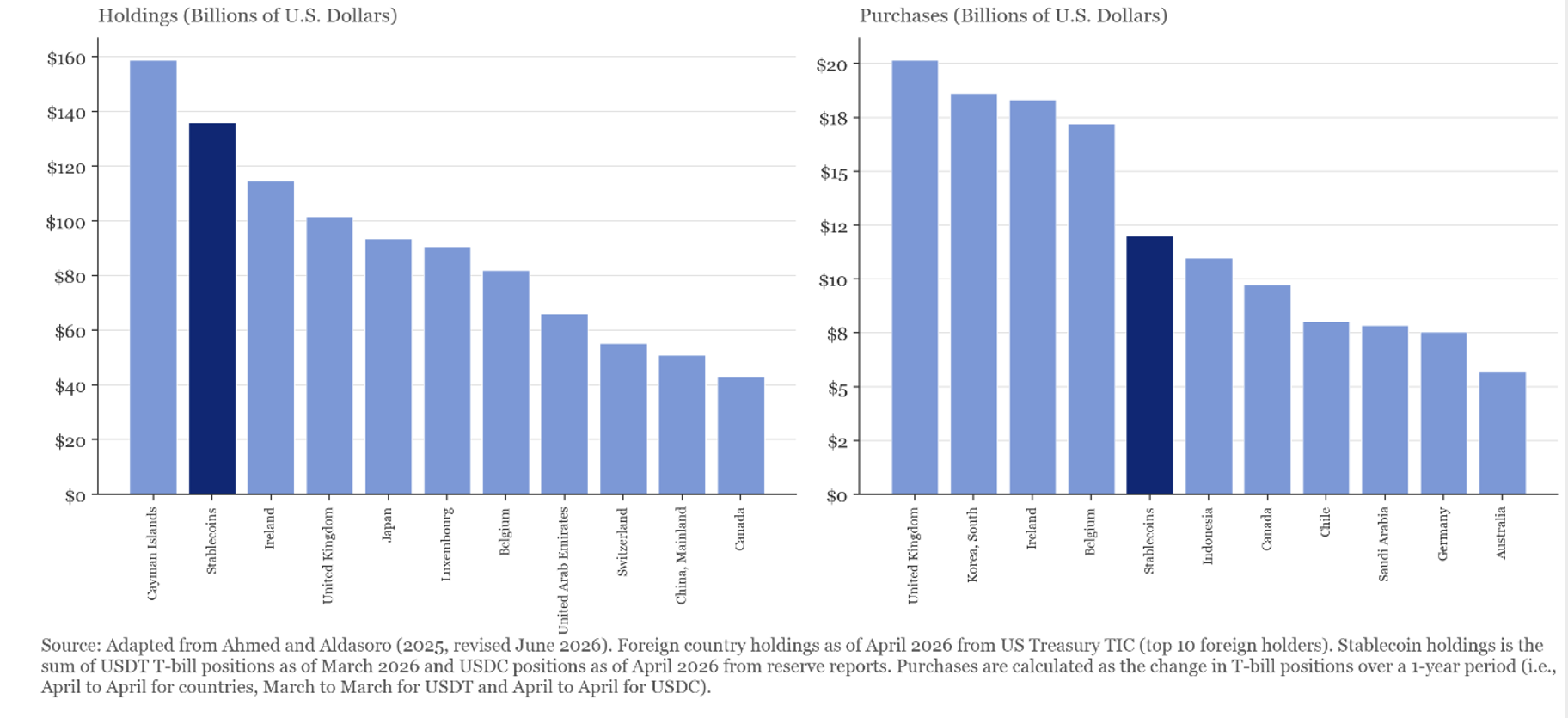
First, they can reinforce demand for safe dollar assets. The GENIUS Act permits several highly liquid reserve assets, including short-dated US Treasury securities. USDT and USDC together held roughly $135 billion in short-term Treasuries in spring 2026 and had purchased about $12 billion over the preceding year (Figure 3). Stablecoin issuers have therefore become meaningful participants in the short-term Treasury market, although their holdings remain small relative to the Treasury market as a whole. Some evidence suggests that additional demand from stablecoin issuers can modestly lower Treasury yields, although the overall effect will be smaller if stablecoin demand mainly reallocates funds from other dollar assets rather than creating new demand for safe assets (Ahmed and Aldasoro 2025; Aldasoro, Frost, and Ito 2026).
Figure 3: Stablecoin issuers’ holdings (left panel) and purchases (right panel) of short-term US Treasuries relative to selected foreign holders
Second, stablecoins can extend dollar settlement. Transactions can take place twenty-four hours a day and cross borders without moving through every layer of correspondent banking. They do not eliminate intermediation because users still rely on issuers, custodians, exchanges, market makers, blockchains, and on- and off-ramps. But they rearrange it and could reduce costs or improve access in some corridors (Liao, Prasad, and Zhang 2026).
Third, they can deepen digital dollarization. In countries with weak monetary institutions or volatile currencies, households and firms already use dollars as stores of value. Stablecoins make it possible to hold and transfer a dollar-linked claim without direct access to a US bank account. Du, Huang, and Scharfstein (2026) find that the advantages are most visible in some emerging-market corridors with capital controls or segmented foreign-exchange markets, although shallow stablecoin-linked FX liquidity still limits scale.
Together, these channels could create a virtuous circle. More stablecoin issuance could raise demand for Treasury bills, with greater liquidity reinforcing the attraction of dollar assets. Wider use of dollar-denominated instruments could then strengthen the incentive for platforms and users to adopt them, further deepening network effects. But every link in that circle depends on confidence in redemption and in the assets behind it, as well as on the ability to deal decisively with episodes of financial stress.
Mind the gaps in the GENIUS Act
Measured against the five conditions suggested by history, the GENIUS Act makes substantial progress. It requires one-to-one reserves, restricts the assets that can back stablecoins, strengthens disclosure and certification, clarifies redemption rights and the treatment of holders in insolvency, and brings issuers within a clearer supervisory framework. These are important safeguards. They reduce the risk that two stablecoins promising a dollar are backed by very different assets or subject to entirely different rules.
But the act goes further on some of the five conditions than on others (Bordo and Wilkins 2026). It addresses backing, redemption, and supervision most directly.
The harder question is what happens in stress.
Eligible reserves include Treasury securities, commercial-bank deposits, repos and reverse repos, and qualifying money-market funds. These are high-quality assets, but they are not all equally liquid under all conditions, and they introduce different counterparty, custodial, and market-liquidity risks. More importantly, the act does not provide a mechanism for dealing with correlated redemptions across several large issuers. One-to-one backing does not, by itself, ensure that those assets can be turned into cash quickly without disrupting markets when many holders want to redeem at the same time.
The Federal Reserve’s proposed limited-purpose Payment Account does not solve this problem. It would give eligible institutions more direct access to the payment system and reduce their dependence on correspondent banks for settlement. But the proposal prohibits overdrafts and would not provide access to Federal Reserve credit. It therefore improves the “plumbing” in normal times without answering the crisis-liquidity question (Federal Reserve Board 2026).
The emerging British framework provides a useful comparison. The United Kingdom distinguishes between ordinary qualifying stablecoins and stablecoins that become systemic, which fall within the Bank of England’s remit. For systemic issuers, the proposed framework is more restrictive about reserve assets and gives more explicit attention to liquidity contingency planning, access to the payment system and arrangements for failure. It also leaves open the possibility of central-bank liquidity for systemic stablecoins under appropriate conditions (Bank of England 2026). Those requirements may make the business model less profitable, but they address more directly the problem that repeatedly emerged in the historical cases. Backing an individual issuer is not the same thing as ensuring that a monetary system can continue to function during a run.
The remaining gaps become more important as stablecoins cross borders. A stablecoin may be issued in one jurisdiction, backed by assets held in another, kept with a custodian in a third, and used by holders elsewhere. The legal rights attached to the token, including redemption rights and the treatment of assets in insolvency, do not automatically travel with it. Nor will supervisors necessarily have the same information or the same responsibilities when an issuer comes under stress.
Over time, international banking developed responsibilities for home and host countries, including supervisory colleges and common standards. If stablecoins become an important form of international money, comparable arrangements will be needed.
From a virtuous to a vicious circle
The gaps in the legislative and policy frameworks matter most when the system is under stress. One-to-one backing helps make redemption credible in normal times. But if many holders want their money back at once, issuers still need to turn reserve assets into cash quickly. As stablecoins grow, that creates a tighter link between confidence in stablecoins and conditions in the markets where their reserves are held.
Stress could start with a stablecoin issuer. Doubts about an issuer, its custodian, or the liquidity of its reserves could trigger redemptions. Issuers might then have to draw down bank deposits, sell Treasury bills, or unwind repo positions. If several large issuers were doing this at the same time, the sales could push up short-term yields and add to market volatility. That could make reserve assets harder or costlier to liquidate and, in turn, encourage further redemptions. The effects could also be asymmetric. While stablecoin inflows can modestly lower Treasury yields, forced sales under redemption stress could have larger, nonlinear effects, particularly when Treasury markets are already under stress (Ahmed and Aldasoro 2025).
Stress could also come from outside the stablecoin sector. Concerns about US inflation, fiscal sustainability, central-bank independence, or broader institutional credibility could weaken demand for dollar assets. Stablecoins would not protect the dollar system from that kind of stress. At sufficient scale, redemptions could add to the selling pressure by forcing issuers to liquidate reserve assets.
Stablecoins may not currently be large enough for this to pose a major threat to the Treasury market. But US policy is explicitly aimed at allowing the sector to become much larger. If that happens, the same links that can reinforce demand for dollar assets when confidence is strong could also transmit and amplify stress when confidence weakens.
Monetary power in a more multipolar world
The dollar system gives the United States considerable strategic leverage. Because many international transactions depend on institutions subject to US law, American authorities can gather information, impose sanctions, and exclude actors from critical parts of the financial network. Secondary sanctions extend that influence well beyond US firms (Farrell and Newman 2019).
That leverage also creates an incentive to develop alternatives. China has expanded the Cross-Border Interbank Payment System for renminbi transactions, while Project mBridge has experimented with cross-border settlement using wholesale central-bank digital currencies (Angeloni and Tille 2025; MacKenzie and Zelmer 2026). Other jurisdictions are developing their own frameworks for digital money, motivated not only by efficiency but also by concerns about monetary sovereignty and financial stability. The result could be a more fragmented, yet potentially more competitive, international payments system even if the dollar remains the dominant currency.

Greater currency competition need not be a bad outcome because competition can spur innovation and improve efficiency (Hayek 1976). Historical experience, however, suggests that such competition is sustainable only when supported by robust institutional frameworks, including coordination around redemption, settlement, and loss allocation.
There is little reason to think that the dollar is about to lose that position quickly. No rival currently offers the same combination of deep and liquid financial markets, safe assets, convertibility, legal credibility, and established use. The dollar can therefore remain the leading reserve and financing currency even as payments increasingly move across a wider range of regional systems and digital networks (Rogoff 2025; Blustein 2025).
Sterling’s experience nevertheless warns against assuming that network advantages are permanent. Before the First World War, sterling bills financed international trade far beyond transactions involving Britain itself. London remained a major financial center, imperial trade links reinforced the currency’s use, and the sterling area preserved a powerful network even after Britain’s relative economic position began to weaken. But war debts strained Britain’s fiscal capacity, the commitment to gold became increasingly difficult to sustain, and Britain’s ability to provide international liquidity declined. Sterling did not disappear suddenly; the dollar displaced it gradually as economic weight and confidence shifted toward the United States (Schenk 2010; Eichengreen 2011).
While network effects can make an international currency remarkably persistent, they cannot indefinitely compensate for weaker fundamentals. Dollar stablecoins could strengthen those network effects by making dollar claims easier to hold and transfer and by embedding them more deeply in new payment systems. They cannot substitute for monetary and fiscal credibility, deep capital markets, legal predictability, or the capacity to provide liquidity in stress (Bordo and Wilkins 2026).
That is why the objective should not simply be to maximize the volume of dollar stablecoins. The United States has an interest in allowing them to develop where they improve payments and extend the usefulness of the dollar, while ensuring the institutional arrangements around them are strong enough to support that growth. Cross-border use also means that rights to redemption, supervision, and arrangements in stress cannot stop at national borders.
The future of dollar dominance will ultimately depend on whether the United States preserves the economic, legal, and policy credibility that makes the rest of the world willing to hold dollar claims.
Carolyn A. Wilkins is a visiting research scholar at the Griswold Center for Economic Policy Studies, Princeton University, and an external member of the Financial Policy Committee, Bank of England. This post is based heavily on a paper coauthored with Michael Bordo titled “Money and Power: Historical Lessons for Stablecoins and U.S. Dollar Dominance,” (NBER working paper 35768, August 2026). The author would like to thank William Neumann for his research assistance. The views expressed here are those of the author and not those of the Bank of England or its Financial Policy Committee.