 Powered by
On February 24, 2022, Russia entered the second—and, as yet, the most aggressive—phase of its war against Ukraine, which began in 2014: it launched a full-scale invasion of Ukraine with the goal of ultimately subjugating it.
Almost immediately, a debate began in Germany over whether economic sanctions, on both the import and export sides, should be imposed on Russia. The import side focused on Russian fossil-fuel imports—coal, oil, and, most importantly, natural gas—because they formed an important component of German imports from Russia. However, they were not only an important component of German imports from Russia, but also an important—and, in the case of natural gas, a dominant—element of Germany’s energy mix (see Table 1 in Bachmann et al., 2024). The main reason for this strong German dependency on Russian fossil fuels was Germany’s 2011 decision, taken in the aftermath of the Fukushima disaster, that is, three years before the start of the Russian aggression in Ukraine, to phase out nuclear power, while maintaining a rapid decarbonization schedule. Russian natural gas was considered the “bridge technology” to get Germany from the nuclear and carbon age to the renewables-only era. On the export side, because trade policy is an exclusive competence of the European Union, the debate was European in scope from the outset.
As for imposing import sanctions on Russian fossil fuels, politicians and business leaders warned of catastrophe. Then– Foreign Minister Annalena Baerbock said that “it would be lights out” if Russian energy imports were cut off; Minister of the Economy Robert Habeck predicted “severe damage”; Chancellor Olaf Scholz worried publicly about an “unbelievable number of jobs”; BASF’s chief executive asked whether Germany wanted to “destroy our entire economy”; and the head of the Federation of German Industries warned that up to four million jobs could be lost (see Bachmann et al., 2024, for the original sources of these quotes).
Politics aside, does economics justify this kind of doomerism? Bachmann et al. (2024), using a variety of approaches from a relatively model-free sufficient-statistics approach, which allows for sanity checks directly from the data, to the fully specified multicountry, multisector trade model pioneered by Baqaee and Farhi (2024), said no. Like many other studies (see Bachmann et al., 2024, Appendix C, for an overview and a discussion of these studies), they argue that imposing a complete import ban on Russian fossil fuels would lead to a severe recession in Germany, but not economic Armageddon.
Germany did not, in fact, impose such a complete import ban, especially not for pipeline gas from Russia. Ultimately, Russia stopped exporting through pipelines by late summer 2022. Perhaps interestingly, Moll et al. (2023) show in one of their autopsies of the case (Figure 13) that the only studies supporting the economic Armageddon view were those financed by special-interest groups like trade unions and business associations. This reveals an interesting political economy dynamic in crises potentially requiring import or export restrictions.
Apocalypse Not Now
Bachmann et al. (2024) also conducted an autopsy of how their predictions lined up with the actual data after Russia’s weaponized gas cutoff and conclude that they did. The economic reason: the power of substitution.
To appreciate the power of substitution, it is useful to start with the extreme case of no substitutability at all. Economists call this the Leontief case, after the—perhaps ironically— Russian-American economist Wassily Leontief. If one production factor falls by 20 percent, output will decline by the same amount. If one production input goes to zero, so will output, and this holds independently of how important this production factor is, as long as a little bit of it is needed to produce output. No matter how prices adjust, no matter how well markets function. Imagine you are organizing a Fourth of July barbecue and plan to serve 100 hot dogs. You therefore need 100 franks and 100 hot dog buns. If your dog eats 20 of those franks and your local supermarket has already closed for the holiday, you will be able to serve only 80 hot dogs, no matter how many buns you have left.
Those who predicted economic Armageddon after a complete import ban on Russian natural gas implicitly had a hot dog model of the economy in mind. Natural gas serves as an input into two main economic processes: providing heat and generating electricity, and serving as a chemical feedstock. Certainly, if a country’s energy mix consisted entirely of Russian natural gas, its situation, at least in the short run, would have been close to the Leontief case and its GDP would have fallen to zero. I note that (i) economic Armageddon, of course, would set in well before a country’s GDP falls to zero, and (ii) even in this extreme case, the country’s consumption level need not have fallen to zero, as it could have met its consumption needs through imports.
Extreme cases are useful for clarifying mechanisms, but they are usually not a good description of reality. At the same time, our hot dog model allows us to highlight how different forms of substitution interact to soften the blow.
First, maybe your local gas station, which remained open during the holiday, still has some franks to sell? Second, maybe you still have some minced meat in the freezer and could make cevapcici from it? Third, maybe you are just fine with letting some latecomers to your party eat only toasted hot dog buns? And fourth . . . OK, for this one, I need to assume that mice have eaten 20 hot dog buns (while the dog left the franks alone)—maybe you have a neighbor who has some frozen dough and sells it to you, allowing you to bake the buns yourself.
Now, similar mechanisms can be at play with natural gas: First, natural gas can be imported from other sources—for instance, Norway—and, after a short period spent building LNG terminals, also from the United States. Second, coal, oil, nuclear power, and renewables can substitute for natural gas in heating and electricity generation. While Germany also imported coal and oil from Russia, it was far less dependent on Russia as a supplier, and international markets for coal and oil made it much easier to source them elsewhere—much easier than was the case with pipeline-dependent Russian natural gas. Third, demand for natural gas can be reduced by heating homes less and using less hot water. Fourth, intermediate goods produced using natural gas can be imported. Importing ammonia for urea fertilizer production, for example, would remove from GDP only the part of the domestic value chain extending from natural gas and hydrogen to ammonia, not the downstream stages from ammonia to fertilizer and beyond. It should be obvious that all these mechanisms can be at play simultaneously.
Further, the more complex a production chain is, the more possibilities for such imports of intermediate goods there are. The more time for adjustment there is, the easier it will be for these substitution mechanisms to play out.
Another important factor for substitution to unfold its power is that market prices are allowed to adjust and to function as signals of scarcity. Households will not lower their room temperatures by a few degrees on their own, and firms will not switch to an old oil-fired furnace to generate heat on their own either; nor are such adjustments easily achieved by government fiat. Households and firms will make them if natural gas prices rise.
In practice, given sufficient time and viewed at a somewhat aggregate level, economies are rarely Leontief. And mathematically, it turns out that just a small deviation from the Leontief case might suffice for the power of substitution to unfold. Moll et al. (2023) show (Figure 3) that output losses with even a little bit of substitution and a production factor that is not too important, tend to be far closer to zero than to the extreme Leontief case, where output losses simply equal input losses in percentage terms.
Furthermore, what I have described thus far is not merely hypothetical; it is what German households and firms actually did:
Natural gas imports from other sources rose by 33 percent; overall demand was reduced by 20 percent (see Moll et al., 2023, Figure 4); firms reduced their demand by 26 percent while changing their output very little; and households reduced their demand by 16 percent (see Moll et al., 2023, Table 2 and Figure 5).
Imports of rubber tires, plastics, and aluminum increased (see Moll et al., 2023, Figure 8).
Online Appendix E of Moll et al. (2023) lists many concrete examples of how substitution occurred in practice, including a screw manufacturer converting its ovens from natural gas to electricity, dairy producers switching from gas to oil, a municipal electricity supplier halting a coal-to-gas conversion project, and a glass manufacturer switching from natural gas to propane.
Bachmann et al. (2024) discuss in Appendix B other historical examples of the power of substitution: a sudden cessation of Argentine gas supplies to Chile in 2007; a Chinese rare-earth embargo against Japan in 2010; Germany’s U-boat campaign against Britain during the First World War, etc. None of these episodes led to economic Armageddon for the affected countries.
Substitution at work
Next, I want to turn to the European Union export sanctions against Russia: since shortly after Russia’s full-scale invasion of Ukraine, the European Union has adopted twenty sanctions packages and is working on a twenty-first. Packages 1 to 4, which were implemented in February and March 2022, focused on restrictions on military, dual-use, aviation, refining, maritime, and even luxury goods. Packages 5 to 10, implemented throughout the first year of the full-scale phase of Russia’s war against Ukraine, featured much broader restrictions on industrial machinery, electronics, chemicals, aviation components, drones, and professional services. Subsequent packages have focused more on preventing circumvention and on ever more detailed lists of goods.
Interestingly, early research was rather sanguine about the efficacy of these export sanctions: a VoxEU column from May 2023 finds that flows from European Union countries were close to zero for restricted goods, and the increase in imports from third countries had replaced no more than one-fourth of the missing shipments. What is more, Russia had particular difficulty finding substitutes for strategically important high-tech goods in those early days of the war, with semiconductors as the one potential exception. However, the column also warns that countries like Armenia, Kazakhstan, Serbia, and Turkey were emerging as major hubs for sanction circumvention against European export restrictions.
Later developments, however, have shown that the power of substitution also applies to Russia, a point that the subsequent literature readily acknowledges. Lax sanctions enforcement—the particularly egregious example of a Russian-owned alumina factory in Ireland that continues to ship alumina to Russia comes to mind—unclear policy specifications leading to substitution towards closely related, unbanned variants, imports from non-sanctioning countries for both overall trade and for military goods specifically, and rerouting trade through third countries, especially in the Caucasus (especially Armenia, Kazakhstan, and, Kyrgyzstan), have considerably weakened European export sanctions on Russia.
According to UN Comtrade statistics, German exports to Kyrgyzstan increased by almost 500 percent in 2022, rising from just US$60 million to around US$350 million. The year 2023 saw another doubling of these trade flows relative to 2022, before the volume of trade between these two countries leveled off at this much higher level. It is highly implausible that Kyrgyzstan’s population experienced such a massive preference shock for German products in 2022.
In addition, political disunity within the European Union means its sanctions regime is less severe than it could be. For example, Greece blocks any restrictions on shipowners transporting Russian oil; Italy and Bulgaria block sanctions on a Georgian refinery specializing in Russian oil; and even Germany blocks sanctions on Russian fish exports for fear of damaging its fish stick industry (no joke). However, it should be noted that the power of substitution can sometimes also work in reverse, as exemplified by China’s cancellation of the Power of Siberia 2 natural gas pipeline project.
The damage to Russia
What does all this imply? An answer to this question is not straightforward and depends on many assumptions and modeling choices, but Jean Imbs and Laurent Pauwels have taken a first step, again using a multicountry, multisector trade model to capture not just direct trade and substitution, but also indirect trade and production chains.
Two key results emerge: first, in their simulations, Russia always suffers more than Europe in GDP terms, whether its imports from Europe or its exports to Europe are sanctioned. Prior to the full invasion of Ukraine in 2022, Europe constituted the largest market for Russian energy exports, twice the size of even China. Conversely, even though Russian energy imports were dominant for Germany prior to 2022, Norway had also a large share and could increase its deliveries quickly. More generally, the power of substitution can unfold much more effectively in peacetime market economies with a functioning price system and an expansive pre-existing trade network. On the export side, the Russian market is simply too small for most European countries to matter.
Second, the detrimental effect on Russia is larger when its exports are sanctioned (import sanctions from the European viewpoint), because Russia’s economy is far more dependent on Europe than Europe’s economy is on Russia.
Specifically—and one can certainly quibble with the exact numbers—an embargo on Russian energy imports to Europe reduces Russian GDP by 1.17 percent, Europe’s by 0.08 percent. A blanket embargo on Russian imports would lead to a GDP reduction in Russia by 3.4 percent, and in Europe by 0.23 percent. Conversely, an export embargo from Europe to Russia would lead to a GDP reduction in Russia by 1.31 percent, and in Europe by 0.24 percent. We should think of these numbers as long-run effects (the short-run effects may be larger due to the reduced power of substitution in the short run and Keynesian aggregate demand effects). They are not catastrophic, even for Russia, but they are nevertheless substantial. These overall results mask some heterogeneity, which is important to understand the political economy of trade sanctions in Europe: any type of trade sanction hits Eastern European countries harder.
A further important insight comes from David Baqaee and Hannes Malmberg, namely, that the long-run effects of trade sanctions, despite the greater scope for substitution, might actually be larger than the short-run effects when capital accumulation and endogenous growth effects are taken into account (which Imbs and Pauwels, 2024, do not incorporate). The idea is simple: When a country like Russia is especially dependent on imports of capital goods and cutting-edge technology, export bans on those goods from Europe (and from elsewhere) will raise their relative prices and, therefore, lead to less capital accumulation and slower adoption of new technology, which could put Russia on a permanently lower growth path.
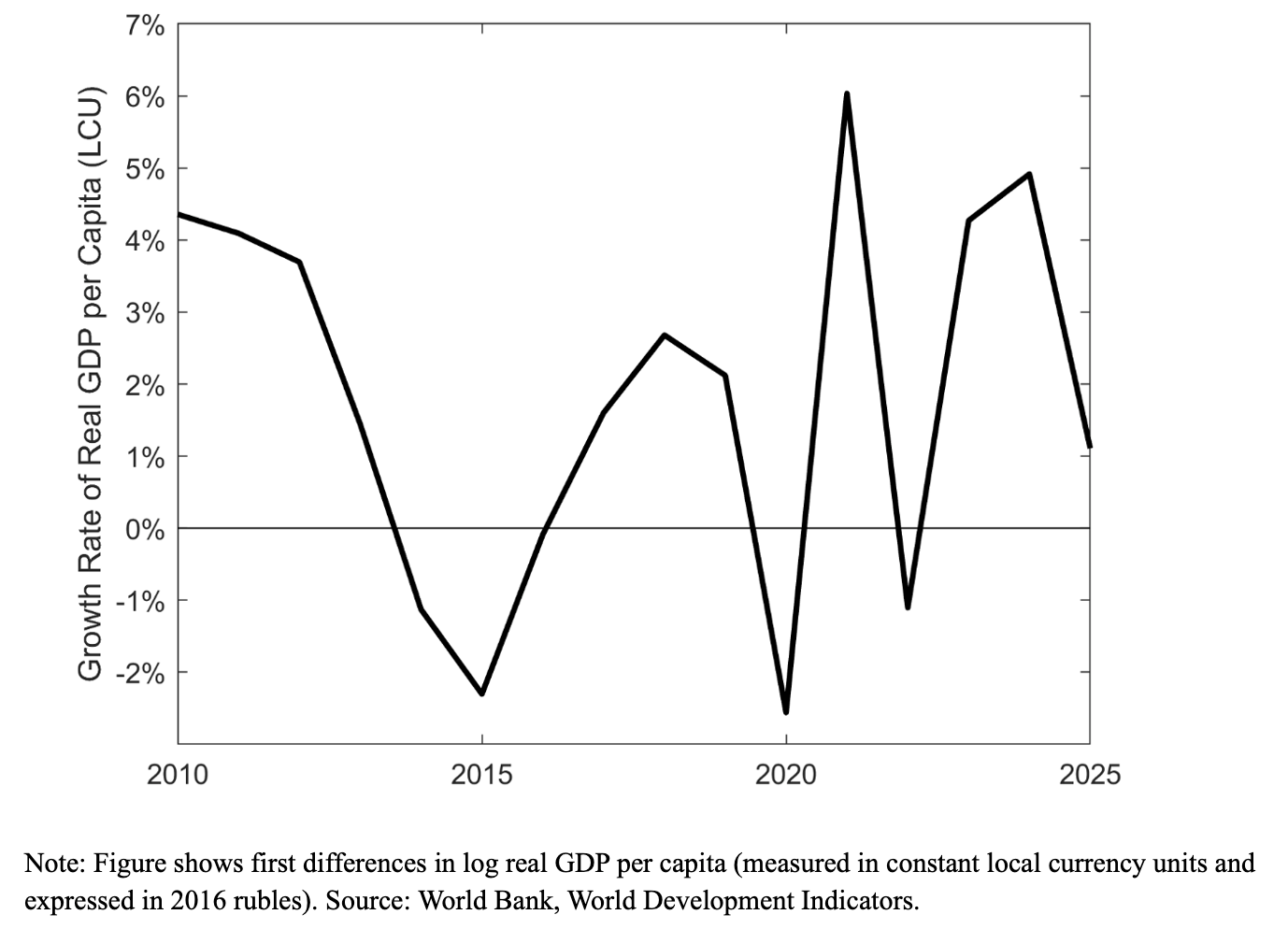
The following Figure shows Russia’s real GDP per capita growth rate over time. It would be asking too much of such a graph to provide conclusive evidence of the effectiveness of the sanctions on Russia—many confounding factors contribute to the pattern shown, not least among them a massive fiscal expansion throughout 2023 and 2024 to sustain the prolonged war effort. Nevertheless, it is noteworthy that, in a generally rather volatile environment, the Russian economy shrank in 2022, at the beginning of the full-scale invasion, expanded strongly in subsequent years, and more recently has appeared unable to sustain strong growth despite continued wartime fiscal stimulus.
The path of Russian real GDP per capita is—as of today—at least consistent with initial damage wrought by the sanctions, subsequent easing of that damage through the power of substitution, and more recent difficulties in maintaining growth, perhaps due to the longer-run corrosive effects of the trade sanctions imposed on Russia.
More intense sanctions
In conclusion, it is important to understand that the power of substitution works both ways. This means that import sanctions are less deleterious for the sanctioning country’s own economy than conventional wisdom and many politicians might suggest. Conversely, export sanctions imposed on an adversarial country can often be circumvented and generally made less potent over time. Here, politicians and commentators appear to split into two camps.
As with import sanctions, some underestimate the power of substitution and, therefore, overestimate the damage that can be done with export sanctions. However, there is also often a second camp that purports double doomerism: no substitution at home and strong substitution at the hands of the enemy. To make export sanctions more effective, perhaps the “boiling the frog” strategy pursued by the European Union, most likely due to the aforementioned disunity and, thus, out of political necessity, should be abandoned in favor of an initial “all in” approach. This would include broad import and export bans, as well as secondary sanctions on third countries, to prevent circumvention and trade rerouting.
This may be politically challenging, but an initial maximalist approach would demonstrate the sanctioning party’s commitment and could leave the sanctioned party with an easier offramp from a foolhardy war endeavor. In any case, trade sanctions alone are unlikely to win a war if they are not accompanied by equally massive and decisive military aid, something which Russia’s Western adversaries have fallen short of for far too long.
Rüdiger Bachmann is a professor of economics at the University of Michigan. He is a research fellow at the Centre for Economic Policy Research (CEPR), a research fellow of the CESifo research network, an IZA research fellow, and an external research professor at the ifo Institute in Munich.