 Powered by

A break in US-China economic relations would be costly for the United States, but the size of the cost depends crucially on how the break occurs. We estimate that a gradual, predictable decoupling, one that gives firms and households time to find substitutes, will reduce long-run US consumption by roughly 0.6 percent. A sudden and unexpected rupture is much more costly, especially if paired with price controls and rationing.
The cost of decoupling depends mainly on two things: how much the United States buys from China, and how easily American firms and consumers can replace those imports. The latter is measured by the trade elasticity. A high elasticity means substitution is easy; a low elasticity means substitution is hard. Since finding substitutes takes time, a gradual decoupling is far less costly than a sudden break. We find that a gradual decoupling lowers US consumption by around 0.3 percent in the short run and by 0.6 percent in the long run.
The long-run effects can be larger because China supplies not only consumer goods but also machinery, equipment, parts, and other goods that help US firms invest. Losing access to those goods makes it more expensive to build and maintain productive capacity, and part of the cost shows up over time as lower wages.

An important driver for these modest effects is that, to some extent, decoupling has already been under way since 2018. China’s share of total US imports peaked in 2018 at just over 20 percent and has been declining ever since. As of 2025, only around 7 percent of US imports come from China.
Although aggregate losses are modest, the costs are not borne uniformly by all households. Therefore, managing the costs of decoupling must also reckon with the uneven distributional consequences. However, as with the aggregate effect, the uneven burden is also likely to be helped by having a slow and predictable path toward decoupling, to give households and businesses time to rearrange their affairs and reduce their exposure.
What determines the cost?
To estimate the aggregate cost of a break in US-China relations, we ask, “How much would US households be willing to pay to avoid losing access to Chinese goods and services?” The key object we need to answer this question is the demand curve of US imports for Chinese goods and services. Examples are illustrated below in Figure 1.
As the price of Chinese imports rises, the quantity Americans purchase declines. The value of each unit purchased is given by its price, so the total value to consumers from access to Chinese imports is the area under the demand curve, shaded in blue. This adds up the value for all consumers across all units of each good imported into the United States from China.
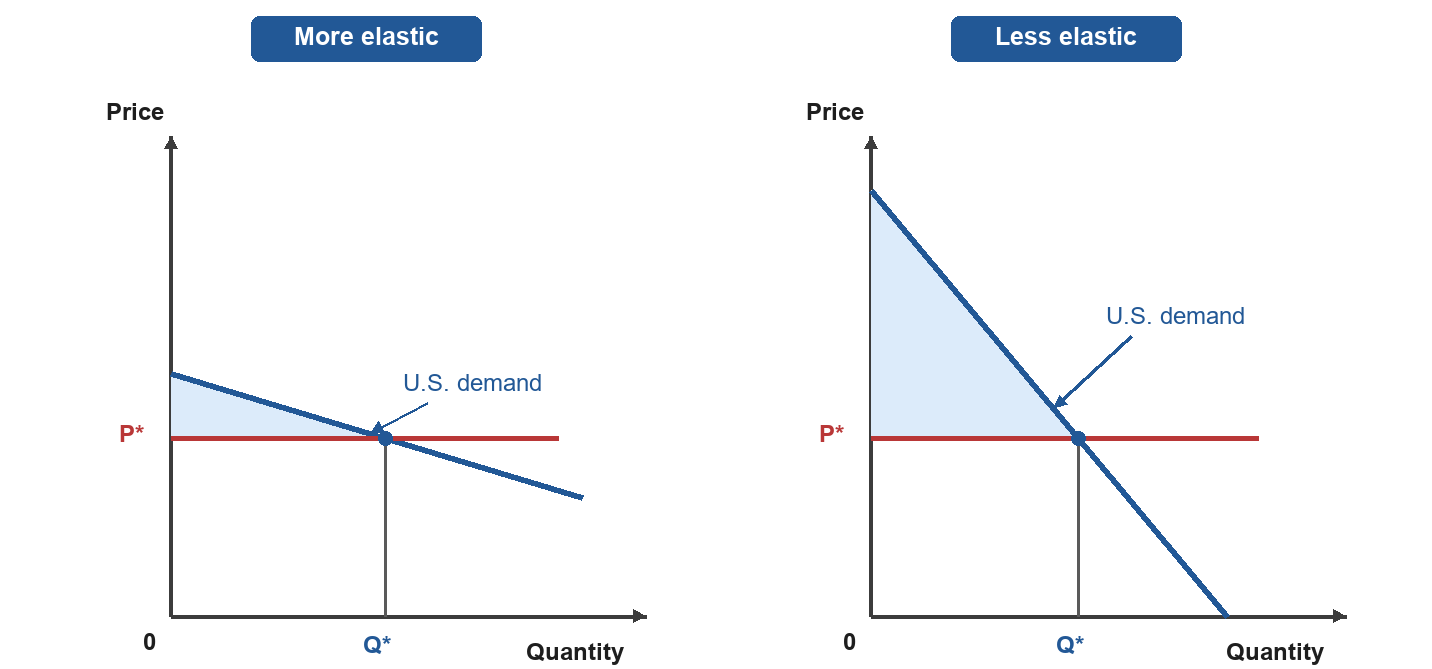

The area under the demand curve, and accordingly the aggregate losses from a Chinese decoupling, depend on the shape of this demand curve—principally on total expenditures and its slope. In economist jargon, these determine its elasticity. The more inelastic the demand curve, the greater are the losses from losing access to a good.
The figure makes the basic point: when Chinese goods are easy to replace (demand is more elastic), the loss from losing them is small; when they are hard to replace (demand is less elastic), the loss is larger. The same logic also means that exposure matters. If the United States buys less from China to begin with, holding the slope of the line constant, the cost of decoupling is smaller.
Economists have a useful rule of thumb for measuring the economic losses due to ending trade with a particular country, say China. That formula is:

In plain English: losses are larger when the United States buys a lot from China and when those imports are hard to replace.
The numerator is relatively easy to measure: it is the value of US purchases from China relative to US consumption. The denominator, the trade elasticity, is harder. It depends not just on how easily American consumers and firms can replace Chinese goods with goods made in the United States or in other countries, but also on how easily workers, equipment, land, and materials can move into new uses and across supply chains.
When prices are allowed to adjust, they send signals about where goods are most scarce and where substitutes are most needed. Resources can then move toward those uses, making the economy more flexible and raising the relevant trade elasticity. If prices are controlled or goods are rationed, those signals are weakened, adjustment is slower and more wasteful, and the losses from decoupling can be much larger.
Applying the simple formula
As discussed above, to a rough approximation, the aggregate losses from ending trade with China depend primarily on (1) expenditures on Chinese imports and (2) the trade elasticity.
Figure 2 plots expenditures on Chinese imports relative to US personal consumption expenditures. This number rose from 1.5 percent in 2000, before China joined the World Trade Organization, and peaked in 2014 at 4.1 percent. Starting in 2018, this number fell rapidly from 4.0 percent back to around 1.6 percent by 2025. Hence, according to our simple formula above, if we hold the trade elasticity fixed, then the losses from decoupling today are 40 percent of what they would have been compared to 2018.
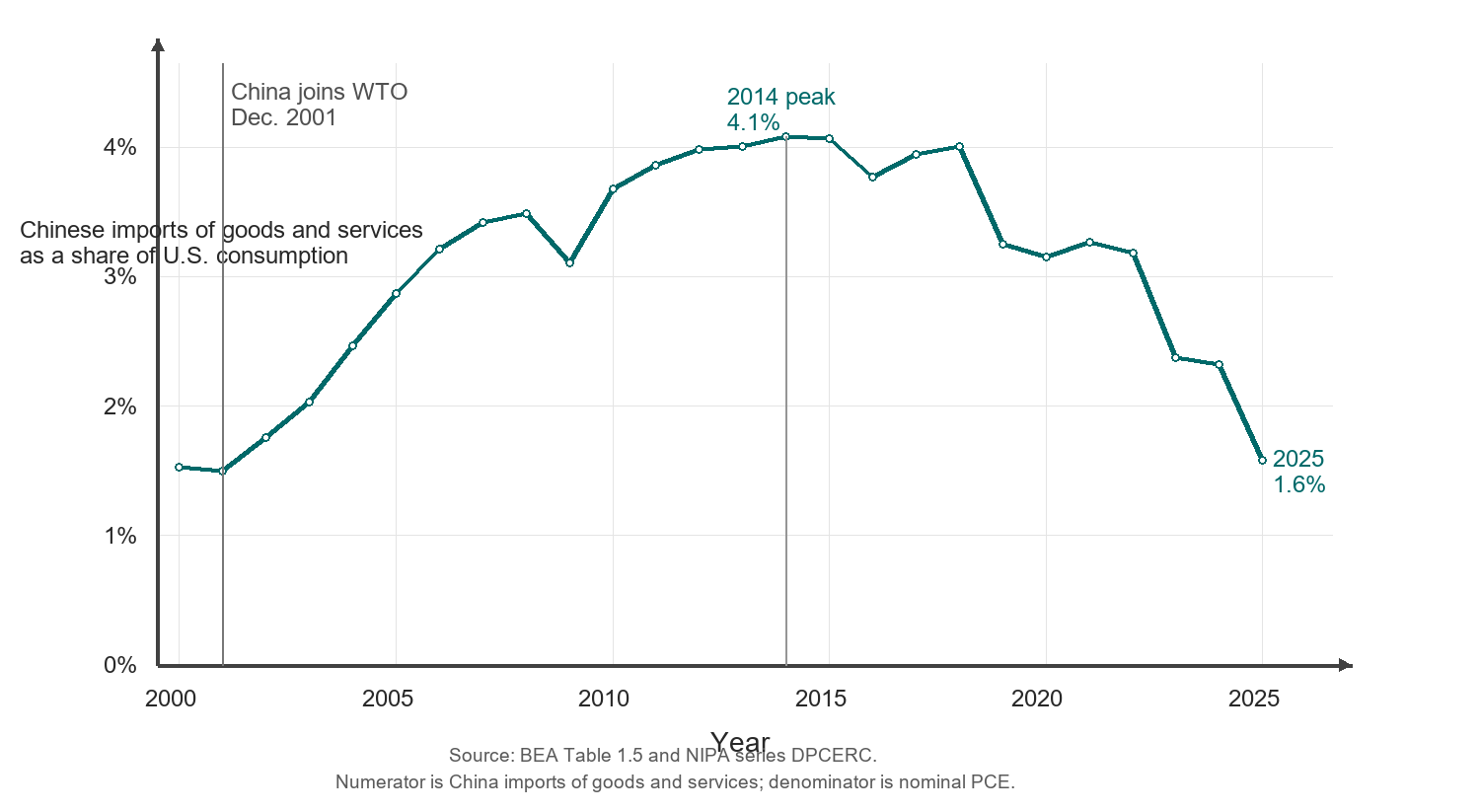

What caused the reduction in imports from China during this time? An obvious culprit is the set of tariffs imposed by the US on imports from China, which came into effect in mid-2018. The average US tariff rate on Chinese goods rose from around 5 percent in 2017 to 25 percent in 2020 (see Trade War Tracker). So, an increase of the average tariff from 5 percent to 25 percent coincided with a reduction in Chinese imports, relative to consumption, from 4 percent to around 1.5 percent. The trade elasticity can be computed using this rate of change. A back-of-the-envelope calculation suggests that the trade elasticity over this horizon was around four. (This decline is broadly consistent with the long-run elasticities used by trade economists.)
This back-of-the-envelope analysis is also consistent with more rigorous empirical evidence. For example, Fajgelbaum and Khandelwal use an event-study approach to study the effectiveness of tariffs in reducing Chinese imports. They find strong evidence that imports fell more for Chinese products facing higher tariffs.
Estimates of the trade elasticity depend on time horizons. In the short run, trade elasticities tend to be much lower than in the long run. On the short end, at the monthly horizon, trade elasticities tend to be close to zero. Over the long run, they rise to be higher and closer to around four. (See Figure 1 from this technical report.)
Hence, assuming a trade elasticity of four, our rule of thumb formula suggests that a gradual decoupling should reduce US consumption by around 1.5 percent divided by 4, or approximately 0.4 percent.
A fuller estimate
The simple formula gives a rough and basic intuition. To go further, we carry out a fuller and more precise analysis using a quantitative model of the world economy developed in a recent technical report. We consider both a gradual and a sudden decoupling scenario. In the gradual scenario, we use a microeconomic trade elasticity of four—which corresponds to an orderly and slow-moving decoupling, consistent with long-run estimates of the trade elasticity. We then consider a sudden decoupling scenario, where we use a trade elasticity value of 0.5—corresponding to a more disordered and rapid decoupling, operating at the scale of months rather than years.
The gradual decoupling scenario
We consider the following decoupling scenario: trade barriers are erected between the United States and China and these trade barriers are high enough that the volume of trade between the two countries falls to zero. Trade barriers with third parties are left unchanged.
We show how consumption responds in the short run, where the capital stock is held constant, and in the long run, where the capital stock adjusts due to depreciation and changes in investment rates.
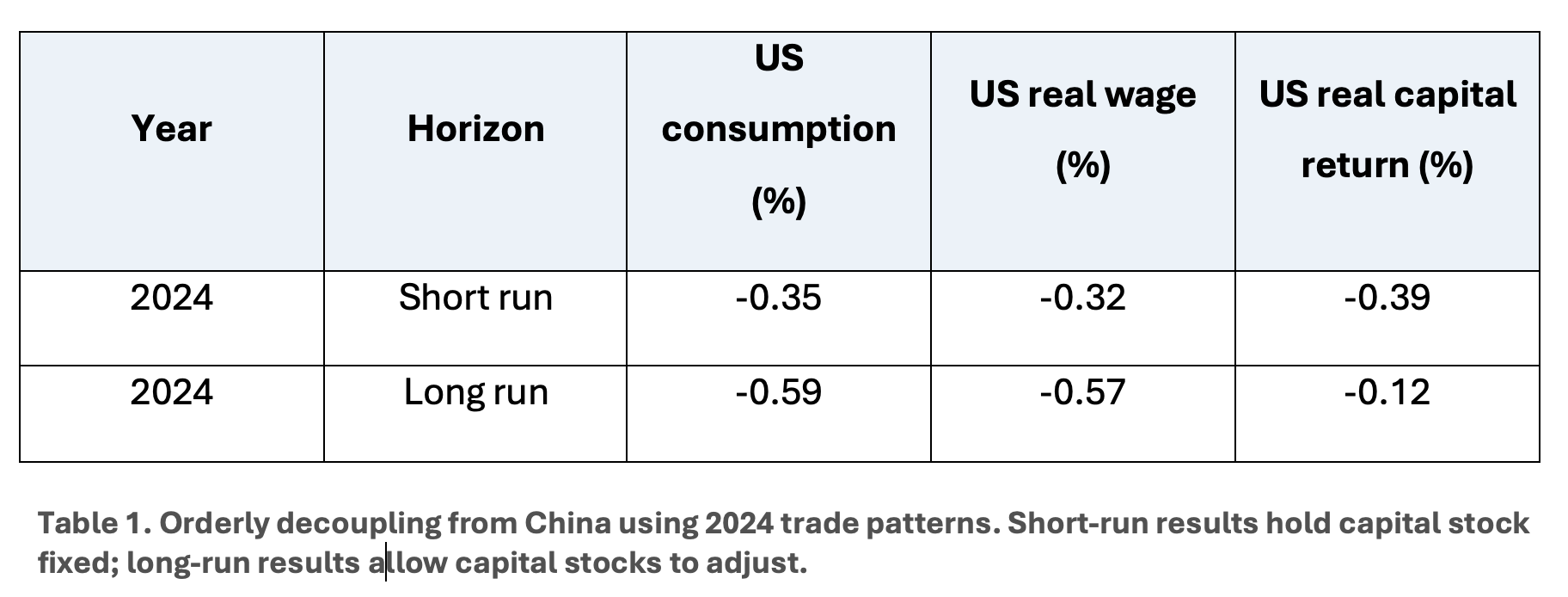
Table 1 shows that orderly decoupling using 2024 trade patterns has modest aggregate effects. US consumption falls by 0.35 percent in the short run and 0.59 percent in the long run. The long-run loss is larger because higher investment costs gradually reduce US productive capacity. Most of that burden ultimately appears as lower real wages.
The sudden decoupling scenario
We now consider a more sudden and disorderly decoupling in which US-China trade is eliminated over months rather than years. We capture this by using a low trade elasticity of 0.5, corresponding to limited short-run substitutability away from Chinese goods. Since this is a short-run exercise, and capital stocks adjust slowly, we hold the capital stock fixed.
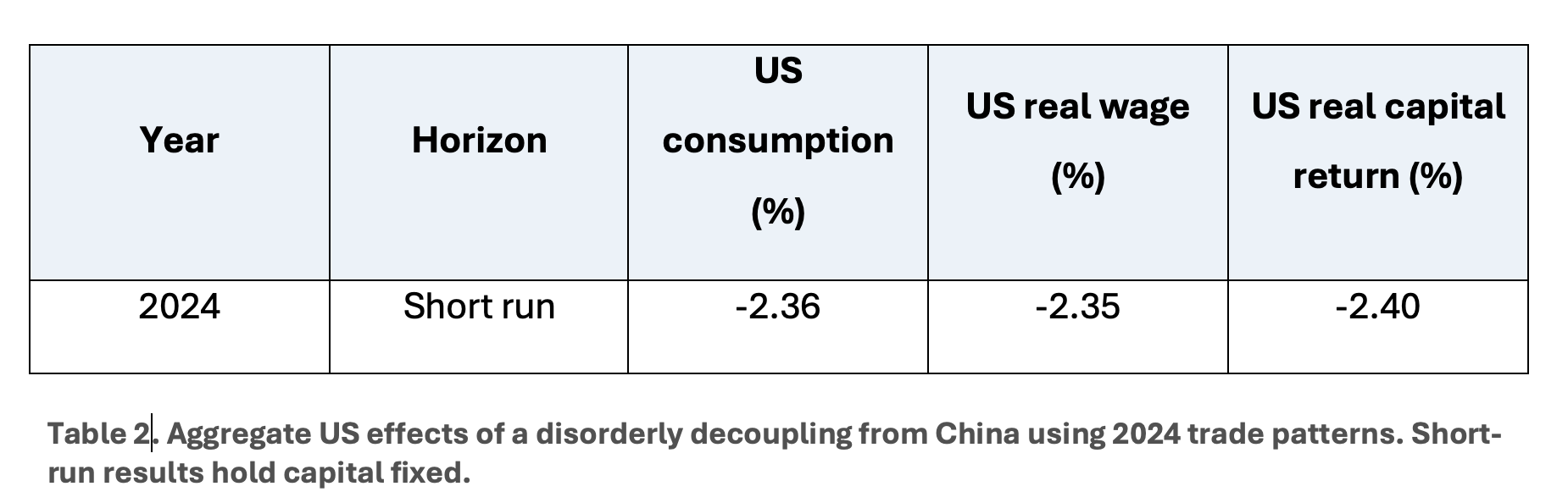
Table 2 shows that the short-run costs of a sudden decoupling are several times larger, and consumption drops by around 2.4 percent. Although these losses are much larger, they are still far from catastrophic. To put the number into context, a loss of 2.4 percent is roughly comparable to losing one to two years of normal consumption growth. Moreover, these losses shrink over time as households and firms have time to adjust their plans and behavior.
The difference a decade makes
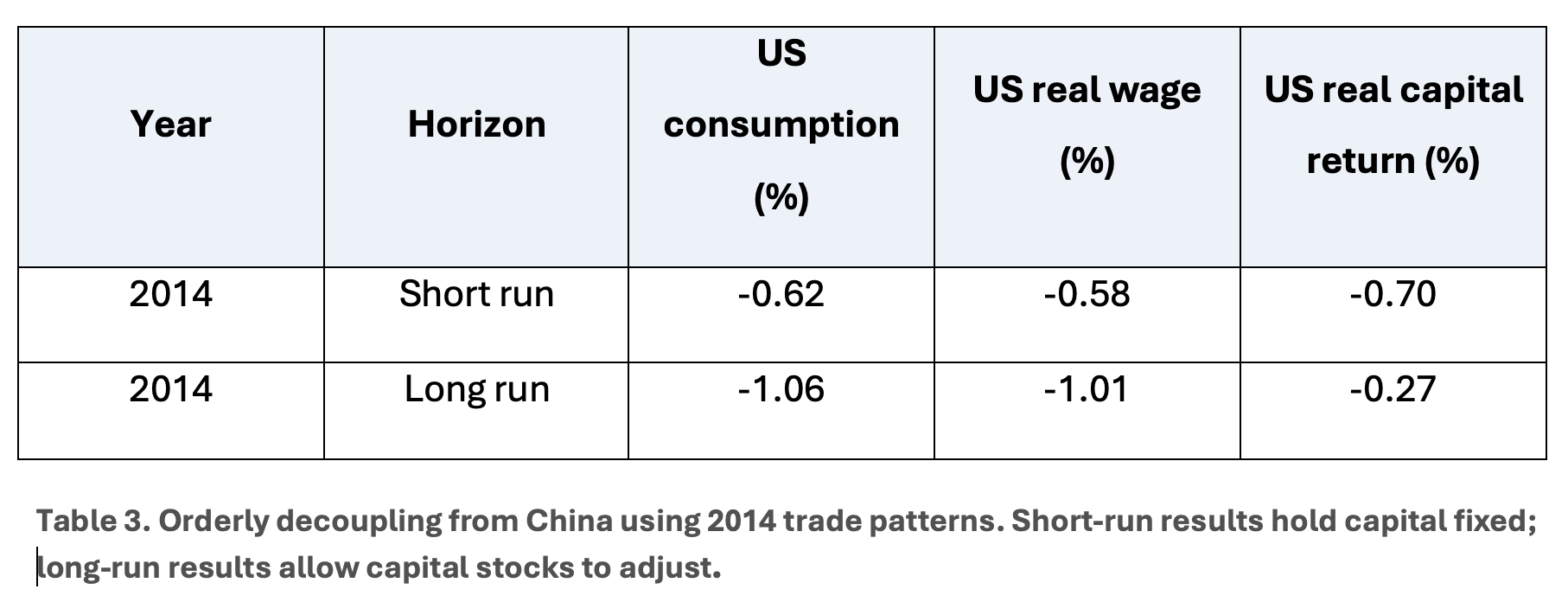
We validate the idea that lower trade volumes reduce the cost of decoupling using the model. In Table 3, we calibrate the model to match trade flows in 2014 instead of 2024. Using 2014 trade patterns, the costs of an orderly decoupling are nearly double those in the corresponding 2024 scenario. This reflects the greater importance of Chinese imports before the recent decline in US-China trade exposure.
Third-country effects and rerouting
Our baseline estimates consider direct US-China trade. A stricter version of decoupling would also block goods that reach the United States through third countries but contain Chinese inputs. This makes substitution harder, since Chinese goods cannot be rerouted through third countries. In our model, adding this stricter rule raises the long-run US consumption loss from 0.59 percent to 0.73 percent. The cost rises meaningfully, but the broad conclusion remains the same: a gradual decoupling, with prices allowed to adjust, is costly but not catastrophic.
A related caveat is that we model decoupling as a bilateral US-China shock. If China were also cut off from other major markets, US firms might face less competition from Chinese exporters in third-country markets. This could partly offset the losses from reduced access to Chinese goods and inputs. Hence, a broader multilateral decoupling from China need not be uniformly more costly for the United States than a purely bilateral one, even though it would represent a much larger disruption to the world economy.
Caveats and other dimensions
We close with some caveats about the main analysis.
Disorderly decoupling
Throughout our analysis, including in the sudden decoupling case, we maintain the assumption that prices are allowed to adjust and that goods are allocated through markets. If prices are controlled and goods are rationed, losses can be much larger. In this case, firms and households lose the signals that tell them where goods are most scarce and the incentives to adjust their behavior. See, for example, this technical paper for a theoretical analysis of how fixed prices and rationing can, at least in theory, result in catastrophic magnification of supply shocks. In a similar vein, we do not model the consequences of a financial crisis and ensuing business-cycle type recession that may be triggered by decoupling. Once again, if decoupling is gradual and predictable, then the chance that it triggers a financial crisis is much lower.
Uneven burden
Although our analysis explicitly accounts for the uneven effects of decoupling on labor and capital, we do not dig into the effects at the industry or regional level. Similarly, our aggregate estimates do not take into account the fact that different households consume different baskets of goods. In particular, low-income households spend a greater share of their expenditures on imports from China than high-income households. Although these effects are real, and must be reckoned with, the fact that the aggregate effects of an orderly decoupling are fairly mild gives scope for public policy to respond to its uneven incidence across households through social insurance.
Linkages through capital and labor markets
Our analysis focuses on China-US goods and services trade, neglecting the flow of financial assets and labor across the two countries. These channels matter, but their inclusion is unlikely to overturn the main estimates. Chinese direct investment in the United States is less than 1 percent of total foreign-owned direct investment, and China’s Treasury holdings amount to only about 2 percent of the Treasury market (see here and here). This suggests that US exposure to Chinese asset demand is modest.
Similarly, decoupling could also reduce migration from China. In 2024, according to the American Community Survey, people born in China accounted for about 5 percent of foreign-born new arrivals to the United States. Losing these migrants would be costly, especially because many are highly skilled and contribute to innovation and research. But those costs would mostly be felt over a longer horizon, through slower growth in knowledge and innovation, and are unlikely to change our assessment of the short- and medium-term costs of decoupling.
Tariff revenues
Our analysis also does not take into account the costs associated with lost tariff revenues in the event of decoupling. In 2024, the year we calibrate our model to, this was roughly 0.2 percent of US consumption expenditures. After the latest increase in tariffs, these revenues rose substantially. Our experiment can be thought of as an exercise where these tariffs are increased until trade between the two countries is eliminated. In this limit, the tariffs generate no revenues since there is no trade taking place.
Essential imports
By using a trade elasticity of four for orderly decoupling, our analysis does not allow for industries where non-Chinese alternatives are much less productive even in the long run. Rare earths are a much-discussed risk: they are essential for electric motors and defense systems, and China dominates downstream processing. The United States has substantial rare earth ores, but the ultimate cost disadvantage of building a productive downstream sector outside China is unknown.
Conclusion
Decoupling from China would impose real costs on the United States, but our estimates suggest that those costs need not be catastrophic. The key condition is that the process be gradual, predictable, and mediated by prices rather than rationing or emergency controls. Direct US reliance on Chinese imports has already fallen substantially from its earlier peak, which reduces the estimated cost of further decoupling. Gradual de-risking, coupled with flexible prices, has another benefit: it gives policymakers an opportunity to learn about which industries or goods are unusually important. Rapid price increases after a policy change are a warning sign: they reveal goods or industries where substitution is difficult and where policymakers should proceed carefully.

The burden of decoupling would also fall unevenly among workers, capital owners, industries, and households. A sensible de-risking strategy gives time for consumers and firms to rearrange their plans and behavior, allows prices to adjust and guide the reallocation of resources, and provides support for households and industries that bear the largest losses.
David Baqaee is a professor of economics at UCLA and a research fellow of the Centre for Economic Policy Research (CEPR) and a research affiliate of the National Bureau of Economic Research.
Hannes Malmberg is an assistant professor in the Department of Economics at the University of Minnesota