 Powered by
The United States dollar occupies a singular position in the global economy. For nearly eight decades since the Bretton Woods Conference, it has served as the world’s primary reserve currency—the unit of account for international trade, the preferred store of value for central banks, private banks and investors, and the safe haven asset that investors flee to when global panic is at its most acute. This status confers benefits on the United States: lower borrowing costs and what French finance minister Valéry Giscard d’Estaing famously called the “exorbitant privilege,” a concept I will explain below.

But what would happen if this status were to erode? If the rest of the world gradually ceased to demand dollar-denominated safe assets as the foundation of their reserve holdings and cross-border financial activity, what would be the macroeconomic consequences for the United States?
These are the questions at the heart of my work with Zhengyang Jiang, Hanno Lustig, and Rob Richmond (2026). The global financial architecture is under more scrutiny than at any point since the 1970s. Geopolitical fragmentation, the weaponization of dollar payment systems through sanctions, the rise of bilateral currency arrangements among BRICS economies, and the erosion of US institutional credibility have all prompted analysts to ask whether the dollar’s reserve currency status is more fragile than it appears.
This essay lays out the analytical framework for thinking through this question—what dollar dominance actually consists of, how it is priced in financial markets, what a macroeconomics model says about the costs and long-run consequences of its loss.
The dollar’s special role: safe asset exporter
A useful starting point is an analogy. Taiwan exports semiconductors to the rest of the world. The United States exports “safe dollar debt.” Just as Taiwan’s comparative advantage in chip fabrication generates export revenue and shapes its trade balance, the United States’ comparative advantage in producing globally trusted dollar safe assets generates a different kind of export revenue—the seigniorage generated by the “convenience yield” that foreign holders of dollar assets are willing to forgo in return for the advantages these dollar assets offer.
The scale of dollar dominance in global finance is striking. In cross-border banking, the Bank of International Settlement (BIS) data estimates that dollar-denominated assets held by banks residing outside the United States in 2024 amount to roughly $18 trillion, dwarfing the equivalent figures for the euro ($6 trillion) and yen ($300 billion). In international bond markets, corporations and governments around the world overwhelmingly issue debt in dollars rather than their own or any other currency. And at the official level, foreign central banks hold the bulk of their trillions of dollars’ worth of foreign exchange reserves in dollar-denominated instruments—such as US Treasury securities and agency debt. When the Bank of Mexico, or Bank Indonesia, or the Saudi Central Bank (SAMA) holds “dollar reserves,” what it actually holds is a claim on dollar-denominated bonds.
The dollar’s reserve currency status is, at its core, a story about the global demand for safe dollar debt.
This demand has a measurable price. On an apples-to-apples basis—adjusting for differences in interest rates and taking into account exchange rate risk—a high-grade borrower (whether a firm, a government, or a bank) that issues debt in dollars borrows at roughly 1–2 percentage points lower interest cost than the equivalent borrowing in euros or other major currencies (see Jiang et al., 2021). This is the convenience yield: the premium that global investors are willing to pay, expressed as a yield discount, for the safety and liquidity services embedded in dollar-denominated safe assets. It is not a small number. At scale, it represents a substantial ongoing transfer from the rest of the world to US borrowers. This is what Valéry Giscard d’Estaing called the “exorbitant privilege” of the United States.
Flight to safety and the dollar
One of the most distinctive and theoretically important features of the dollar’s reserve currency status is that it is strongest precisely when it is most needed: during financial panics and global crises. This is the opposite of what simple interest rate parity would predict for a normal currency. Ordinarily, when a country’s interest rates fall, its currency tends to depreciate, as capital seeks higher returns elsewhere. The dollar systematically violates this pattern during financial panics.
During the Global Financial Crisis of 2008 and again during the COVID-19 shock of March 2020, the dollar appreciated sharply even as US interest rates plunged toward zero. Global investors, in their panic, did not flee the dollar—they fled to it. This flight-to-safety dynamic reflects the fact that dollar Treasuries and other high-grade dollar assets function as the global financial system’s collateral backbone. When uncertainty spikes and balance sheets need to be deleveraged, the asset everyone wants is the one that investors view as the safest, can be used to settle obligations, and post as collateral across the widest range of counterparties and jurisdictions. That asset is, and has been for decades, the US Treasury bond.
This countercyclical property is central to what makes the convenience yield on dollar assets so persistent and valuable. It is not simply that dollar assets pay a lower yield in normal times; it is that they pay an insurance premium—they appreciate in value and provide liquidity exactly when liquidity is most scarce. Foreign investors are willing to hold dollar assets at lower yields in part because of this insurance property. The corollary is also important: a loss of the dollar’s safe haven function reduces the convenience yield both in calm times and during panics. The dollar then becomes just like any other currency.
Quantifying the effects
To move from qualitative description to quantitative assessment, one needs a model. The framework developed by Jiang, Krishnamurthy, Lustig, and Richmond (2026) is a two-country macroeconomic model. The key feature is that foreign investors derive extra benefits from holding dollar-denominated safe assets—both public (Treasuries and agency debt) and private (high-grade corporate bonds, bank debt)—beyond the financial return those assets generate. This specification captures the idea that dollar assets provide safety, liquidity, and collateral services that are not priced purely through expected returns.
The model is calibrated to the US situation in 2016, which includes a total stock of safe bonds equal to roughly 150 percent of US GDP, with 30 percent of those bonds held by foreign investors and a convenience yield of 2 percent on dollar safe assets. The question the model answers is: what is the new macroeconomic equilibrium if the rest of the world’s preference for dollar safe assets falls to zero—that is, if the dollar completely loses its reserve currency status?
The model implies three consequences from the loss of reserve currency status.
First, the dollar depreciates permanently by approximately 8.8 percent in real terms, eroding its purchasing power in international markets. The weaker dollar raises the price of imported goods for American consumers, prompting a reduction in imports while making US exports more competitive abroad. The result is a rebalancing of trade: foreign demand for American goods rises as domestic demand for foreign goods falls.
Second, US dollar interest rates rise by roughly 90 basis points. The increase passes through to borrowing costs throughout the economy—raising mortgage rates for households and debt-service costs for the federal government at a time when public debt stands at 100 percent of GDP.
Third, annual seigniorage revenue—the implicit subsidy the United States receives when foreigners hold its debt at below-market yields—falls from roughly 1.04 percent of GDP to zero. This loss of revenue is the end of the “exorbitant privilege” that the United States has enjoyed as the world’s reserve currency.
The mechanism
Understanding these magnitudes requires tracing through the macroeconomic mechanism. Figure 1 describes the main elements of this mechanism. We can think of the seigniorage revenue that the United States receives as an “export” of liquidity services, even though they are not counted as exports under trade balance accounting conventions. Then the trade account includes, as usual, imports and exports of goods and services from the rest of the world (RoW in the figure), plus the revenue from the additional export of liquidity services. See Panel A of the figure.
Now if the US dollar is no longer the reserve currency, the export of liquidity services goes to zero. In this case, imports must fall/exports must rise. Panel B in the lower left of Figure 1 graphs the trade balance in goods and services as a function of the strength of the dollar. A stronger dollar leads to more imports relative to exports; i.e., a worse trade deficit. Now if the United States loses the export of liquidity services, the trade balance has to adjust. The dollar depreciates to reduce imports and increase exports. The magnitude of this adjustment depends on both the quantity of liquidity services and the slope of the orange line in Panel B. That slope is closely related to what international trade economists refer to as the “trade elasticity,” which is a well-studied object. Our computation is based on estimates of the long-run trade elasticity from research in international trade.
Figure 1: US Bond and Currency Market Equilibrium
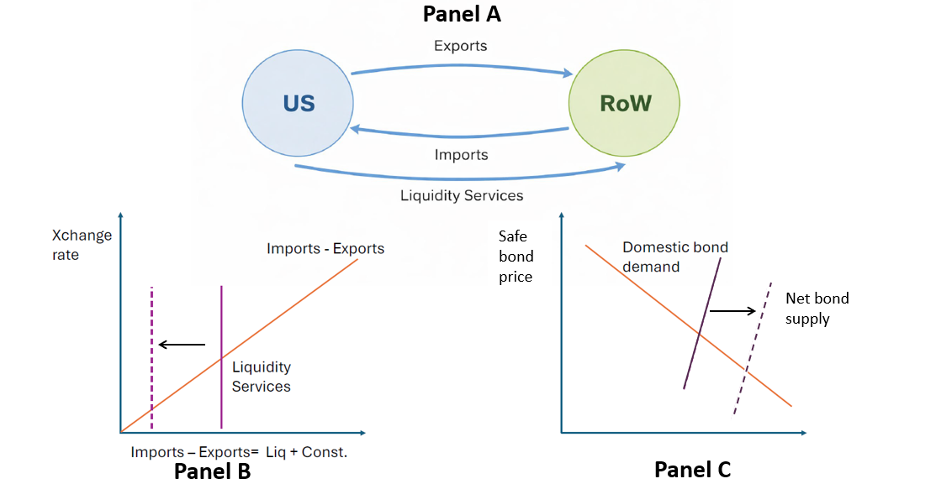
The interest rate channel operates separately. When foreigners no longer have a special demand for dollar bonds, the roughly 45 percent of GDP worth of dollar safe assets previously held abroad has to be absorbed by domestic US investors. This requires a higher real interest rate—estimated at about 90 basis points—to induce US households to hold more bonds in their portfolios. This is the supply-demand logic of the bond market: a large buyer (the rest of the world) exits, and prices have to fall (yields have to rise) to bring domestic buyers in. As illustrated in Panel C of the figure, this sale will cause the net bond supply to rise, leading US bond prices to fall. The magnitude of this increase will depend on the slope of the orange line, which is the bond demand elasticity. We use estimates of this slope from Krishnamurthy and Vissing-Jorgensen (2012).
Present value of lost seigniorage
The steady-state flow effects—1.04 percent of GDP per year in lost seigniorage, 90 basis points higher interest rates—are significant. But a full accounting of the welfare and asset price consequences requires capitalizing these flow losses into present values. This exercise, which applies standard valuation methods to the seigniorage stream, produces numbers that are large enough to reframe the policy debate.
The seigniorage loss is a stream of risky cash flows that grows and fluctuates with the economy. To value it appropriately, we need to account for long-run growth, the time value of money, and the risky nature of seigniorage cash flows. I assume a long-run real growth rate of 1.8 percent per year. Using a standard discount rate model that accounts for the risk of these cash flows, I find that the annual seigniorage loss of 1.04 percent of GDP equates to a present value of roughly 107 percent of GDP—on the order of $33 trillion at current US GDP levels.
This is not a narrow financial calculation. It has implications for asset prices across the economy. The franchise value of US financial institutions—banks, which are significant private producers of safe dollar assets—is partly a function of the convenience yield premium they can charge on their liabilities. A permanent reduction in the convenience yield reduces this franchise value. Collateral asset values, including housing, are also affected to the extent that US household wealth is partly a function of the United States’ privileged position in the global financial system. And the loss of reserve currency status would lead to higher debt service costs on the government’s outstanding liabilities.
Implications and policy relevance
A central policy objective of the current administration is a weaker dollar, motivated in part by the goal of revitalizing the US manufacturing sector. Our analysis confirms that the loss of reserve currency status would indeed weaken the dollar—but the magnitude of this effect is modest, on the order of an 8.8 percent real depreciation. Moreover, this depreciation comes at a direct cost to American households through higher prices on imported goods, which erodes purchasing power.
The more substantial cost manifests in interest rates. The loss of reserve currency status would raise real US interest rates by approximately 90 basis points. To place this figure in perspective, at a debt-to-GDP ratio of 100 percent, a 90 basis point increase in the real interest rate adds roughly 0.9 percent of GDP to the annual deficit. By way of comparison, the entire US defense budget amounts to approximately 3.3 percent of GDP. Capitalizing this permanent flow loss yields a total cost to the US economy on the order of $33 trillion.
These are not modest costs.
The dollar’s reserve currency status is not merely a geopolitical trophy. It is a source of real economic value — lower borrowing costs, a persistent seigniorage transfer from the rest of the world, a stronger real exchange rate, and asset valuations that embed the expectation of continued US dominance in global safe asset production.

Recent data show that the measured convenience yields on US Treasuries have declined. Foreign official holdings of US public debt have fallen as a share of the total. Geopolitical fragmentation, the weaponization of dollar payment systems through sanctions, the rise of bilateral currency arrangements among BRICS economies, and the erosion of US institutional credibility have all intensified pressure on the reserve currency status of the dollar.
This does not mean that dollar dominance is about to collapse—the network externalities of the dollar system are deep and the alternatives remain underdeveloped. But the direction of travel, and the magnitude of what is at stake, argue for taking the question seriously.
The dollar’s “exorbitant privilege” has always been underappreciated in tranquil times. The risk is that its erosion will be underappreciated too, until it is not.
Arvind Krishnamurthy is the John S. Osterweis Professor of Finance at Stanford University and a senior fellow at the Stanford Institute of Economic Policy Research (SIEPR).