 Powered by
This article is part of Liberty Amplified, a series produced in partnership with the Hoover Institution’s Human Security Project and the Hoover Institution Library & Archives, featuring voices that challenge authoritarianism in pursuit of freedom.
Imagine waking up to discover that your bank accounts have been blocked and your assets frozen. Shortly thereafter, you learn that your family’s private information, including banking, travel, and communication records, has been shared with a foreign government seeking to undermine your political freedoms or business activities. This mechanism is now a routine instrument of transnational repression, used by foreign regimes on US and European soil.
Hostile governments and their proxies have learned to turn democracies’ own defenses against them. The systems built to combat money laundering, terrorist financing, and cybercrime now double as tools for surveilling and silencing critics abroad. By manipulating these systems, hostile governments can target people and entities outside their territorial jurisdiction by converting politically motivated accusations into legal, intelligence, and compliance signals that democratic institutions usually treat as legitimate risk indicators.
Financial repression in action
One of the co-authors of this article, Lyudmyla Kozlovska, experienced this mechanism directly.
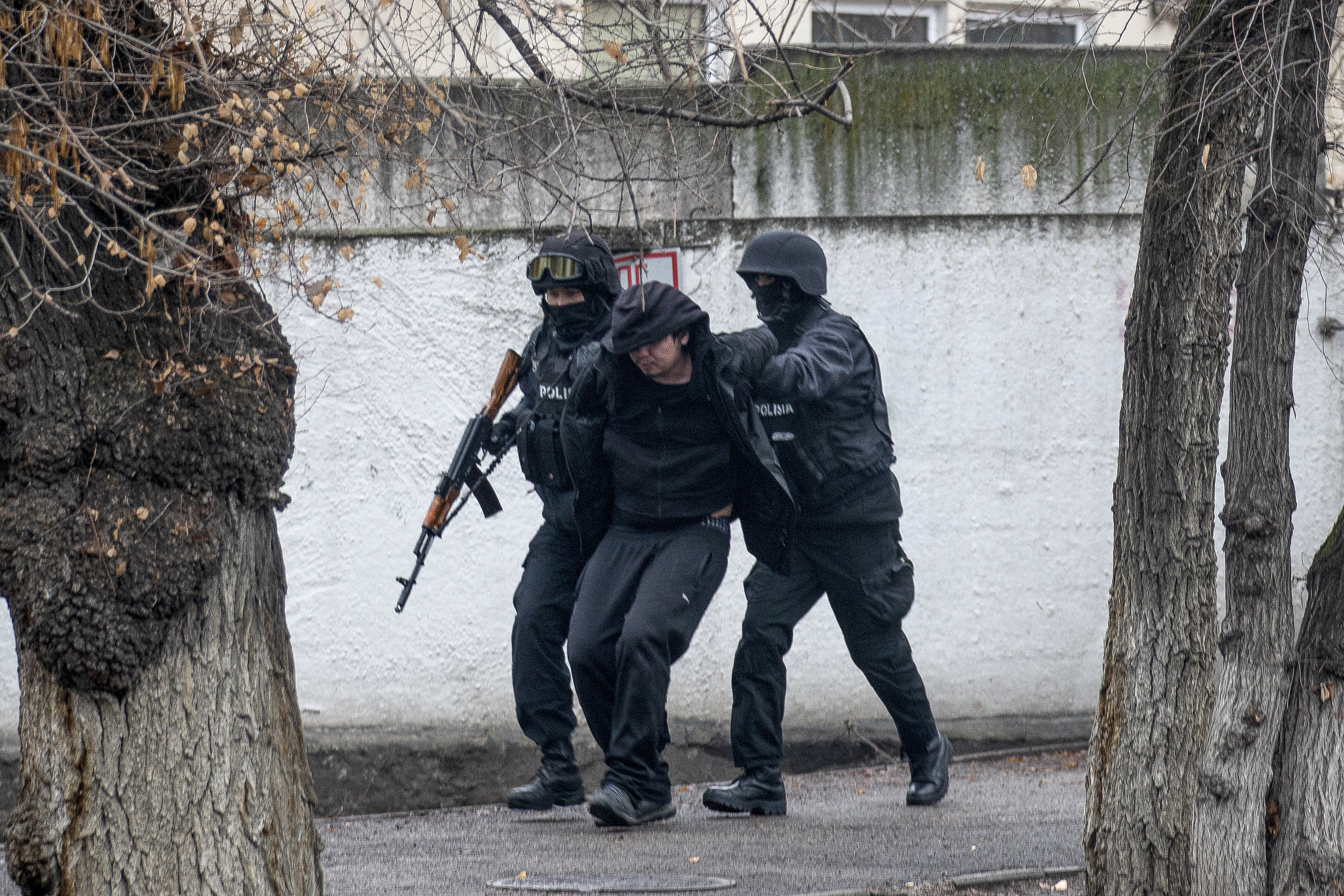
In 2022, Lyudmyla and her organization, the Open Dialogue Foundation (ODF), documented gross human rights violations, the mass shooting of peaceful protesters, and sanctions evasion by Kazakhstan. In response, the country’s security services orchestrated a criminal complaint in Belgium. Serving Kazakh police officers posed as private victims, in part under cover of representing their minor children, and accused Kozlovska and ODF of harassment, slander, and cyberbullying. The complaint demanded the removal of videos documenting the Kazakh officers’ alleged role in repression, torture, and killings.
The complaint was filed by Claude Moniquet, a former French intelligence officer whose firm, ESISC, had been examined in the Council of Europe’s “caviar diplomacy” investigation into Azerbaijan’s campaign to corrupt European parliamentarians. Moniquet’s involvement illustrates a broader pattern: the same proxy operators who served one authoritarian regime are available to others, creating a professional market for transnational repression on European soil.
On their face, the ODF charges were about reputation and the protection of the officers’ children. Their practical purpose was different. Through the Belgian proceedings the complainants sought an extensive body of private data on Kozlovska and ODF: passport records and travel history between Belgium and the United States, Schengen border crossings, whereabouts and hotel bills in Miami and Washington, bank-account movements and the sources funding her travel, and private e-mail correspondence. To do so, they invoked pretexts of “suspicious activity” and “customer due diligence,” weaponizing the very anti-money-laundering and cross-border cooperation mechanisms designed to combat financial crime.
The reach extends to the United States. Much of what the complainants sought through the Belgian court concerned Kozlovska’s activity on US soil. EU jurisdictions become the entry point through which authoritarian regimes obtain data on US persons.
Belgian courts dismissed the complaint at every stage. The investigating judge found that the requests appeared designed “to use Belgian justice to collect the maximum amount of personal and private data on Kozlovska for purposes other than simply establishing the truth,” and the Court of Appeal confirmed the dismissal in November 2025. Tellingly, the campaign was partly retaliation for ODF’s work documenting anti-money-laundering abuse—from Kazakhstan’s and Kyrgyzstan’s role in helping Russia evade sanctions to financial repression against dissidents. Those very mechanisms were then deployed against the organization itself.
In 2024, we coined the term transnational financial repression to explain this process of weaponizing international agreements with the purpose of targeting human rights activists, policymakers, journalists, donors, and businesspeople. Then, in 2026, Lyudmyla’s case was officially recognized by the Organization for Security and Co-operation in Europe (OSCE) as a case of transnational financial repression.
Her case is not isolated. It is part of a growing pattern in which legal-cooperation and financial-intelligence mechanisms originally designed to protect national security are repurposed to collect sensitive information about individuals and organizations operating lawfully within democratic societies. At the same time, pressure is applied to financial institutions, foundations, donors, and commercial partners to sever relationships with law-abiding individuals, organizations, and businesses.
How does this happen?
Transnational financial repression arises from the abuse of a series of trust-based international frameworks that were designed to enable rapid cooperation among democracies against serious transnational threats. These include, but are not limited to:
Anti-money-laundering and countering the financing of terrorism regimes (AML/CFT) based on the Financial Action Task Force (FATF) recommendations
Cybersecurity and data-access laws
Mutual legal assistance treaties (MLATs)
International law-enforcement cooperation mechanisms
Interpol Notices and Diffusion mechanisms.
In these frameworks, democracies take a trust-based approach to the intelligence and legal requests from other states. “Trust based” means democracies generally operate under the assumption that requests submitted by foreign authorities are made in good faith. As a result, these requests can move through legal, regulatory, intelligence-sharing, or financial channels without sufficient independent verification of the underlying evidence, the credibility of the requesting authority, or the political context behind the case.
Unfortunately, there is increasing evidence that numerous states are weaponizing this degree of interstate trust to repress people and organizations transnationally.
A lack of due-process safeguards facilitates the abuse of these frameworks. For instance, since crimes such as money laundering are complex, transnational, and difficult to detect in real time, the regulatory architecture designed to prevent them is based on the premise that enforcement cannot wait for the completion of formal judicial proceedings. As a result, international anti-money-laundering standards deliberately prioritize preventive and administrative measures. These standards allow states, whether democratic or autocratic, to trigger transnational enforcement actions without a prior court decision or full testing of the evidence.
While this design is intended to preserve effectiveness against genuine security threats, it also creates a legal environment where coercive measures can be initiated from unverified or politically motivated allegations, with limited procedural safeguards and delayed, costly, or ineffective avenues for challenge.
The threat of legal loopholes
Some policymakers have begun to recognize this phenomenon, but it remains largely absent from the analytical frameworks of most experts and institutions. Neither the United States nor other democracies have legal mechanisms to protect their people from transnational financial repression. This a loophole must be addressed by US and European governments alike, so they stop allowing foreign governments to distort their legal systems, undermine the integrity of the banking sector, exploit weaknesses in data protection and compliance regimes, and overall, compromise economic security.
These loopholes pose a national security threat to the United States in particular, as hostile states can use America’s financial, legal, and intelligence systems for illegitimate purposes. Foreign malicious governments could use legal assistance requests, financial intelligence exchanges, or cybersecurity investigations to obtain sensitive private information about people and companies in America. And this information can be weaponized.
Lyudmyla’s case illustrates precisely how legal-cooperation and financial-intelligence mechanisms can be repurposed to gather intelligence—and how even a complete legal victory does not prevent the underlying data demands from being made in the first place.
Jorge Jraissati is a Venezuelan economist and the president of the Economic Inclusion Group, an international policy organization focused on protecting people and entities from debanking risks, supporting countries with their economic security, and advancing the reconstruction of the Venezuelan economy.
Lyudmyla Kozlovska is president of the Open Dialogue Foundation and a leading civil society voice on transnational repression and the weaponization of financial and security tools, which she frames as a national security threat to Western states, not only a human rights concern.
Liberty Amplified features the voices of those who defy autocracy in pursuit of freedom. It is produced in partnership with the Hoover Institution’s Human Security Project and the Hoover Institution Library & Archives.