 Powered by

The multilateral trading system embodied in the World Trade Organization (WTO), devised under US leadership over the half century following World War II, is now unraveling. The United States has taken the lead in deviating from negotiated tariff ceilings and the most-favored-nation nondiscrimination principle. It has scuttled the WTO dispute-settlement system by refusing to allow confirmation of appellate judges. But problems at the WTO go well beyond US actions, as I will discuss.
In hindsight, the WTO’s predecessor—the General Agreement on Tariffs and Trade (GATT)—looks more robust. From 1947 to 1994, eight multilateral negotiating rounds occurred under GATT auspices, yielding lower tariffs and progress on nontariff trade barriers. The GATT culminated with the Uruguay Round of negotiations, which subsumed GATT commitments into the new WTO and added new commitments for trade in services and intellectual property. The WTO also brought a new and “binding” dispute settlement process. While hailed at the time, the Uruguay Round marked the last successful instance of large-scale multilateral negotiations.
What went wrong with the WTO? Why, in contrast, was the GATT able to make steady progress over nearly half a century?
The answers boil down to a few key factors. First, the GATT facilitated progress on new issue areas by allowing like-minded members to address them through side agreements that did not need to include the entire membership, while the WTO throws up roadblocks to such arrangements.
Second, the GATT emphasized diplomatic solutions to disputes among members over alleged breaches of the rules, while the WTO embraced greater legalization, with “binding” dispute resolution and rigid legal precedents that resisted change even when key players viewed the precedents as illegitimate.
Finally, throughout the GATT’s history, the important players were market economies. Its rules were designed to secure fair competitive opportunities for private sector firms. China played no role in GATT negotiating rounds after the Communist Revolution and did not accede to the WTO until 2001. Since then, China has become the world’s largest trading nation, with much of its economy driven by state industrial policies or state-owned enterprises (SOEs) that are not adequately addressed by existing rules. The challenges posed by China to national security interests in the West further complicate the problem.
The legislative function
GATT began with a focus on tariff cuts, but domestic protectionist pressures then spilled over onto other policy instruments. The original GATT did not do enough to prevent these other policies from undermining tariff commitments, and over time they proved increasingly problematic.
Starting in the 1960s, the GATT membership addressed many of these problems with various “Codes” or side agreements on subjects such as antidumping measures, subsidies and countervailing duties, technical standards, customs valuation practices, and government procurement. These were plurilateral agreements in the sense that not all GATT members acceded to them. The Codes did not require amendments to the original GATT instrument because their obligations extended to new matters not addressed in GATT, or clarified ambiguities found in GATT.
These GATT Codes let coalitions of the willing address important issues that GATT itself did not, at least not satisfactorily. The major complaint about the Codes was that some members opted out, and thus certain obligations that many members regarded as important were not assumed by all. In addition, the Codes left important matters unaddressed, such as distortions in agricultural trade and trade in services.
During the Uruguay Round, major players such as the United States, Europe, and Japan devised a plan to address these complaints. First, new issue areas such as agriculture, services, and intellectual property were negotiated and resulted in new commitments. Second, the major players accepted the newly negotiated agreements in full. To force the entire membership to go along, they further agreed to withdraw from the GATT (even though its legal text would remain part of the WTO) and then accede to the WTO. To retain the benefits of GATT in their trade with the major players, including the tariff commitments negotiated over its history, other GATT members had to accede to the WTO. in this way, the 128 members of GATT joined the WTO in January 1995.
The advent of the WTO represented an enormous expansion in the scope and depth of multilateral trade commitments, but it has failed to make any material progress on new issues facing the global trading system, or to address deficiencies in its existing treaty network. A key reason is that the WTO makes all important decisions by “consensus,” which in practice requires unanimity. Even though certain provisions of WTO law provide for modification or amendment by supermajority votes in the absence of consensus, such provisions are never used for important matters. Moreover, as is generally the case in international law, new treaty obligations cannot be imposed on members without their consent. Even if changes could be made over the objection of some members by supermajority vote, therefore, opponents would not be legally bound by them.
What about new issue areas not addressed by established rules? Can like-minded members pursue plurilateral arrangements to make progress in these areas, much as GATT members did with the GATT Codes? This avenue has been opposed by some WTO members, which argue that plurilateral negotiations undermine the multilateral trading system. Further, no new plurilateral agreement can become a binding part of WTO law, even among the members that accede to it, without a “consensus” of the whole. Accordingly, although subsets of the membership can always negotiate on new issues, unanimity is required if the results of those negotiations are to be deemed legally enforceable in the WTO.
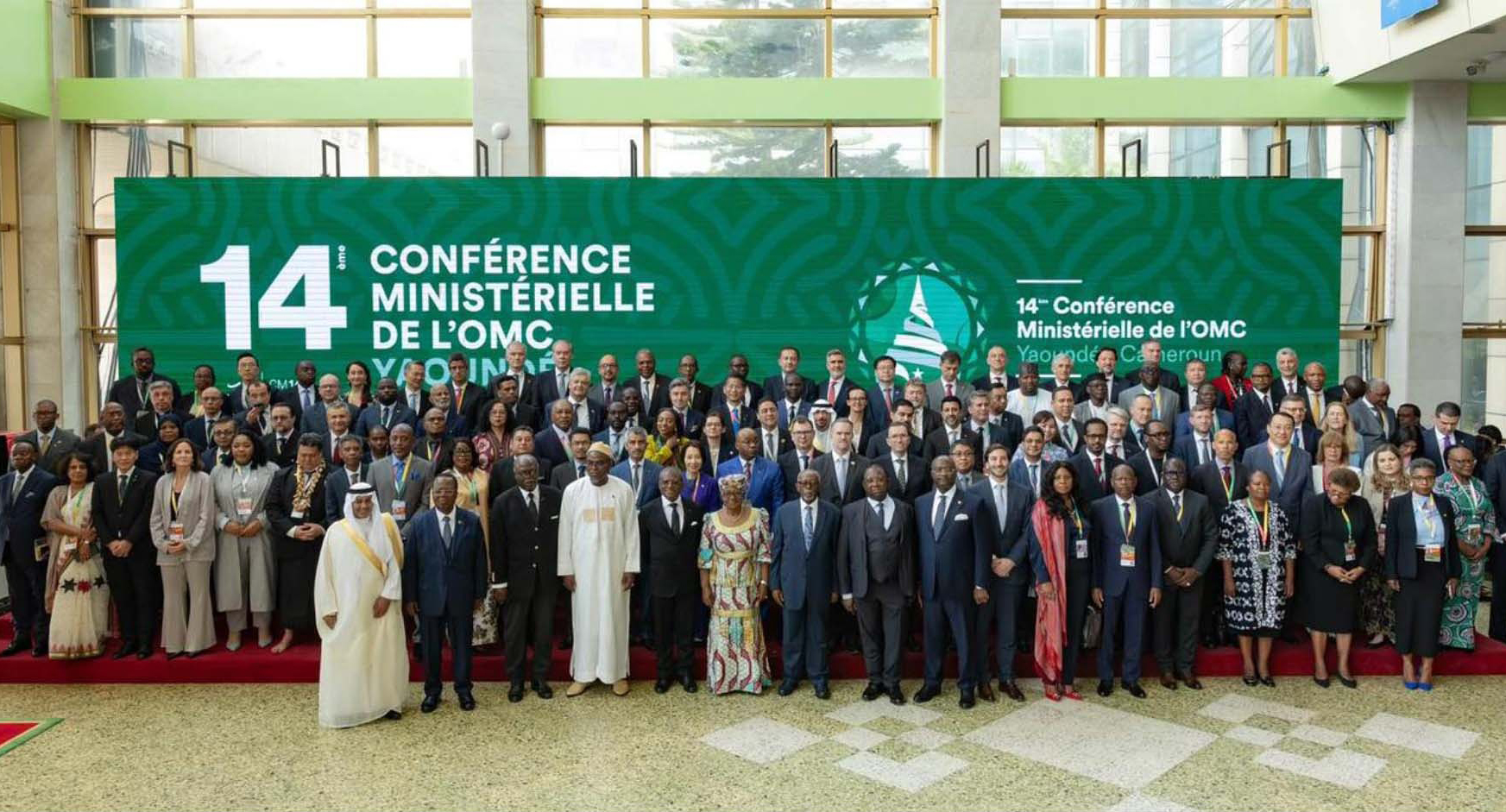
At the March 2026 Ministerial meeting in Cameroon, many members—but not the United States—entered a plurilateral e-commerce agreement. Other members have blocked it from becoming an enforceable WTO plurilateral agreement. Nevertheless, as a freestanding agreement among some members, it represents a possible way forward for matters not covered by existing rules. But this approach does nothing to overcome the obstacles to changing outdated rules.
The judicial function
Trade agreements must be self-enforcing. No army will punish nations that violate them; no judge can impose fines or put officials in jail. The consequences of noncompliance involve self-help measures by aggrieved counterparties, often trade retaliation. Member nations will follow the rules, and abide by the findings of adjudication, if and only if they believe that they will come out ahead on balance.
What value does adjudication have if it cannot enforce compliance? It can reveal information about the facts of a dispute, examining allegations of noncompliant behavior and assessing their accuracy so that members can take any appropriate self-help measures. Further, when rules are ambiguous or incomplete, adjudication can resolve ambiguity and fill gaps. It can be useful in the latter role, however, only if adjudicators are good at identifying rules that benefit the members.
The GATT dispute settlement process allowed members that could not resolve a dispute through consultations to proceed to a panel of independent arbitrators. The panel would hear the case and issue an opinion on the facts and the law. Its decision was not “binding,” however, unless the membership as a whole—including the losing disputant—agreed to accept the findings (a process known as “adoption”). If a decision was adopted but the loser did not fully comply, a unanimous consensus was required for authorization of formal sanctions. Thus, members could not be officially adjudicated as scofflaws, or formally sanctioned, unless they agreed. This system led to some intransigent disputes in which the loser blocked adoption of panel findings, and the complainant sometimes engaged in trade retaliation. Such “unilateralism” was a primary motivator for the creation of a new dispute-settlement system in the WTO.
Under the WTO system, adjudication again started with an arbitral panel. Arbitral decisions could be appealed to a standing Appellate Body (AB). The losing disputant could no longer block adoption of the eventual findings—final rulings were automatically adopted and were “binding” on the loser. If the loser did not comply with the ruling within a reasonable time, the original complainant could seek authority for proportional trade sanctions. Members that did not comply with rulings were also regularly harangued at meetings of the membership.
The AB often issued interpretations of ambiguous or incomplete legal obligations. AB rulings also established precedents that future arbitral panels had to follow. Many of these rulings went against the United States on issues of considerable political importance, such as the method for calculating antidumping duties, the prerequisites for “safeguard measures” (temporary protection for troubled industries facing stiff import competition), and the question of whether Chinese SOEs can confer subsidies, a point to which I return below. In the US view, these decisions were not supported by the treaty text and undermined the bargain that had been struck during the Uruguay Round. They led to an eventual refusal by the United States to permit the appointment of new judges to fill AB vacancies, resulting in its demise at the end of 2019. Arbitral panels still operate, but the loser can still appeal to the non-functioning AB, bringing the dispute resolution process to a standstill.
Contrasting the two systems, GATT ultimately relied on diplomacy to settle disputes. Members could not be definitively adjudicated to be in violation of the rules without their consent and did not have to accept the legal validity of arbitral rulings with which they disagreed. The downside was that impasse could result in some disputes, mainly where members clung to different interpretations of ambiguous or incomplete obligations. Those disputes at times led to unilateral retaliatory measures. The WTO eliminated the problem of legal impasse, but only by depriving members of the ability to prevent objectionable legal interpretations from becoming “law,” potentially leading to formal sanctions for noncompliance.
Both systems were imperfect, but the GATT approach allowed the most politically difficult disputes to remain on a diplomatic track, with neither disputant legally deemed to be “in the wrong.”
Moreover, the “binding” nature of WTO decisions did not solve the problem of fundamental disagreements over the content of obligations. The unilateral retaliatory measures that might arise due to impasse under GATT simply turned into the prospect of formal sanctions imposed on a recalcitrant WTO scofflaw. Further, the AB’s insistence on fidelity to precedent meant that questionable legal interpretations could be locked in indefinitely with little room for future arbitral panels to revisit the hard issues.
Trade agreements are inherently incomplete contracts, and disagreements over their meaning are often better resolved through diplomacy than by judges who may or may not be sensitive to the underlying political imperatives of members. There is also virtue to an arbitral system that passes only on the dispute before it, leaving future arbitrators the flexibility to disagree.
The rise of China
China was a modest player in world trade when it joined the WTO in 2001. Since then, China’s share of trade has exploded, and it is now the world’s largest trading nation. Its share of merchandise (as opposed to services) trade has expanded the most, drawing even with the United States in 2010 and now substantially exceeding the US share (see Figure 1).
Figure 1
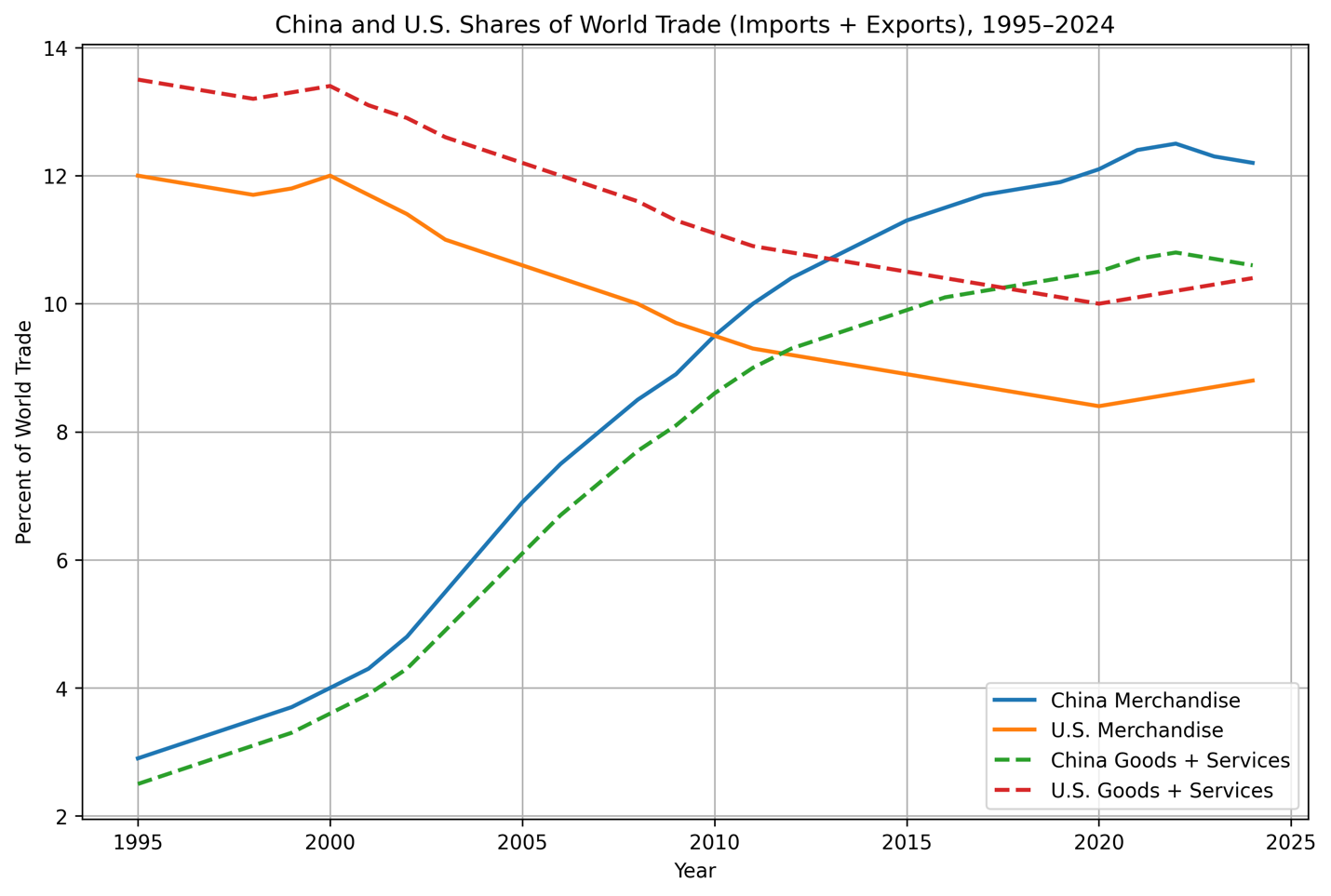
Source: WTO and OECD Statistics
The impact of China’s growth on the manufacturing sectors of other nations is termed the “China Shock.” Widely cited economic research attributes to it the loss of hundreds of thousands of manufacturing jobs in the United States alone. Many of the hardest-hit communities in the United States are in electoral swing states. This fact alone created substantial pressure for an effective political response and has been compounded by the fact that China’s manufacturing growth is driven in significant part by government subsidies, often funneled through state-owned enterprises. Whatever economists may say about the potentially favorable effects of China’s subsidies on the aggregate national income of its trading partners, the loss of jobs to subsidized foreign competition is widely perceived to be unfair and strengthens the calls for action to curb China’s expansion. Geopolitical concerns have further amplified concerns about China’s policies, along with efforts by China to leverage its chokehold over certain global supply chains.

Options for addressing China’s industrial policies under existing WTO rules are weak. The WTO incorporates elaborate limits on subsidies and allows countervailing duties to offset them, but legal complaints to the WTO and countervailing duty actions under national law are slow and expensive. Cases must be proven by gathering information about the subsidies and their effects, information that is difficult to obtain from China. Cases proceed industry by industry, and China can respond to them by altering its industrial policies to offset any countermeasures. Efforts to use antidumping laws to address China’s exports, or to afford temporary protection from Chinese competition using safeguard measures, are subject to similar problems.
Further, when the United States used countervailing duties to counter “subsidies” conferred on downstream Chinese exporters by SOEs (such as banks and energy companies), the AB ruled that SOEs cannot bestow countervailable subsidies under WTO law unless they exercise a “governmental function.” This test is nowhere to be found in the treaty text, and implies, for example, that a state-owned steel company selling steel to Chinese manufacturers at prices far below those available in the private market cannot be treated as conferring a subsidy.
Many of China’s trading partners have thus concluded that existing WTO disciplines do not allow an adequate response to China’s industrial policies. But efforts to impose further disciplines on China will require China’s agreement. China seems willing to accept some additional rules for SOEs, as evidenced by its application to join the Comprehensive and Progressive Agreement for Trans-Pacific Partnership. But any additional commitments will be difficult to enforce.
Nations like the United States have thus resorted to measures that are incompatible with WTO rules to generate negotiating leverage with China or at least to counter some of its industrial policies, including higher tariffs and new industrial subsidies for “strategic” industries. Proposals have also emerged to de-emphasize conventional trade agreements with China, and to replace them with “managed trade” deals based on quantitative import and export benchmarks as was done years ago when certain nonmarket economies acceded to GATT. This approach was embraced in part during the first Trump administration in the “Phase One Trade Deal,” with limited success.
The inability of WTO rules to address China’s industrial policies to the satisfaction of the United States, Europe, and other market economy competitors poses perhaps the greatest long-term challenge to the WTO system. China seems largely content with the status quo and has an effective veto over any changes.
Lessons for the future
The future of the world trading system is murky, and I cannot predict how it will evolve. Instead, I will simply suggest some lessons from the GATT and WTO experiences for the design of future multilateral trade agreements.
Most important, trade agreements must be adaptable to changing circumstances, many of which may be unforeseen during the negotiating process. They inevitably require modification and refinement to retain political support. They must achieve this flexibility against a backdrop in which treaty commitments bind only the nations that consent to them.
One implication is that it is folly to give members an effective veto over negotiations on new issues. Coalitions of the willing must be allowed to make progress. These plurilateral arrangements will often need to be “closed,” so that commitments run only to those who have joined the agreement and do not extend to others through a most-favored-nation principle. There is value to having these plurilateral arrangements under the umbrella of a larger arrangement such as the WTO to facilitate issue linkage in negotiations and to take advantage of an established dispute resolution process.
The harder question is how to design trade agreements to enable them to be modified when their existing provisions become obsolete. GATT and the WTO have built-in flexibility mechanisms such as safeguard measures and a procedure for renegotiating specific tariff commitments. But the experience with China, and with other rapidly growing developing countries that were never asked to make tariff concessions on the scale required of the developed economies, shows why these mechanisms are insufficient.
One option is a sunset clause, requiring members to renew their support for some or all of the agreement by a date certain or following a triggering vote of some portion of the membership. Of course, renegotiation is costly, and sunset provisions can introduce business uncertainty that is harmful to trade. But some solution must be found to situations like the current challenge posed by China, which has an effective veto power over any new rules.
A narrower lesson from the experience with China is that existing trade agreements evolved against a backdrop of mostly private firms operating in market economies. Those provisions do not guarantee effective market access to an economy such as China or provide adequate discipline over its industrial policies and SOEs. Nobody likes the idea of “managed trade,” but effective and enforceable alternative approaches to the challenges posed by China under its current government are not obvious.
Turning finally to dispute resolution, the contrast between GATT and the WTO suggests the potential virtue of entrusting disputes to a diplomatic process, even if it sometimes reaches impasse. “Binding” dispute resolution as envisioned by the WTO is never really binding and may simply aggravate political tensions arising from intransigent disagreements over the content of legal obligations. To be sure, an arbitral process to establish the facts and offer a nonbinding opinion on the law is useful, but it is not clear that further legalization is constructive. It is also questionable whether arbitral decisions should be subject to an appeal, which may lead to quasi-binding precedents that may be as likely to be wrong as they are to correct mistakes. It may be best to let arbitral panels revisit issues over time in response to signals from the membership.
Alan O. Sykes is professor of law and the Warren Christopher Professor in the Practice of International Law and Diplomacy at Stanford Law School, where he directs the master’s degree program in International Economic Law, Business, and Policy. He is also a senior fellow at the Stanford Institute of Economic Policy Research (SIEPR).