 Powered by
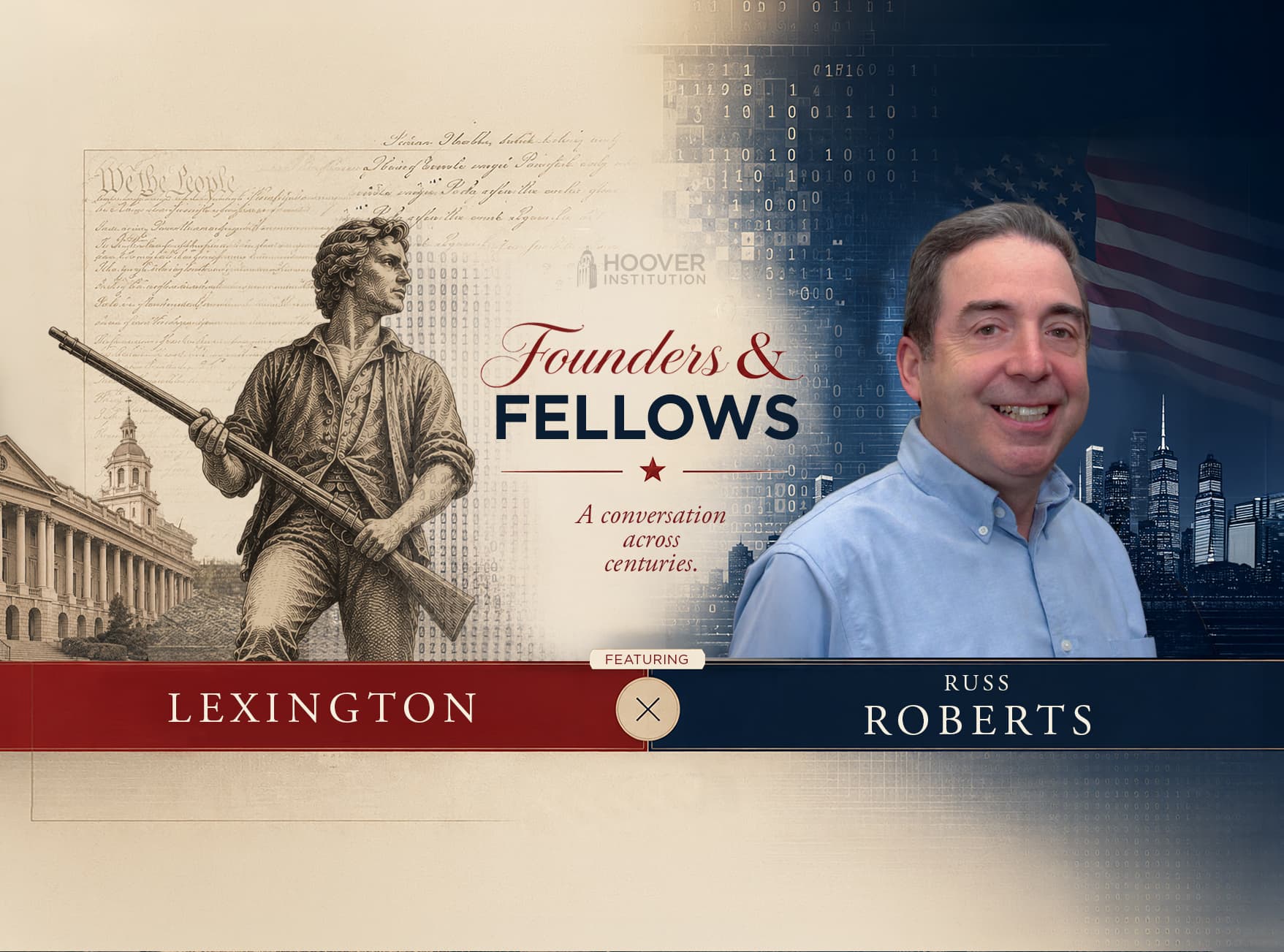
Instead of writing about an American founder, I’d like to pay tribute to a place that was central to the founding, the place where it all started, the Battle Green of Lexington, which was part of my childhood.
In 1962, when I was seven years old, we moved from Moses Lake, Washington, a small town of then about 30,000 people in the eastern part of the state, to Lexington, Massachusetts, the Boston suburb. My father warned me that the kids in Lexington would know a lot about the American Revolution and that I would need to up my history game in our new location. I found this vaguely intimidating. Not surprisingly, at the age of seven, I knew little or nothing about the Revolution.
It turns out, I didn’t have to worry. My classmates also knew little or nothing about the Revolution. I went to Muzzey Junior High School, which Claude tells me was named for the Muzzey family and their importance to the town of Lexington—Benjamin Muzzey had owned the land that became Lexington Commons, later called the Battle Green, the site of the Battle of Lexington. John Muzzey built Buckman’s Tavern, where the Lexington militia met the night before the battle. And Isaac Muzzey died in the Battle of Lexington. Yet I cannot remember a single moment in my three years in the school where anyone talked about or taught us any of those things.
When I finished eighth grade at Muzzey, I entered Lexington High School. On the walls of the auditorium was written “April 19th, 1775: What a glorious day for America.” I don’t remember much talk about the Revolution in high school either. By the time I reached ninth grade, it was 1968, and the war in Vietnam, not the Revolutionary War, consumed the interest of my classmates and my teachers.
It’s been about forty years since I visited Lexington. My memory of the Battle Green is indistinct, other than the statue of the Minuteman at the entrance to the Green. Google Maps tells me that the Minuteman statue is of Captain John Parker, the commander of the troops on April 19, 1775, who was famously quoted as saying: “Stand your ground. Don’t fire unless fired upon. But if they mean to have a war, let it begin here.” But because the statue was unveiled in 1900, it’s more of a sculptor’s rendering than a likeness. Parker’s musket is preserved at the Massachusetts State House.
I don’t think we learned anything of this when I was a boy in Lexington. But I like imagining the Battle Green on that April morning, with something like seventy-five to eighty Lexingtonians showing up bravely to face seven hundred British soldiers. The large imbalance in numbers was only part of the reason those Lexington farmers were so brave to show up and stand their ground. They were amateurs facing professional soldiers— professional soldiers from the best army in the world. It’s no wonder that in the battle that morning, the Lexington militia members fared poorly. (I played soccer at Lexington High School. The Battle of Lexington was something akin to our high school soccer team going up against Harry Kane, Jude Bellingham, and the British national team.)
But numbers and skill aren’t the whole of it. There’s something else to notice about the skirmish that lit the flame of the American Revolution. Why did those farmers muster with their muskets in the first place? What could they possibly have been thinking? Duty, yes. But I think something more than that, and it’s related to where the battle took place. This was their home. The Battle Green was Lexington Common. It was their communal space.
James Russell Lowell later wrote of the British soldiers in America: They came three thousand miles, and died/To keep the Past upon its throne. Three thousand miles from home to maintain the old order. The Lexington farmers walked out of their own front doors onto the Green they crossed every ordinary day, and they did it for the opposite reason. Not to keep the past on its throne but to take a stand to create a future, a future they could not have described or even imagined. But the place itself, their home and what it meant to them, was enough to put themselves in harm’s way.
They lost the battle, but just by showing up, they started something that would lead eventually to victory.
Remembering what that small piece of earth meant to them helps us understand their courage that day. It can snow in April in New England. Can you see those Lexington farmers trying to stay warm, dressed in the drab farmer clothing of the day, muskets in their hands, outnumbered something like ten to one by the British soldiers in their brilliant red uniforms?
What were those farmers from Lexington thinking as they moved into position that April morning? Seven of them were destined to die. An eighth American died that morning, a prisoner the British had with them who made a bid for freedom when the shooting started, only to be gunned down. One of the seven Lexingtonians who died, Jonathan Harrington, was able to drag himself to his front door before he died. His house was on the Green. He died in his wife’s arms. Harrington’s house still stands.
In my mind’s eye, it was foggy that morning and the fog soon mixed with the darker smoke from the muskets, creating wraiths of smoke and fog that drifted close to the ground and obscured what was actually happening. The battle was only maybe ten minutes long. The Americans quickly dispersed. Why weren’t more of them killed, given the numerical and skill imbalance? Maybe because the British weren’t set on a battle—they were on their way to Concord. They disposed of those farmers standing in their way with little effort. No British soldiers were killed. It was a rout.
Those British soldiers must have looked at the ragtag militiamen and saw them as little more than a nuisance rather than an enemy to be reckoned with. They got that wrong. They marched on, oblivious to what was set in motion that morning. A great drama was ready to unfold and keeps unfolding. Act I, Scene 1, was set on the Battle Green of Lexington.
Russ Roberts is a visiting fellow at the Hoover Institution and the president of Shalem College in Jerusalem. He hosts the weekly podcast EconTalk: Conversations for the Curious, on Freedom Frequency. His latest book is Wild Problems: A Guide to the Decisions that Define Us (Portfolio, 2022).