 Powered by
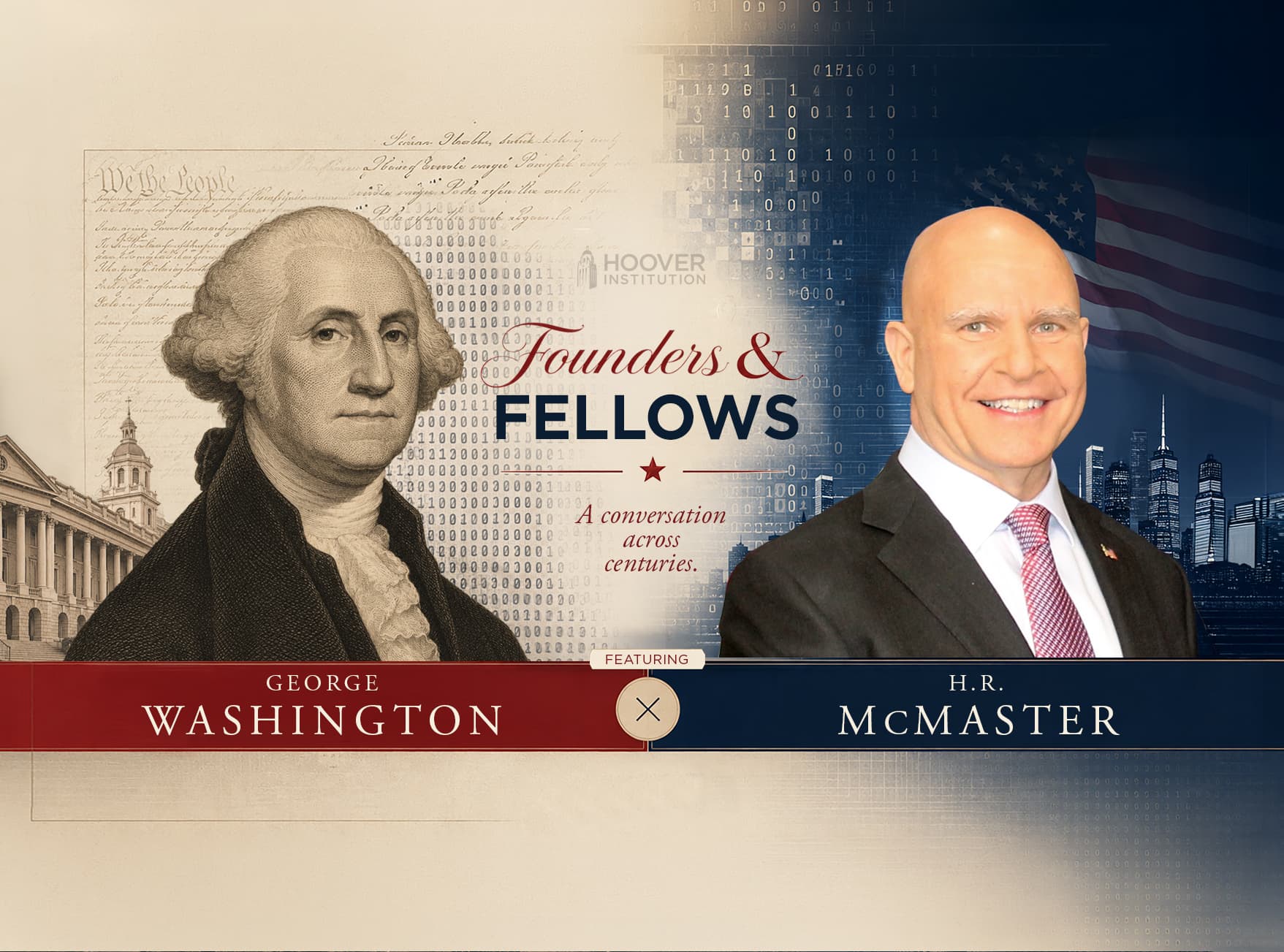
The example, the image, and even the legend of Washington have had an immense influence in shaping the American officer corps and in providing ideals of responsible leadership. I would point to General George C. Marshall, the World War II chief of staff, as a faithful follower of the Washington tradition.
—Brig. Gen. James L. Collins Jr.
As America celebrates the 250th anniversary of its founding, citizens have an opportunity to reflect on the role of the military in winning independence and securing the nation under the Constitution. Since our nation’s birth, citizens’ confidence and trust in our military have depended on a covenant that binds our armed forces to the American people, a covenant based on the expectation that those who serve in uniform rise above faction in service to the Constitution. We should be grateful that the commander of the Continental Army and our first president, George Washington, established an American military tradition and professional ethic that remain vital to the confidence that citizens have in our armed forces as defenders of our republic.
Across thirty-four years of service as an officer in the US Army and my four years as a cadet at West Point, I never voted. When I took the oath of service on West Point’s parade ground known as The Plain in 1980 at the age of seventeen, I believed that our pledge to “support and defend the Constitution of the United States against all enemies, foreign and domestic,” required that we all do our part to keep our military out of partisan politics. I do not expect that other officers follow the practice of not voting, but I chose to emulate General George C. Marshall, the architect of victory in World War II, who once quipped, “As to my political faith—I have never voted. My father was a Democrat, my mother a Republican, and I am an Episcopalian.” Not voting was a symbolic, concrete way of allaying one of the greatest concerns of our founding fathers: that those charged with defending our democracy could have a hand in strangling it if military institutions took sides in political debates that only elected representatives should resolve.
That concern has persisted across two and a half centuries of American history. In recent years, some of our fellow citizens, including some prominent elected officials, have tried to pull military leaders across the line that separates our military from political debates. Our military is not the only institution that some politicians and political activists are trying to drag into zero-sum partisan competitions that dominate political discourse today. Examples include the intelligence community and the Department of Justice. But undermining the American military tradition and professional ethic would present a particularly severe danger to the future of our republic.
In this 250th year of our nation, we should be attuned to actions that undermine the founding principle that underpinned our Declaration of Independence, the Articles of Confederation and our Constitution: that sovereignty lies with the people. “We the people” exercise that sovereignty through whom we elect to represent us in government. Generals and admirals are not elected and therefore must remain subordinate to civil authority.
Washington and civil authority
George Washington’s example is vital to understanding the role of our military in our democracy because his relationship with the Continental Congress across eight years of war modeled the proper role of senior military officers under civil authority. Washington provided candid assessments and advice but did not use his influence to check or circumvent Congress’s policies or actions. He sent many letters to the president of the Continental Congress, John Hancock, lamenting its chronic inability to man, fund, and supply the Army. Congress could only request funds from the states, had no real taxing power, and could not enforce requisitions for troops and supplies. But Congress was also slow to act in areas it did control—such as officer promotions, pay, and procurement—due to poor management and political partisanship. (That may sound familiar to readers.)
Washington was frustrated, but he gave Congress his best advice and frank assessments without crossing the line between advice and advocacy that might undermine civil authority. He demanded the same from his officers and soldiers.
In 1783, the victorious Continental Army was unpaid and restless. In what became known as the Newburgh Conspiracy, anonymous agitators urged officers to threaten Congress and refuse to demobilize. Washington chastened the conspirators while urging Congress to do its job and provide overdue compensation. In a March 1783 speech to the Army, Washington, who had shared the hardships and dangers with his troops in that long, hard, and costly war, remarked as he put on his glasses, “I have grown not only gray, but almost blind in the service of my country.”
He began: “By an anonymous summons, an attempt has been made to convene you together—how inconsistent with the rules of propriety! how unmilitary! and how subversive of all order and discipline—let the good sense of the Army decide.” Washington’s appeal to soldiers’ sense of duty preserved civilian control of government and reinforced, early in the history of our Republic, the tradition of taking no action that might undermine civil authority. Washington then resigned his commission to Congress in Annapolis on December 23, 1783, an act he intended as a concrete demonstration that the military is subordinate to civilian government.
General Washington’s example of deferring to the Continental Congress helped shape Articles I and II of the Constitution and allay concerns among the anti-federalists and others who harkened back to the English Civil War to raise the specter of an Oliver Cromwell–like “man on horseback” who, while claiming to defend liberty, would end the people’s say in how they are governed. Alexander Hamilton warned in Federalist no. 8 that the military acting as a political force could lead to the most deadly species of despotism.
But Hamilton went on to argue in Federalist no. 26 that congressional control of the military through military funding and appropriations, as well as the president’s authority as commander in chief, would ensure civilian control of the military. That is why Article I, Section 8 of the Constitution gives Congress the authority to “declare War,” “raise and support Armies,” “provide and maintain a Navy,” and to “make Rules for the Government and Regulation of the land and naval Forces.”
And it is important for Americans to realize that, while Congress, like the judiciary, is an appropriate check on executive authority, the military is most assuredly not. Because institutions are comprised of people, legal and structural safeguards against the abuse of power, no matter how well crafted, are not foolproof protections against military leaders crossing over the line into politics.
The most dramatic breach of civil control was, of course, the defection of officers of the Army of the United States to the Confederacy in the Civil War. It is worth noting, however, that of the seven Virginian colonels then on active service in 1861, only one, Colonel Robert E. Lee, chose to fight for the Confederacy.
After the Civil War there were other, less consequential, examples of military officers crossing over the line between advice and advocacy of particular policies. In what became known as the 1947 revolt of the admirals, for example, Navy officers circulated critical documents and testified against secretary of defense policies that prioritized Air Force bombers and reduced resources for naval aviation.
The most well-known example of a senior military officer crossing the line may be that of General Douglas MacArthur publicly undermining President Harry S. Truman’s policies during the Korean War in 1951, behavior that spurred the president to fire the storied general.
A lesser-known example is Admiral William J. Fallon’s public statements that cut against the George W. Bush administration’s Iran policy as well as undercut the president’s decision to reinforce the security effort in Iraq, known as “the surge.”
Attempts to co-opt the military
It is important to learn from those transgressions of the American military tradition as well as from examples of those who adhered to Washington’s and Marshall’s examples. I have personally witnessed officers like General Joe Dunford who, as chairman of the Joint Chiefs of Staff during President Trump’s first administration, respect civil authority while giving unvarnished, best advice to the president and the secretary of defense. He and many other officers with whom I served knew that it is a disservice to senior civilian leaders to tell them what they want to hear.
But preserving Washington’s legacy depends on citizens and political leaders as well as senior military officers. There are many examples in recent decades of political leaders trying to use the military to advance personal or party interests. When presidential candidate Bill Clinton was worried about charges that he had dodged the draft, he assembled a list of retired admirals and generals to endorse him. That started a practice that continues to this day, a practice that is regrettable because group endorsements could create the impression that the military as an institution is behind a candidate or party. President Trump’s referring to senior military as “my generals,” is reminiscent of President Lyndon Johnson telling the Joint Chiefs of Staff in the summer of 1965, “Hey, I’m like a coach I used to know and you’re my team. You’re all Johnson men.”
In public and private comments, presidents should bolster respect for military leaders across both political parties as Constitution men and women who serve at the pleasure of and follow the orders of the commander in chief and the secretary of defense while also recognizing Congress’s role in overseeing the military.
Even more threatening to the military’s ability to maintain the trust of all Americans regardless of political affiliation is the practice in recent years of the misuse of the military to score partisan political points or to advance social and political agendas that undermine combat readiness and combat effectiveness.
During the first year of the Biden administration, the Pentagon and the White House advocated post-modernist and various critical theories that undermined the warrior ethos and distracted the military from its mission. In a 2021 essay in National Review, I warned that the valorization of victimhood, pursuing equality of outcome rather than equality of opportunity, and the practice of judging people by identity category would “weaken the bonds of sacred trust among warriors” in a way that is destructive to combat effectiveness. Moreover, “if ensuring the ability to fight and win is not the focus of the Defense Department, confused priorities threaten to dilute the warrior ethos and create uncertainty about what the military is for.” It seemed particularly absurd that “as it was conducting the humiliating retreat from Kabul, the Pentagon was developing a climate strategy in response to the president’s guidance to ‘prioritize climate change considerations.’ ”
Secretary Pete Hegseth’s speech to a convocation of generals and admirals on September 25, 2025, in Quantico, Virginia, was meant to reinstate the appropriate priorities for the Department of War, prioritize equality of opportunity rather than lowering standards to meet diversity objectives, and reverse policies based in postmodernist and critical theories inimical to unit cohesion. But his message to the flag officers and actions of the Department of War since then have perpetuated the fundamental problem of dragging the military into partisanship. For example, when Secretary Hegseth told the flag officers that they faced a choice between loyalty to the Department of War or what he called the Department of Woke, he seemed to misunderstand the chain of command. The policies to which he objected had not originated with the generals and admirals in that room.
The Obama and Biden administrations’ practice of White House officials invalidating the recommendations of promotion boards to make more room for women and minority officers was ill-advised, but top civilian leaders ordered those actions. President Biden’s first executive order embedded the idea of “equity” into everything the administration does and directed all agencies, including the Department of Defense to develop “Equity Action Plans” that derived from it and directed the military institutions to develop “a holistic strategy for continuing to cultivate enduring and equitable change.” Defense Secretary Lloyd Austin conducted a February 2021“stand-down” to eliminate “extremist ideologies” based on specious claims that veterans were overrepresented during the January 6, 2021, assault on the Capitol. Austin also reversed the Trump administration’s prohibitions on the use of critical race theory and replaced the Trump administration’s consideration of gender dysphoria and treatment associated with it as a condition that could undermine soldiers’ combat readiness with a policy that promised “a means by which transitioning service members may obtain gender-affirming medical treatment and recognition of their self-identified gender, and seeks to protect the privacy of all service members.”
Secretary Hegseth’s message that officers should have resisted or rejected the agenda of the Biden administration, no matter how ill-conceived and destructive, would open the door for senior officers to actively oppose Trump or Hegseth policies with which they disagreed. Applying the same logic, officers might resist or undermine Secretary Hegseth’s actions with which they disagree, such as the reported selection of officers for promotion based on fealty to him or the forced retirement of officers and removal of officers from promotion lists, in part, because they are women or minorities.
Resist the partisan temptation
It falls to the American people and their representatives in Congress to make it unmistakably clear to leaders in both parties that the US military has no place for identity-based social engineering, nor for sexism, racism, or any form of bigotry.
Unfortunately, the way that the Trump administration set out to reverse some of the Biden administration’s policies continued an approach that undermines the American military tradition and the professional military ethic. In a speech on the Senate floor in October 2025, Senator Jack Reed of Rhode Island noted that the Uniform Code of Military Justice prohibits active-duty personnel from partisan political activities, citing the 1976 Supreme Court case of Greer v. Spock that upheld military regulations strictly prohibiting partisan political activity on military bases. The majority opinion in that case stated that the military must avoid “both the reality and the appearance of acting as handmaiden for partisan political causes or candidates.”
Reed warned that “once the military becomes politicized, it loses the trust of the American people. A military seen as serving one party cannot claim to serve the nation. For nearly 250 years, this principle has held. The American military has remained the most trusted institution precisely because it has stayed out of politics.” He listed actions that undermined that trust, such as an event at Fort Bragg during which soldiers were positioned in the bleachers as background props for an event that had the appearance of a political rally. The president’s staff encouraged soldiers to boo the president’s opponents, cheer his applause lines, and jeer the press. Vendors sold campaign merchandise on base to soldiers in uniform.
During Secretary Hegseth’s convocation of generals and admirals, President Trump complained about “an enemy within,” and told the officers that dealing with this domestic enemy “is going to be a major part for some of the people in this room.” The president’s words evoked the founders’ fear of a leader who expects personal loyalty in a way that undermines constitutional checks and turns members of the military against rivals. President Washington, in what became known as his Farewell Address in 1796, warned against “the alternate domination of one faction over another, sharpened by the spirit of revenge.”
Two months after President Trump made his remarks citing an “enemy within,” Democratic representatives in Congress did their part to undermine the American military tradition with the release of a video in which they urged servicemen and women not to follow “illegal orders.” They did so against the backdrop of controversial presidential decisions such as the strikes against narcotics traffickers in the Caribbean Sea and the deployment of National Guard units to US cities. The implication was that the military should check executive authority and decisions with which the members of Congress and senators disagreed. But under the Constitution, it is the people’s representatives—those who appeared on the video and their colleagues in Congress—who are the appropriate check on the executive branch.
Under Article I, Section 8, of the Constitution, Congress has the authority to “declare War,” “raise and support Armies,” “provide and maintain a Navy,” and “make Rules for the Government and Regulation of the land and naval Forces.” Under Article III of the Constitution, the judiciary provides additional checks on executive authority through judicial review, injunctive relief, and restraining orders against unlawful executive action, interpretation and enforcement of statutory limits on executive power, and protection of individual rights through habeas corpus and due process enforcement.
The ultimate check on an executive’s authority comes from the American people and how they vote in elections. The election of President Trump and the appointment and confirmation of Secretary Hegseth put an end to the policies that they opposed. That is why the campaign against so-called “woke generals and admirals” is like a rearguard action against phantoms. The claims by some Republicans that the military was woke, like the claims by some Democratic politicians the military was extremist, were meant to score partisan political points.
American citizens might see fit to send a clear message to politicians in both parties to stop rhetoric and behavior that undermines the American military tradition and the covenant between our military and its citizens.
Hold the line
So, as we commemorate the 250th anniversary of our republic, we should do our part to keep the bold line in place between our military and partisan politics. And we should make clear to our senior military officers that we expect them to give their best advice without crossing the line between advice and advocacy and to eschew any notion that they are an appropriate check on executive authority.
As historian Don Higginbotham pointed out in his 1984 lecture, “George Washington and George Marshall: Some Reflections on the American Military Tradition,” keeping the military out of partisan politics does not mean that military officers should be separate from their fellow citizens or hesitate to provide civilian leaders with military advice. Higginbotham cites the great Marshall biographer Forrest Pogue as noting that the general “became familiar with the civilian point of view in a way rare among professional military men.” A member of Marshall’s staff noted that Marshall “didn’t have to adjust to civilians—they were a natural part of his environment. . . . I think he regarded civilians and military as part of a whole.” Higginbotham points out that Marshall comported himself consistent with Washington’s advice that “We should all be considered, Congress, Army, &c. [citizens] as one people, embarked in one Cause, in one interest; acting in one interest: acting on the same principle and to the same End.”
In his 1960 book, We Hold These Truths: Catholic Reflections on the American Proposition, Father John Courtney Murray observed that “Neither as a doctrine nor as a project is the American Proposition a finished thing. Its demonstration is never done once for all; and the Proposition itself requires development on penalty of decadence.”[i] Washington’s relationship with the Continental Congress, actions in Newburgh, and the resignation of his commission founded the military tradition and modeled the professional military ethic that underpins military and civilian officials’ oath to “support and defend the Constitution.”
Let us do our part to strengthen the military tradition and ethic inherited from Washington and foster the trust that binds our military to our citizens. As Washington noted during the Revolutionary War on March 31, 1779, “Our cause is noble. It is the cause of mankind, and the danger to it springs from ourselves.”
[i] For more on Murray’s work, see Father Michael Sherwin, Nove et Vetera (American Edition) 25 (2027): forthcoming.
H. R. McMaster is the Fouad and Michelle Ajami Senior Fellow at the Hoover Institution and leads Hoover’s Human Security Project and the Hoover Afghanistan Research and Relief Team. At Stanford University, he is also the Bernard and Susan Liautaud Fellow at the Freeman Spogli Institute and lecturer at the Graduate School of Business. He is the host of Today’s Battlegrounds and a regular on GoodFellows, both produced by the Hoover Institution.