 Powered by

For much of the period since the Second World War, trade policy appeared to be a largely settled issue in advanced economies. Successive rounds of multilateral liberalization occurred under the General Agreement on Tariffs and Trade (GATT) and its successor, the World Trade Organization (WTO). This multilateral liberalization took place at the same time as an expansion of preferential trade agreements, such as the North American Free Trade Agreement (NAFTA). Together these two forms of liberalization reduced the level of trade policy barriers and diminished uncertainty over the future evolution of trade policy.
By the mid-2010s, average import-weighted tariffs in the United States had fallen below 2 percent, an exceptionally low level by historical standards, as shown in Figure 1. These low and predictable trade barriers, together with improvements in information and communication technologies (ICTS), contributed toward the formation of global value chains (GVCs), in which firms separated stages of production across national borders.

These GVCs are one of the most distinctive features of globalization today compared with past episodes of globalization such as the late nineteenth century. A famous example is Apple’s iPhone: designed in California but assembled in China and India, with parts and components shipped from many other countries.
Figure 1: US Average Effective Tariff Rate Since 1790
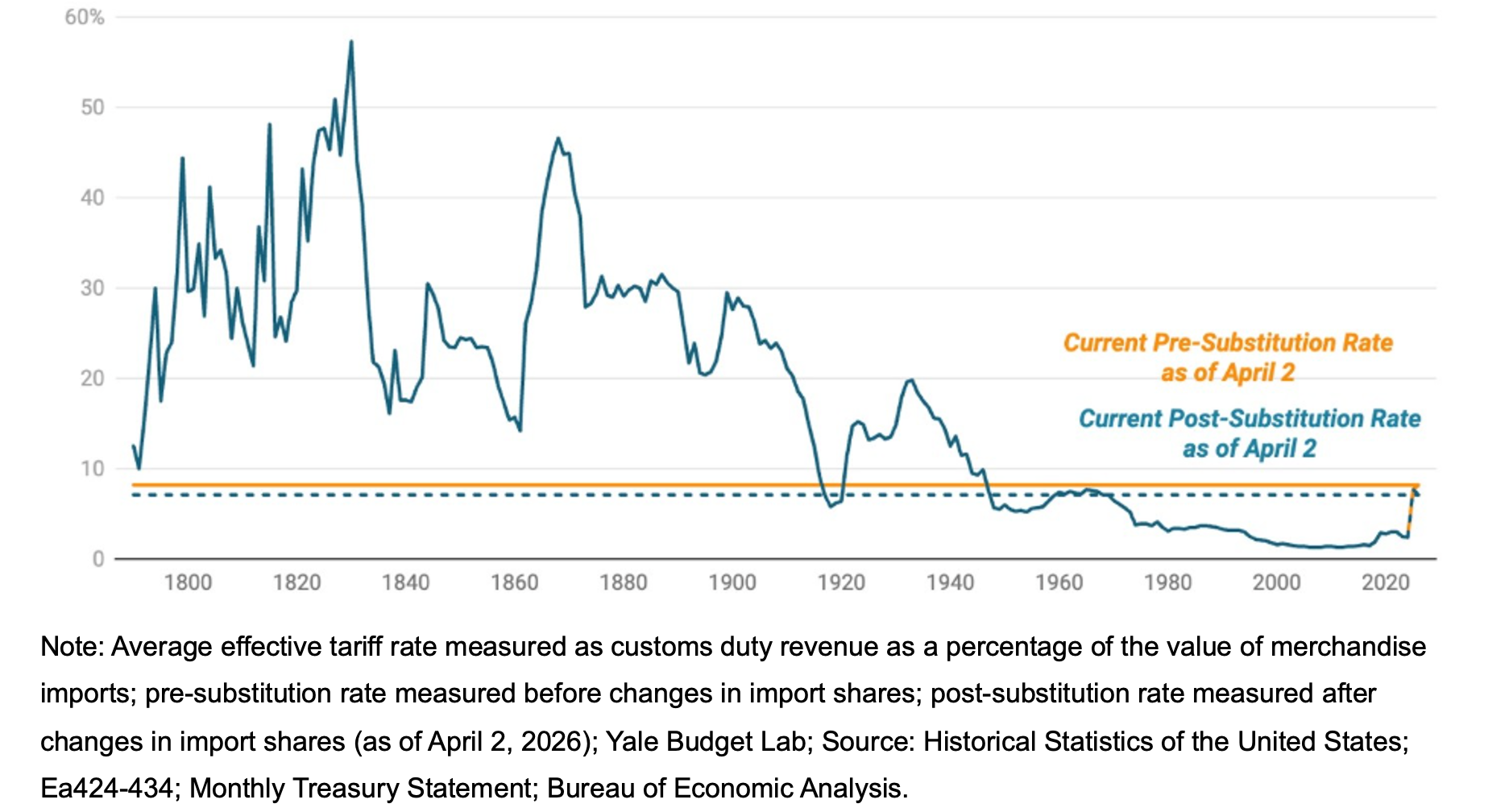
In recent years, this situation has changed dramatically. Beginning in 2018–19 and intensifying in 2025–26, the United States imposed successive waves of tariffs that raised protection to levels not seen since the Smoot-Hawley Tariff Act of the 1930s, as also shown in Figure 1. In previous decades, trade policy decisions were made within a rules-based international order centered on the World Trade Organization (WTO). In contrast, these recent rounds of US tariffs have been imposed under a series of US-based legal justifications, including import surges (Section 201 of the Trade Act of 1974), national security (Section 232 of the Trade Expansion Act of 1962), unfair foreign trade practices (Section 301 of the Trade Act of 1974), and a national emergency (the International Emergency Economic Powers Act (IEEPA) of 1977).
The 2025–26 tariffs initially announced by the Trump administration were subsequently adjusted a number of times, in part through bilateral bargaining with the foreign countries involved, which resulted in considerable uncertainty over tariff levels. Additionally, the average effective rates of tariffs in Figure 1 have remained below the statutory rates because of a combination of exemptions, shipment lags, imperfect enforcement, and greater attention to compliance with the rules-of-origin requirements of NAFTA for goods to enter tariff free (Gopinath and Neiman 2026).
On February 20, 2026, the Supreme Court ruled that IEEPA does not give the executive branch the power to impose tariffs. This decision struck down most of the 2025–26 tariffs on an import-weighted basis. In response, the Trump administration immediately imposed a 10 percent global tariff for 150 days under Section 122 of the Trade Act of 1974, which was later increased to 15 percent. With the expiry of the Section 122 tariffs on July 24, 2026, the Trump administration announced further tariffs under Section 301 of the Trade Act of 1974. These tariffs were imposed on the grounds that the targeted countries had failed to impose, or effectively enforce, a prohibition on importing goods made wholly or partly from forced labor. These tariffs are now the subject of litigation currently before the US Court of International Trade, ensuring that the legality of the administration’s approach to trade policy remains a contested matter.
In the aftermath of these frequent changes in trade policy stance, measures of trade policy uncertainty based on newspaper coverage of policy announcements following Baker, Bloom and Davis (2016) have been at all-time highs. More broadly, the resurgence of national protectionist trade policies has called into question the future of the rules-based international order that emerged in the aftermath of the Second World War.
Several countries, including Canada and China, have launched complaints at the WTO about the US tariffs imposed since 2018. However, the WTO’s Appellate Body has been non-functional since 2019 (the United States has blocked appointments), and in March 2025 the United States announced a suspension of its contributions to the WTO budget pending review. The Trump administration additionally argues that tariffs imposed on national security grounds under GATT Article XXI are not subject to WTO review.
Tariffs create barriers
International-trade economists typically emphasize that tariffs are costly even without uncertainty over their levels. The reason is that international trade is not zero-sum but is instead positive-sum or mutually beneficial for countries. Instead of having to produce all goods domestically, countries can instead specialize in what they are relatively good at producing, and use market-based exchange to obtain the goods that they are relatively bad at producing.

For a large country such as the United States, trade economists usually estimate these real income gains to range from 2-8 percent of gross domestic product (GDP), depending on the assumptions made (e.g., Costinot and Rodríguez-Clare 2018). Given a GDP of $29.2 trillion and 132.2 million households in 2024, a central value of a 5 percent gain corresponds to $11,044 per household per year, compared to a median household income in 2024 of $83,730.
We are all aware of this insight from our everyday lives. Most of us do not grow all of our own food or make all of our own clothes. Instead, we specialize in our chosen profession, sell our labor services in return for income, and use that income to purchase on markets the goods that we do not produce ourselves. International trade is simply an example of these gains from market-based exchange relative to self-sufficiency. Since markets do not stop at countries’ borders, these gains hold internationally as well as domestically.
Tariffs are a tax on this international exchange of goods and reduce the ability of countries to participate in this mutually beneficial trade.
Although tariffs are directly levied on imports, they indirectly raise the price of domestic import-competing products, because domestic producers face less competition for their products, and face increased costs for their imported inputs. Furthermore, although tariffs expand economic activity in domestic import-competing sectors, this expansion draws resources away from export-orientated sectors. Therefore, the indirect effect of tariffs is to simultaneously reduce both exports and imports (e.g., Ossa and Redding 2026).
Since tariffs reduce both exports and imports, they have a limited effect on a country’s multilateral trade deficit (with all foreign nations). A country runs a multilateral trade deficit if it spends more than its income today, in return for spending less than its income in the future. The resulting trade deficit is financed by capital inflows from the rest of the world (selling IOUs to the rest of the world), such that the balance of payments equals zero as an accounting identity.
Therefore, tariffs affect a country’s multilateral trade deficit only to the extent that they change incentives to spend versus save income. These effects of tariffs on the incentive to spend versus save are subtle and modest in magnitude, with little evidence of much effect of the 2018–19 and 2025–26 tariffs on the US multilateral trade deficit.
In a world of many countries and goods, a country can have complex patterns of bilateral deficits and surpluses with individual foreign partners, even if its multilateral trade deficit is zero. These bilateral imbalances are a consequence of market-based exchange. Britain can specialize in producing whisky and export it to Japan, and use the resulting revenue to purchase cars from Germany, in which case it can have bilateral trade surplus with Japan, and a bilateral trade deficit with Germany.
Again, we are aware of this feature from our daily lives. We specialize in a career that we are relatively good at, sell our labor services on the market, and use the revenue obtained to purchase the goods that we are relatively bad at supplying. As a result, most of us have bilateral surpluses with our employers, and bilateral deficits with our grocery stores. Since markets do not stop at borders, the same is true for countries as whole. Only in a world of bilateral bartering of goods, without market-based exchange, would all bilateral deficits and surpluses equal zero.
Supply chains are disrupted
Trade policy is not the only way in which the international trade environment has become more uncertain in the past decade. The COVID-19 pandemic and its aftermath highlighted the potential vulnerability of global supply chains to large-scale transportation disruptions. Increased geopolitical tensions between China and the United States, and the war between Russia and Ukraine, have created national security concerns about uncertain access to critical minerals (such as rare earths) and components (such as advanced semiconductors). For each of these reasons, firms’ supply chain decisions are now made in a less-predictable environment.
International trade economists highlight that uncertainty over trade policy, and the trade environment more broadly, bring additional costs (e.g., Handley and Limão 2022). In a predictable world, firms can develop specialized supply chains, in which they source each component from the lowest-cost supplier. Before the recent waves of US tariffs, for example, Apple’s watch was assembled only in China. In contrast, in an uncertain world, firms have to take into account the risk of disruption to a supplier, and need to develop supply chains sufficiently resilient in the face of these risks (e.g., Kleinman, Liu, and Redding 2026).
In response to higher uncertainty, firms can choose to diversify foreign suppliers and build redundancy into supply chains (as in the oft-discussed example of China plus one), in order to hedge against future changes in trade policy or other disruptions. Alternatively, firms may respond to higher uncertainty by reshoring stages of production, building spare production capacity, or hoarding inventories of components. Each of these strategies raises firm production costs relative to those in a predictable world where firms can organize supply chains based on specialization and sourcing from the lowest-cost supplier.
When firms make these decisions about their own supply chains, they do so based on their own profits, and need not fully internalize systematic risks to the economy as a whole. As a result, there can be a role for the government in promoting resilience in supply chains for critical minerals and components, such as rare earths and advanced semiconductors. However, this rationale for policy intervention is typically limited to a small number of critical minerals and components, and it is hard to justify broad-based tariffs across large swathes of products in these terms.
Uncertainty over trade policy can be especially costly in today’s world of global supply chains because firms are required to incur upfront (sunk) costs for decisions that are costly to reverse, such as the costs of constructing a new production facility. In the face of higher uncertainty, firms may hold off incurring these sunk costs until the uncertainty is realized. For example, it can be challenging for an auto executive to decide whether to locate a production facility at home or abroad, or in which particular foreign country, when they do not know whether tariffs in the immediate future will be zero, 10, 25, or 50 percent.
If all firms hold off making these sunk investments in this way, this reluctance slows down the reallocation of resources to their most productive uses and lowers the economy’s aggregate productivity and real income. Perhaps the most striking example of this phenomenon is the reduction in investment in Britain in the aftermath of the 2016 Brexit referendum, which gave rise to persistent uncertainty over several years about the status of the country’s relationship with its European trade partners (e.g., Bloom, Bunn, Mizen, Smietanka, and Thwaites 2025).
Think of the years to come
This impact of uncertainty on firms’ decisions over sunk investments has wide-ranging policy implications. If the United States wants to foster strategic investments in domestic production capacity (e.g., munitions, or rare earths mining and refining), and promote resilient supply chains (which require cooperation with international friends and allies), it’s essential to provide a predictable and transparent regulatory environment, protection of private property rights, and assurance about demand over time periods of many years.
In polarized democracies where the political party of the president can change from one term to the next, it is hard to achieve such predictability through executive orders. Instead, it requires trade agreements endorsed by Congress and containing firm and detailed commitments, a predictable and favorable regulatory regime, and multiyear congressional appropriations to provide the demand assurance needed to enable firms to make these sunk investments.
Stephen J. Redding is the Kleinheinz Family Professor of International Studies and a professor of economics at Stanford University.