 Powered by

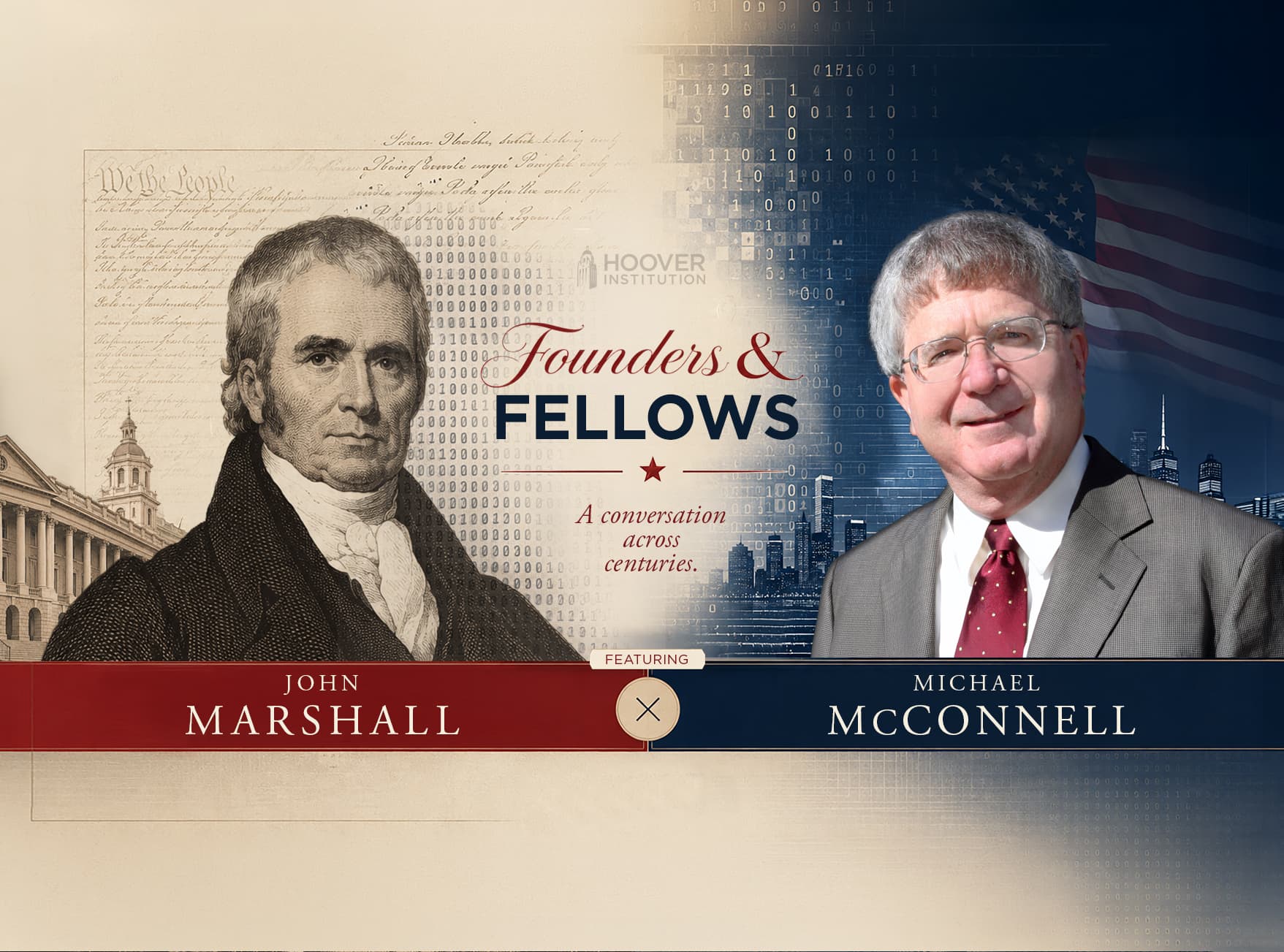
John Marshall is the founder who did it all. He fought as a young man in the Revolution, ably defended the Constitution as a delegate to the Virginia ratifying convention, served with distinction in the House of Representatives, was envoy to France during the notorious XYZ Affair, wrote a five-volume biography of George Washington, helped avert war with France as secretary of state and John Adams’s most trusted cabinet officer, and served as chief justice of the United States for thirty-four of the most consequential years of Supreme Court history. Dubbed by many the “Great Chief Justice,” no one was more responsible than Marshall for establishing this country as a constitutional republic, governed by law.
Marbury v. Madison (1803) is his most famous opinion—but it is widely misunderstood, even by many lawyers and judges. Most people think that Marbury originated the principle that courts have authority to set aside laws they judge to be inconsistent with the Constitution: the principle of “constitutional judicial review.” For decades, America was almost the only democracy to have judicial review (for example, Britain and France did not), but now it is a global phenomenon, and considered essential to constitutionalism.
But judicial review was not Marshall’s creation, and it did not start with Marbury. Debates at the Constitutional Convention in Philadelphia in 1787 show that the framers expected courts to exercise judicial review—though they did not use that term. Judicial review was vigorously debated during ratification; Alexander Hamilton wrote its most prominent defense in Federalist no. 78. Marbury was not even the first Supreme Court case to engage in the practice. Seven years earlier, in Hylton v. United States, the court considered a constitutional challenge to a federal tax on carriages, concluding that it was permissible under Article I. Both sides in that case embraced the principle of judicial review without question. And judicial review was not particularly controversial even in Marbury: Thomas Jefferson was infuriated by the opinion, but for reasons other than the court’s decision to hold a portion of the Judiciary Act of 1789 unconstitutional.
Marbury was indeed one of the most important cases in Supreme Court history, and never more so than in the present day. It protected the independence of the judiciary at its time of greatest peril, when a popular president (Jefferson), backed by majorities in Congress, was attacking the judiciary, preparing to ignore its orders, and impeaching judges for decisions he did not like. Marbury established the principle—which was genuinely contested—that the courts could review the legality of executive action and issue orders (called “mandamus”) to the executive branch requiring them to comply with the courts’ interpretation of the law. This is what attracted Jefferson’s ire.
It will not escape notice that this power to countermand illegal executive action is now in the news practically every day. Donald Trump does not like it any more than Jefferson did.
The genuine story of Marbury is far more dramatic than the conventional account. The courts were perhaps the biggest issue in the election of 1800, due to the prosecution and conviction of critics of the Adams administration under the Alien and Sedition Acts of 1798. One of the last acts of the lame-duck Sixth Congress was to pass the Judiciary Act of 1801, which eliminated circuit riding by Supreme Court Justices and instituted a system of intermediate appellate courts. (Circuit riding was the duty imposed on the justices to travel about the country on horseback or stagecoach, on bad roads, to preside over ordinary cases.) This was a genuine reform, but it was tinged with partisanship because Adams filled all the new appellate judgeships with loyal Federalists. Jefferson, faced with an all-Federalist judiciary, asserted that the Federalists “have retired into the Judiciary as a stronghold . . . and from that battery all the works of Republicanism are to be beaten down and erased.”
In the midst of all this came the knottiest presidential election stalemate in history: the Electoral College tie between Jefferson and his running mate Aaron Burr. Under the Constitution as it then stood, the tie was to be broken by the lame-duck Federalist House of Representatives. Many Federalists (but neither Hamilton nor Adams) connived with Burr to elect him president in Jefferson’s stead. No one knew the outcome until February 17, 1801, fifteen days before inauguration. And to top it off, Chief Justice Oliver Ellsworth resigned his post for reasons of health and Adams’s first choice, John Jay, declined the position even after being confirmed by the Senate. Stymied, Adams selected the 45-year-old secretary of state, Marshall, to the position of chief justice. A week later, Marshall was confirmed and sworn in.
In what seems to us an incongruous arrangement, but was approved by both Adams and his successor Jefferson, Marshall continued to discharge the duties of secretary of state even after becoming chief justice. In that capacity, he screwed up in what seemed to be a relatively minor matter.
On Friday, February 27, Congress had created a government for the new capital, including forty-two justices of the peace, who combined executive and judicial functions. The following Tuesday, the last day of Adams’s tenure, the Senate confirmed Adams’s nominees to the new position, one of whom was a Georgetown businessman, William Marbury. It was the statutory responsibility of the secretary of state to place the seal of the United States on the commissions of all officers, after signature by the president. But Marshall and his office were not able to deliver all the commissions before midnight. The next day, Jefferson’s appointee as acting secretary of state discovered a stack of undelivered commissions, among them Marbury’s. Jefferson ordered that they not be delivered, and probably that they be destroyed.
One of the first acts of the now Republican-dominated Congress was to repeal the Judiciary Act of 1801. This was of questionable constitutionality for several reasons: (1) there was a good argument that circuit riding by Supreme Court justices was unconstitutional, both because it assigned the justices a legal duty outside that of serving as a supreme court and because it put the justices in the position of ruling on appeals from cases where they had been the lower-court judges, and (2) it effectively fired the new appellate judges, in seeming violation of the constitutional guarantee of tenure for “good behavior.” This was by far the most important and contentious constitutional issue of the day. To make matters trickier, the justices were credibly threatened with impeachment if they disapproved the repeal.
Several months later, while litigation over the constitutionality of the Judiciary Act repeal was pending, there arose what seemed to be a side show. Four of the justices of the peace who had not received their commissions sued to get them from the new secretary of state, James Madison. Weirdly, the main eyewitness to the events was Marshall, who as acting secretary of state must have known what happened to the commissions, but who now presided over the case as chief justice. Jefferson denied the power of the courts to require an executive officer to do his legal duty; it is the president, not the courts, who according to Article II has the duty to “take Care that the Laws be faithfully executed.” In brazen defiance, Secretary of State Madison refused even to attend or be represented. No more eloquent a demonstration could be made of the Jeffersonian view that such a case against the executive was illegitimate. And counsel for Marbury did not raise the constitutional issue on which the case would ultimately be decided.
Marbury won and Madison lost every issue in the case except one. Yes, Marbury was entitled to his commission. Yes, it was illegal for the president to fire the justices of the peace. Yes, the secretary of state had a duty to deliver the commissions. Yes, the courts had power to issue a writ compelling him to do so—meaning that courts do have the power to issue legally compulsive orders to officers of the executive branch. But in the final section of the opinion, the court held that the provision of the Judiciary Act under which Marbury sued, which granted the Supreme Court power to exercise “original” (meaning non-appellate) jurisdiction, was unconstitutional, which meant that Marbury had sued in the wrong court and the case had to be dismissed. Marbury had won all the important issues, but the court did not have to order Madison and Jefferson to do anything. Had Marshall actually issued the compulsive writ requiring delivery of the commissions, it is almost certain that Jefferson would have refused to comply—establishing a precedent permitting defiance by the president of final court orders.
Marshall’s opinion also had implications for the Judiciary Act repeal. If presidents cannot fire mere justices of the peace, who serve for five-year terms, surely he cannot fire Article III judges, who have good-behavior tenure. And if it was unconstitutional to assign the Supreme Court original jurisdiction in cases like Marbury, surely it was unconstitutional to assign the justices circuit-riding duty in original cases. Thus, the Marbury opinion implicitly decided both of the constitutional questions at issue in the Judiciary Act repeal—without ever mentioning it.
One week later, the court handed down a decision in the Judiciary Act repeal case, Stuart v. Laird. In a one-paragraph order with almost no reasoning and Marshall not participating, the court quietly acquiesced in the Judiciary Act repeal. In a bare-knuckle fight between the courts and the combined power of a Republican Congress and a popular Republican president, the court would likely have lost, the justices been impeached, and the principle of an independent judiciary destroyed. Stuart was thus a total retreat on the biggest issue of the day. But Marbury—a two-bit case resulting in no order at all—picked up the pieces. Almost no one has heard of Stuart v. Laird, the case that mattered, but Marbury v. Madison is the most famous case in Supreme Court history.
When Jefferson was gone and the judiciary was in a stronger political position, it would flex the power Marshall had declared, but not put into effect, in Marbury. With authority to review the constitutionality of both executive and legislative acts, and the independence needed for both, the future court would be able to strike down school segregation, establish one person–one vote, protect and then un-protect abortion rights, defend freedom of speech, and, in the past few years, hand down decision after decision requiring Presidents Trump, Biden, Obama, and Bush to stay within the lawful powers of their office.
Michael McConnell is a senior fellow (joint) at the Hoover Institution and co-leader of Hoover’s Regulation and Rule of Law Initiative. He is the Richard and Frances Mallery Professor of Law and the director of the Constitutional Law Center at Stanford Law School. He is the author of The President Who Would Not Be King: Executive Power under the Constitution (Princeton University Press, 2020).