 Powered by
The United States and its allies won the Cold War because they had a superior economic system. Key features of that system include property rights, rule of law, limited government, strong reliance on markets and individual initiative, and an openness to international trade.
This article is part of The Commons Dispatch, a channel produced in partnership with the Hoover Institution’s Economic and Security Commons initiative, which draws on America’s constitutional principles and reflects the Hoover Institution’s founding commitments: to advance freedom and to address the world’s shared challenges.
In contrast, the Soviet bloc largely isolated itself within a closed economic system. That isolation contributed to its failure to keep pace with innovation and economic development in the free world. Yes, the Soviet system exhibited an impressive capacity to marshal societal resources towards militaristic ends, repression at home, and mischief abroad. But ultimately, resource mobilization could not overcome poor economic performance.
Sound government policy, public sector competence in the execution of policy, and military preparedness also played essential roles in the Cold War victory. For all their virtues, markets alone don’t fund the military or produce enough basic research. Markets alone won’t safeguard our infrastructure from foreign adversaries and malign actors. Markets alone won’t fully address chokepoints and other vulnerabilities that can arise from international trade. These matters of economic and national security are “public goods” in the language of economics. They require taxpayer funding, sound policy, a competent public sector, and a dedicated, powerful military.
With this background, consider the present-day economic and security challenge posed by the People’s Republic of China. That challenge differs from the Soviet one in four key respects:
China has a much larger population, more than four times that of the United States. In contrast, the Soviet and US populations were roughly the same size in the 1980s.
China is deeply integrated into the global economy and is the largest trading partner for many countries. As a result, China has much more geoeconomic power than the Soviet Union ever had.
China has a much larger, more efficient industrial base—including in the production of goods that have high value for military purposes. China is, for example, the main supplier of many critical components in drone production. That’s a national security concern, especially given the battlefield role of drones in the Russia-Ukraine war and current conflicts in the Middle East.
China has become a peer rival to the United States in many areas of scientific and commercial innovation.
Figure 1. GDP per Capita Relative to the US at Market Exchange Rates: Soviet Union, 1960-1991, and China, 1993-2024
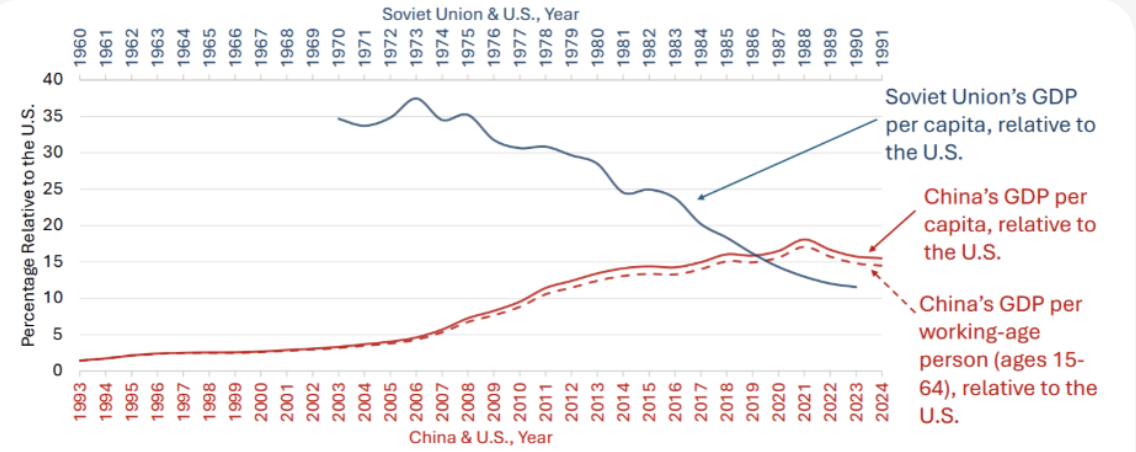
Still, as figure 1 suggests, China’s economic success is often greatly exaggerated. Yes, its economy grew rapidly after 1979, and it’s well worth asking how that growth came about. But a more pertinent question is this: Why is China still so poor fifty years after the end of the Maoist era, with all of its staggering societal upheaval and gross economic mismanagement?
In recent years, China’s GDP per capita is about one-sixth of the US level at market exchange rates. China’s consumption per capita is about one-tenth of the US level, or about one-sixth when adjusting for living costs. In other words, people in the United States produce and consume about six times as much per person as people in China.
Our economic system is superior to China’s. We should keep that in mind as we consider how best to respond to the economic and security challenge presented by the PRC.
Demographic advantage
China’s population has peaked and will fall sharply in the coming decades. Its total fertility rate is one child per woman. According to UN projections, China’s population ages 15 to 64 will fall by more than half over the next fifty years. China also has no capacity to attract and absorb large numbers of immigrants. It’s on a path to serious demographic decline, with no evident offramp.
Contrast that to the United States: The population continues to grow. The fertility rate is about 1.6 children per woman, not high enough by itself to prevent an eventual fall in population but much higher than in China. Moreover, the United States has a history of attracting immigrants and successfully integrating them into the economy and the American social fabric. Unless we bar the door and throw away the key, the US population can grow at a manageable pace for decades to come.
Those immigrants have made, and continue to make, vital contributions to American scientific and commercial innovation, to the great benefit of our economy and our national security. Thanks in no small part to Christopher Nolan’s epic film about Robert Oppenheimer (based on the book American Prometheus, by Kai Bird and Martin J. Sherwin), many Americans are broadly familiar with the contributions that European scientist-refugees made to the Manhattan Project that developed the atomic bomb.
Less well appreciated are the tremendous contributions that European émigrés made to major branches of physics, chemistry, genetics, and other fields before, during, and after World War II. In their article “German Jewish Émigrés and US Invention,” three of my fellow economists show that “émigrés encouraged innovation by attracting new researchers to their fields.” American-born scientists wanted to work with the best, and the best were often immigrants. That is still true, as I discuss with Stanford professor Rebecca Diamond on an episode of the podcast Economics, Applied. In recent decades, East and South Asia have become the most important sources of immigrant scientists, engineers, and physicians for the United States, as I discuss with UC-San Diego’s Gaurav Khanna in another episode.
To summarize, the United States has three major long-term advantages in its geopolitical contest with China: a superior economic system, a more favorable demographic outlook, and a demonstrated capacity to attract highly talented immigrants to help propel scientific and commercial innovation.
Unless the United States discards or squanders these advantages, it is much better situated for the “long game” than is China.
Degrading the trade advantage
Let’s return to the role of trade and its connection to security and prosperity. How did trade openness help America and its allies prevail in the Cold War? Briefly, in five ways:
Trade lets countries specialize in what they do best relative to other countries, acting like an improvement in production technologies. That’s David Ricardo’s great insight about comparative advantage.
Capital mobility lets resources flow to their most profitable uses, raising returns on investment.
Trade facilitates knowledge diffusion and the creation of new knowledge, further raising output and living standards.
An open trading system offers more room to exploit scale economies, lowering unit costs and strengthening the commercial incentives for innovation.
Finally, trade is a source of political influence and power, especially for a large, dynamic economy. America’s extensive commercial relationships with other countries were a major source of its geoeconomic power during and after the Cold War.
Under the second Trump administration, US trade policy has been chaotic, volatile, economically incoherent, and a major source of uncertainty for American businesses and for US allies and trading partners.
That uncertainty discourages investment, especially long-lived investments that are costly to reverse. It also diverts and dissipates the time and attention of business leaders and their staff, as they try to navigate a needlessly complex economic and policy environment. My Freedom Frequency article in October and a recent article by my friend and Hoover colleague Amit Seru in the New York Times elaborate on the economic damage caused by policy-induced uncertainty.
To be sure, the second Trump administration is not the first nor the only engine of harmful policy uncertainty in US history, but it has surpassed all previous administrations as a source of trade policy uncertainty. The retreat from a predictable, rules-oriented approach to international trade undermines trust and confidence in the reliability of the United States. It raises doubts about every trade agreement the United States has ever signed, and about the agreements it might sign in the future. It alienates allies and friends who help enhance our national security—whether it be Canada in the Arctic, Japan and Korea in East Asia, Australia and the Philippines in the South Pacific, or European NATO members.
Although the United States has not isolated its economy in the Soviet manner, we have made ourselves less attractive as an economic partner. We have diminished our economic leverage and political influence in the international arena as a consequence of the Trump administration’s approach to trade policy. It will take internal reforms and many years to repair the damage, even with a firm intention to do so by future US policymakers.
Some observers who lament the chaotic character of recent US trade policy still argue for a heavy use of tariffs to promote security and prosperity. I will close by considering just one element of this argument: the claim that tariffs are a useful policy instrument for promoting national security.
In fact, import tariffs are poorly suited to achieve national security objectives. Why is that?
At the most basic level, tariffs distort production and consumption decisions, whereas national security concerns usually arise elsewhere: they often pertain to production capacity (not production itself) and to resilience in the face of potential supply disruptions.
To appreciate this point, consider a concrete example. It’s often claimed that the United States needs (extra) steel-making capacity as a matter of national security. Let’s accept the claim for the sake of argument.
Are steel tariffs fit for purpose here? No, they are not. They raise prices for American consumers who buy products made with steel. They raise costs for US producers that use steel inputs. They discourage US exports of products made with steel. None of these consequences is in the economic or national security interest of the United States. They are just collateral damage.
Now, it’s true that tariffs on US steel imports encourage domestic steel production. But whether they lead to an expansion in domestic production capacity is a more complex matter that turns on expectations about future tariffs, among many other considerations. No firm builds a new steel mill simply because of a temporary tariff on steel imports. More broadly, tariffs that rest on nothing firmer than presidential pique and whim offer a poor foundation for capacity investments that support economic and national security.
Tariffs hurt our prosperity in other ways. They generate ill will among trading partners and invite retaliation, which causes additional harm to our economy and theirs. Tariffs imposed on dubious national security grounds weaken the credibility and value of future trade agreements—including President Trump’s many “deals.” Many tariffs imposed during the second Trump administration also run afoul of US trade agreements with other countries. Running roughshod over our trading partners further undermines trust and confidence in the reliability of the United States.
Of course, steel firms and workers appreciate the impact of tariffs, even temporary ones, on profitability and labor demand in the steel industry. So they have strong commercial incentives to invent and promote arguments for tariffs. In our democratic society, they have a right to do so. And we, as citizens, have a civic responsibility to recognize the motivations and to think through the actual effects of steel and other tariffs on our prosperity and security.
Staying the course
Trade openness contributed to Cold War victory. The leaders of communist China saw that experience and learned from it. China’s adoption of a more open posture to international trade is a principal reason it has emerged as a more powerful adversary in the economic realm.
Has China abused aspects of the international economic system? Certainly. Is that a sensible reason for the United States to retreat from a stance of openness to international trade? Certainly not. What is sensible is to ask how we can reform the trading system to ensure that it continues to advance American prosperity and security.
Steven J. Davis is Thomas W. and Susan B. Ford Senior Fellow and director of research at the Hoover Institution. Davis is an award-winning economist who studies working arrangements, business dynamics, economic fluctuations, and policy uncertainty. These and other economic policy issues are regularly covered on the Hoover Institution podcast he hosts, Economics, Applied.