
Global supply chains have entered a period of growing uncertainty and vulnerability. When natural disasters, pandemics, geopolitical tensions, wars, and protectionist policies cause disruptions of supply chains in one country, this quickly affects firms and consumers elsewhere. For the United States, this raises an important question: how can it maintain the benefits of global trade while reducing excessive dependence on risky or unreliable supply-chain partners? This article argues that Japan can play a much larger role in answering that question.
The power of diversification
Recent empirical evidence shows that disruptions of global supply chains can have large economic consequences because shocks do not remain confined to the firms or countries where they originate. They can travel downstream from suppliers to customers when key inputs are unavailable, and upstream from customers to suppliers when demand collapses.
A central way to reduce this vulnerability is to diversify supply-chain partners—both suppliers and customers—across countries. If firms rely too heavily on one country, a country-specific shock can sever critical links and interrupt production. By contrast, when firms maintain relationships with a broader set of partners in different locations, they are more likely to find substitutes when one source of supply or demand is disrupted.
Empirical evidence supports this view. Studies of the 2011 Great East Japan Earthquake, Hurricane Sandy, and the COVID-19 pandemic show that shocks propagate through firm-level supply chains, and that the size of the impact depends heavily on whether firms can substitute alternative suppliers. Evidence from disasters in the United States indicates that shocks are especially severe when inputs are specific rather than standardized. The case of Hurricane Sandy in 2012 also shows that internationally connected firms were less vulnerable than purely domestic firms, suggesting that foreign supply-chain links can provide valuable substitution channels in times of crisis.
However, the market economy may not achieve the socially optimal level of diversification. Private firms underinvest in supply-chain relationships because they bear the cost of creating productive and resilient links but do not fully capture the benefits those links generate for other firms. The implication is clear: supply-chain resilience has public-good characteristics and therefore provides a legitimate rationale for policy intervention.
US progress in diversifying supply chains
From this perspective, one major vulnerability for the United States before the US-China tariff war began in 2018 was its heavy reliance on China as a supplier of materials, parts, components, and final goods.
Since then, however, the United States has made substantial progress. Total imports from China declined sharply, from $563 billion in 2018 and $576 billion in 2022 to $327 billion in 2025. China’s share of total US imports fell from 7.2 percent in 2018 and 7.5 percent in 2022 to 4.9 percent in 2025 (Figure 1). The shift is even more striking in some strategic sectors. US imports of electrical and electronic equipment and parts from China dropped from $156 billion in 2018, equivalent to 42 percent of total imports in that category, to $84 billion in 2025, or only 16 percent.
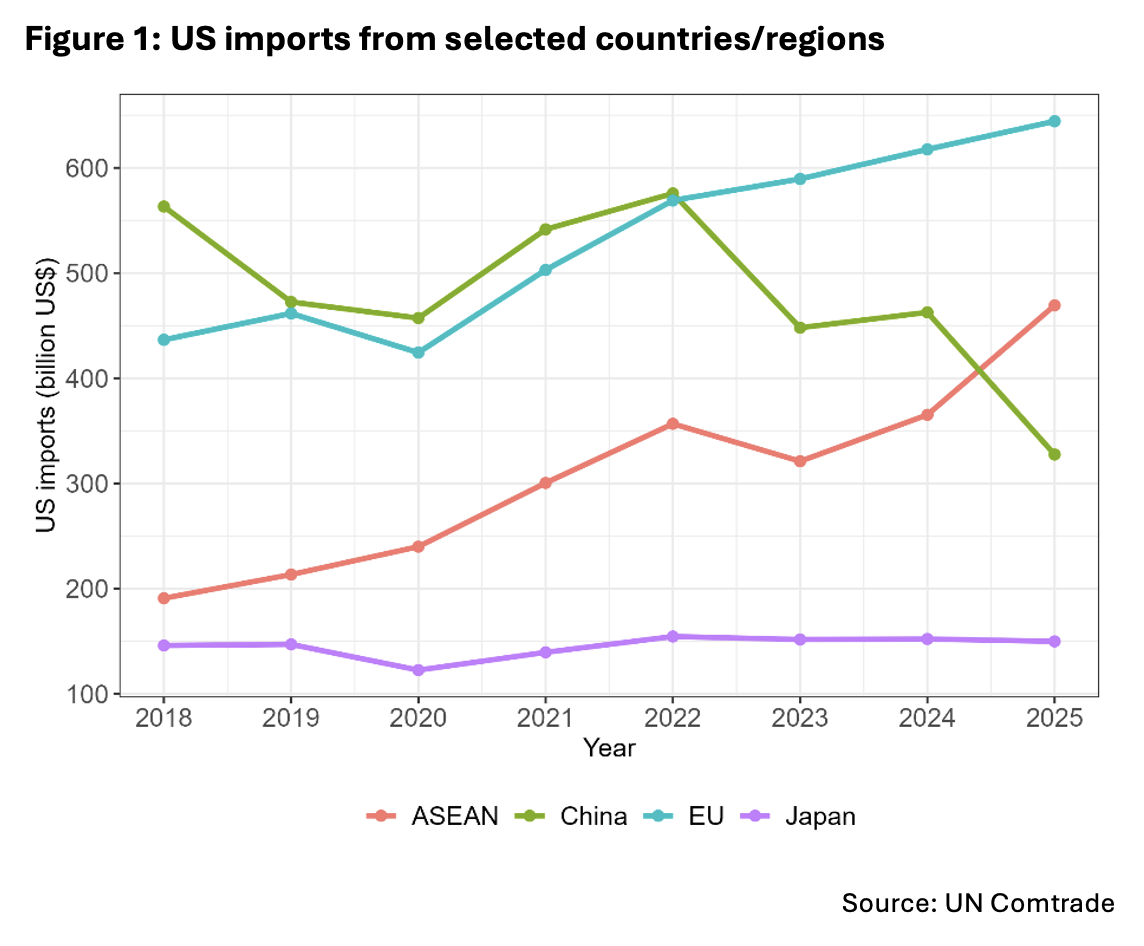
At the same time, US imports from Europe and ASEAN increased substantially. Particularly notable are the rise in pharmaceutical imports from Europe and the growth of electrical-equipment imports from ASEAN, especially Vietnam. These changes suggest that US firms have been reallocating part of their procurement away from China and toward alternative partners.
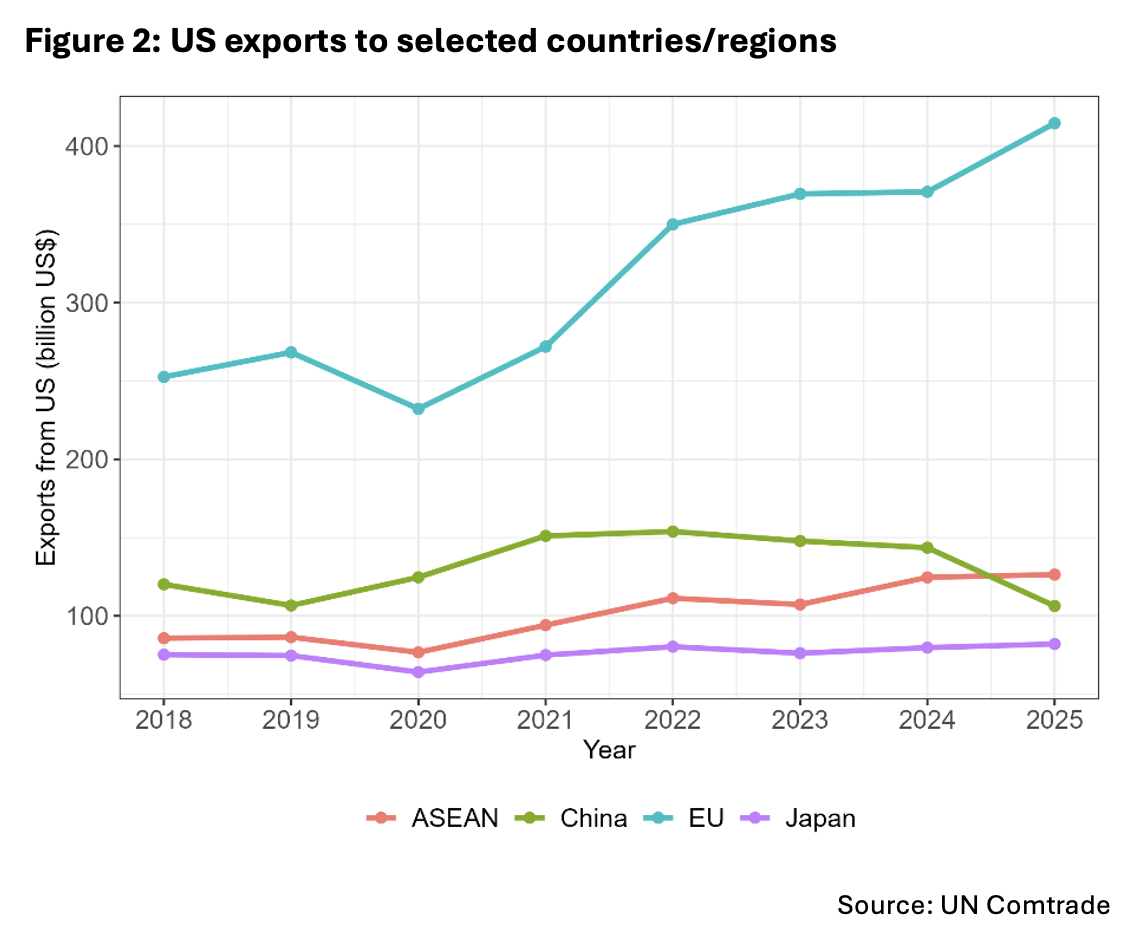
A similar pattern appears on the export side. Figure 2 shows that US exports to Europe increased, while exports to China have followed a declining trend since 2022. The expansion of exports to Europe was driven largely by liquefied petroleum gas (LPG), as Europe reduced its reliance on Russian energy following Russia’s invasion of Ukraine in 2022.
Taken together, these developments indicate that the United States has reduced its dependence on China in several critical areas, including pharmaceuticals and electrical and electronic equipment. This shift has strengthened both economic security and supply-chain resilience. It has also been shaped by US policy measures, including export controls on high-tech products bound for China and higher tariffs on Chinese goods.
But US-Japan trade has remained stagnant
One surprising finding from Figures 1 and 2 is that trade between the United States and Japan has remained largely stagnant. Japan has not become a substantially larger destination for US exports, nor has it gained importance as a source of US imports.
This stagnation is particularly notable in automobiles and auto parts, a sector in which Japan remains highly competitive globally. US imports of automobiles and related parts from Japan declined from $52 billion in 2018, or 17 percent of total US imports in this category, to $46 billion in 2025, or 14 percent. This decline may partly reflect indirect trade through Mexico and the expansion of Japanese firms’ local production in the United States in response to tariffs introduced in 2025. However, South Korea faced similar policy conditions and nevertheless increased its automobile exports to the United States from $19 billion to $38 billion over the same period.
The limited growth of US-Japan trade represents a missed opportunity for both countries. For Japan, expanding exports of automobiles, machinery, electronic equipment, and other advanced products to the United States would generate substantial economic gains. At the same time, greater imports of LPG and oil from the United States would help Japan strengthen its energy security by diversifying away from the Middle East.
The United States would also benefit from deeper trade with Japan for two main reasons.
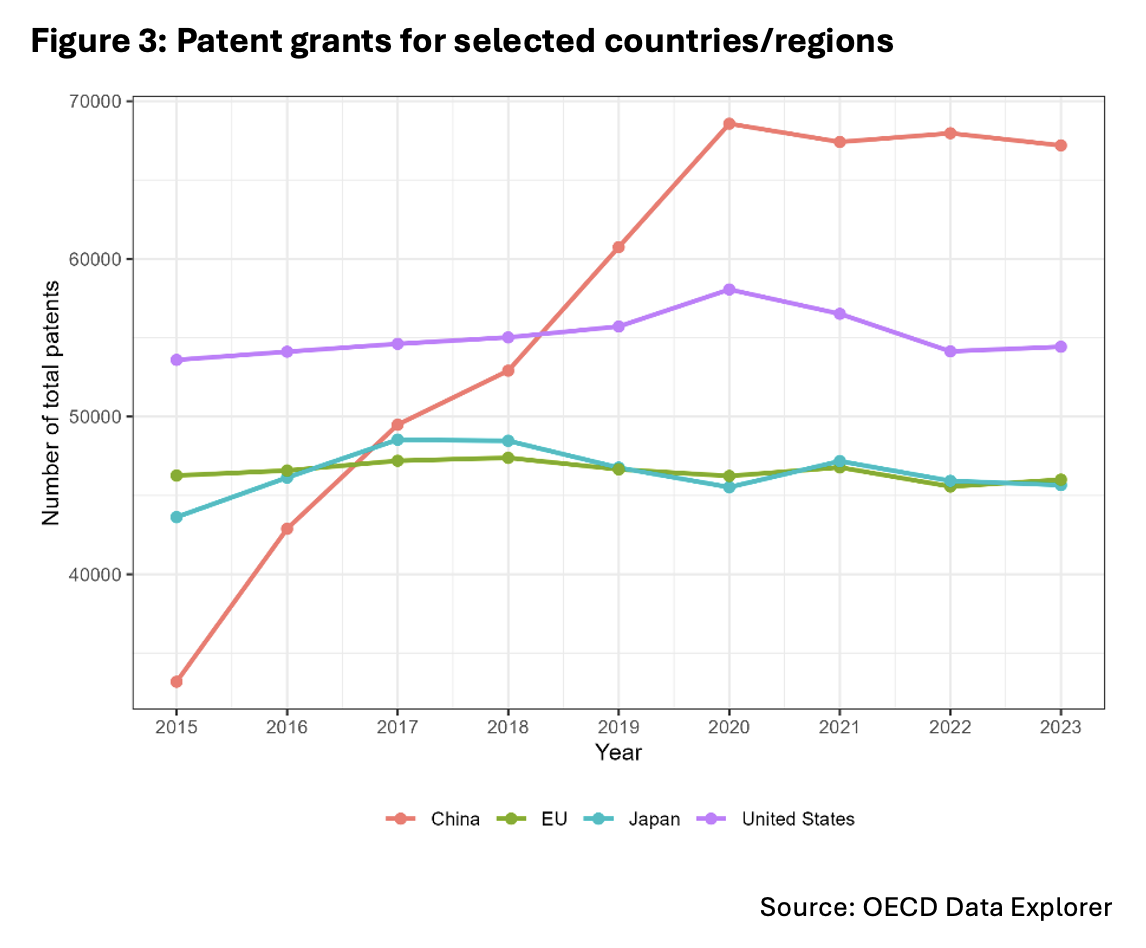
First, Japan is one of the world’s most innovative economies and produces a wide range of high-quality goods. Figure 3 shows that Japan remains among the world’s top three patent-producing economies, behind China and the United States and roughly comparable to the combined total of EU member states. In addition, Harvard’s Atlas of Economic Complexity ranks Japan first in the world in terms of the diversity and sophistication of its export capabilities. Greater imports from Japan would therefore improve the welfare of US consumers and firms by giving them access to high-quality, technologically advanced products.
Second, expanding trade with Japan would strengthen US economic security and supply-chain resilience because Japan is one of America’s closest and most reliable strategic partners. Figures 1 and 2 show that the United States has shifted part of its trade away from China and toward ASEAN. However, this shift does not necessarily remove the underlying vulnerability of US supply chains. Some exports from ASEAN to the United States may still rely heavily on Chinese inputs, Chinese capital, or Chinese-controlled production networks. In other cases, the apparent movement of trade from China to ASEAN may partly reflect detour trade: goods, components, or production stages are routed through third countries, but the underlying dependence on China remains largely unchanged.
Therefore, increasing trade with Japan would contribute not only to economic efficiency but also to a more secure and resilient supply-chain architecture for the United States.
How Japan can increase trade with the United States
The policy implication is straightforward: US diversification strategy should include a more explicit Japan pillar. A stronger US-Japan trade relationship, however, cannot be built by Washington alone. Japanese firms also need to adjust their strategies. Despite rising geopolitical risks, many Japanese companies remain deeply embedded in China-centered supply chains, and Japan’s diversification toward ASEAN, India, and the United States has been limited. For example, China’s share of Japan’s automobile-parts imports rose, rather than declined, from 35 percent in 2018 to 44 percent in 2025.
This continued reliance on China contrasts sharply with the recent US shift away from Chinese suppliers. One possible reason is that Japanese firms underestimate the risks of supply-chain disruptions associated with excessive dependence on China. Such underestimation may reflect managerial myopia or status-quo bias. Another possibility is that firms are reluctant to bear the costs of collecting and analyzing geopolitical risk information, because the benefits of such information spill over to other firms through supply chains and cannot be fully internalized. Recent survey-experimental evidence is consistent with this interpretation, finding that, even under current geopolitical threats, Japanese manufacturing firms are not willing to bear the costs of supply-chain diversification.
For this reason, the Japanese government should support the collection and dissemination of information on risks associated with supply-chain partners so that private firms can adequately assess the risks. Japan has already begun to build institutions for this purpose. The government plans to establish an Economic Security Center to strengthen economic intelligence, and it has launched the Trusted Thinktank Network Strategic Dialogue to share information on country risks and security risks with the private sector. These initiatives should help Japanese firms reassess their dependence on China and encourage them to turn more actively to the United States as a trade and supply-chain partner.
Using Japanese investment to aid trade and security
Another way to expand US-Japan trade is to make more effective use of foreign direct investment (FDI) between the two countries. In response to US protectionist policies aimed at reviving domestic manufacturing, Japanese manufacturing FDI in the United States has increased dramatically, from 1.1 trillion yen in 2018 to 5.6 trillion yen in 2025. In addition, following bilateral negotiations over reciprocal tariffs in 2025, Japan committed to $550 billion in strategic investment in the United States.
This expansion of Japanese FDI is likely to stimulate trade between the two countries, because trade and investment are closely connected. A recent empirical study finds that intrafirm trade between parent firms and their affiliates accounts for roughly half of US imports and one-third of US exports. Evidence from the 2011 Great East Japan Earthquake also shows that Japanese affiliates in China particularly increased imports from Japan after the shock. These findings suggest that FDI can create new export capacity and strengthen cross-border supply chains.
The expected projects under Japan’s $550 billion investment commitment illustrate this potential. One example is nuclear-reactor development by Westinghouse, in which Japanese firms such as Mitsubishi Heavy Industries and Toshiba are involved. Such projects are likely to generate exports of materials, parts, and machinery from Japan to the United States. Other planned areas include LNG, critical minerals, pharmaceuticals, and semiconductors, in all of which trade and investment are interrelated.
If designed well, these projects can create a genuine win-win outcome. From the US perspective, Japanese capital can expand domestic industrial capacity, create jobs, increase exports, and reduce reliance on China for strategic materials and manufacturing inputs. From Japan’s perspective, investment in US energy, critical minerals, and advanced manufacturing can diversify procurement away from geopolitically risky sources, strengthen Japan’s own economic security, and create new opportunities for Japanese exports to the United States.
Linking trade and FDI to knowledge networks
The benefits of trade and investment can be further strengthened when they are connected to knowledge networks, including research collaboration. Patent-based evidence shows that international research collaboration improves the quality of innovation in participating countries, including both the United States and Japan.
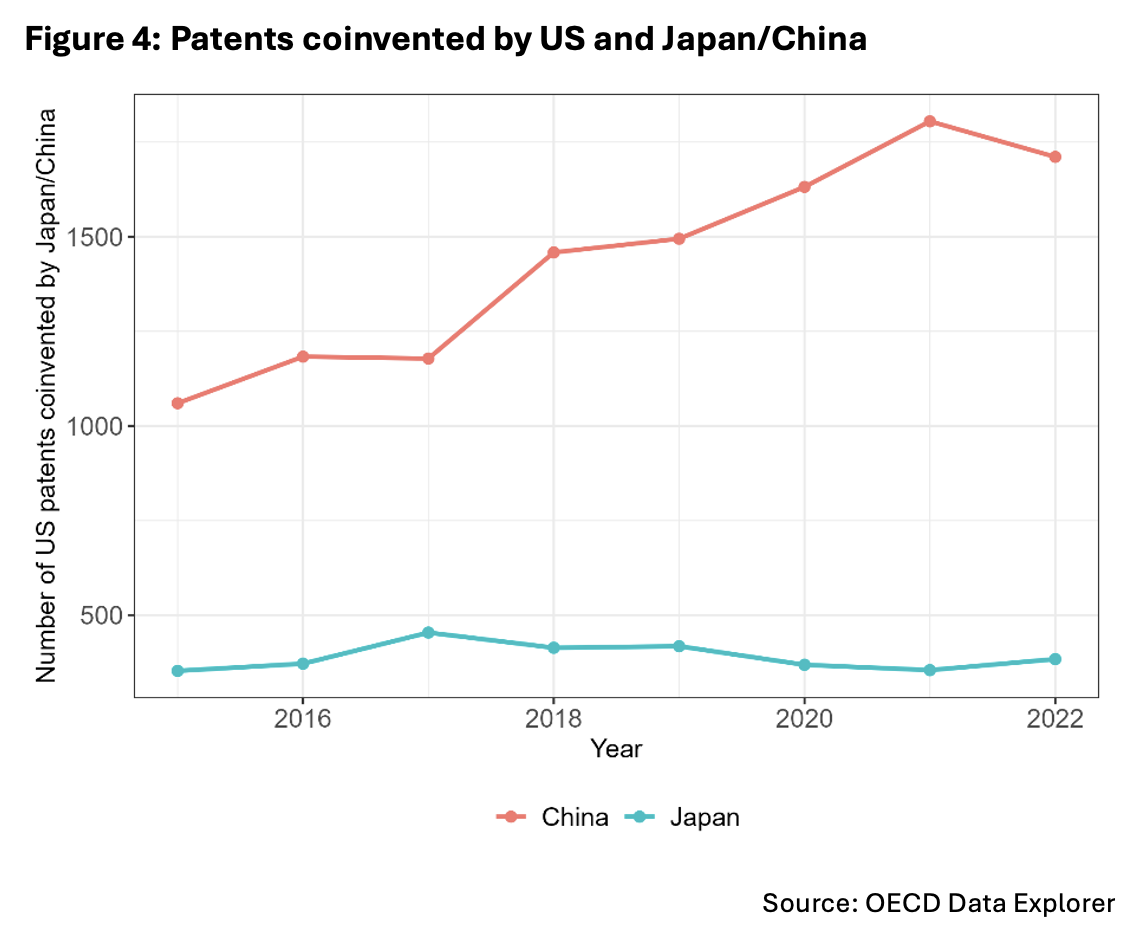
At present, however, US-Japan research collaboration remains surprisingly limited. As shown in Figure 4, the number of patents co-invented by Japanese and American researchers has been far lower and more stagnant than the corresponding figure for US-China collaboration.
There are, however, encouraging signs in the semiconductor industry. Supported by Japan’s new industrial policies, Rapidus—a new semiconductor firm receiving substantial government support—has pursued R&D collaboration with IBM in the United States, IMEC in Belgium, Leti in France, and other leading institutions. This includes the dispatch of 150 Rapidus engineers to IBM’s R&D center. In another policy-supported initiative, Japanese firms and universities, including Tokyo Electron and the University of Tokyo, are conducting joint research with foreign firms such as Intel, IBM, TSMC, and Samsung.
International joint research can also be facilitated by FDI. For example, Toyota’s research center in the United States collaborates with Stanford University on automated-driving technologies. Many Japanese firms investing in the US semiconductor industry are participating in research consortium in the semiconductor cluster in Arizona. The recent increase in Japanese FDI in the United States can therefore help promote bilateral research collaboration, particularly in frontier and critical sectors targeted by the $550 billion investment, as mentioned earlier.
To maximize joint research between the United States and Japan, policies are needed because firms and universities of the two countries often lack information about possible research partners. Therefore, the governments should cooperate with each other, creating consortia for information sharing and providing subsidies for joint research projects. Innovation corridors built by policies would raise the productivity of investment projects, increase the technological content of bilateral trade, and make both countries less dependent on China-centered innovation ecosystems.
Conclusion: Japan should be central to a de-risking strategy
The United States has made meaningful progress in reducing its reliance on China, but a durable de-risking strategy requires more than shifting trade to alternative locations. It requires building deeper economic ties with partners that can provide high-quality products, trusted supply chains, strategic investment, and advanced technological collaboration. Japan is uniquely positioned to play that role. Expanding US-Japan trade, making better use of Japanese investment in the United States, and linking those investments to research and innovation networks would benefit both countries: the United States would gain a more resilient industrial base and more secure access to critical inputs, while Japan would diversify away from geopolitical risk and create new opportunities for its firms.
In an era when economic efficiency and national security are increasingly inseparable, Japan should be treated not as a secondary trading partner but as a central pillar of America’s long-term economic security strategy.
Yasuyuki Todo is a professor at the Graduate School of Economics, Waseda University, and a former department head at the Department of International Studies, University of Tokyo. He is also a program director at the Research Institute of Economy, Trade and Industry.
 Powered by