 Powered by
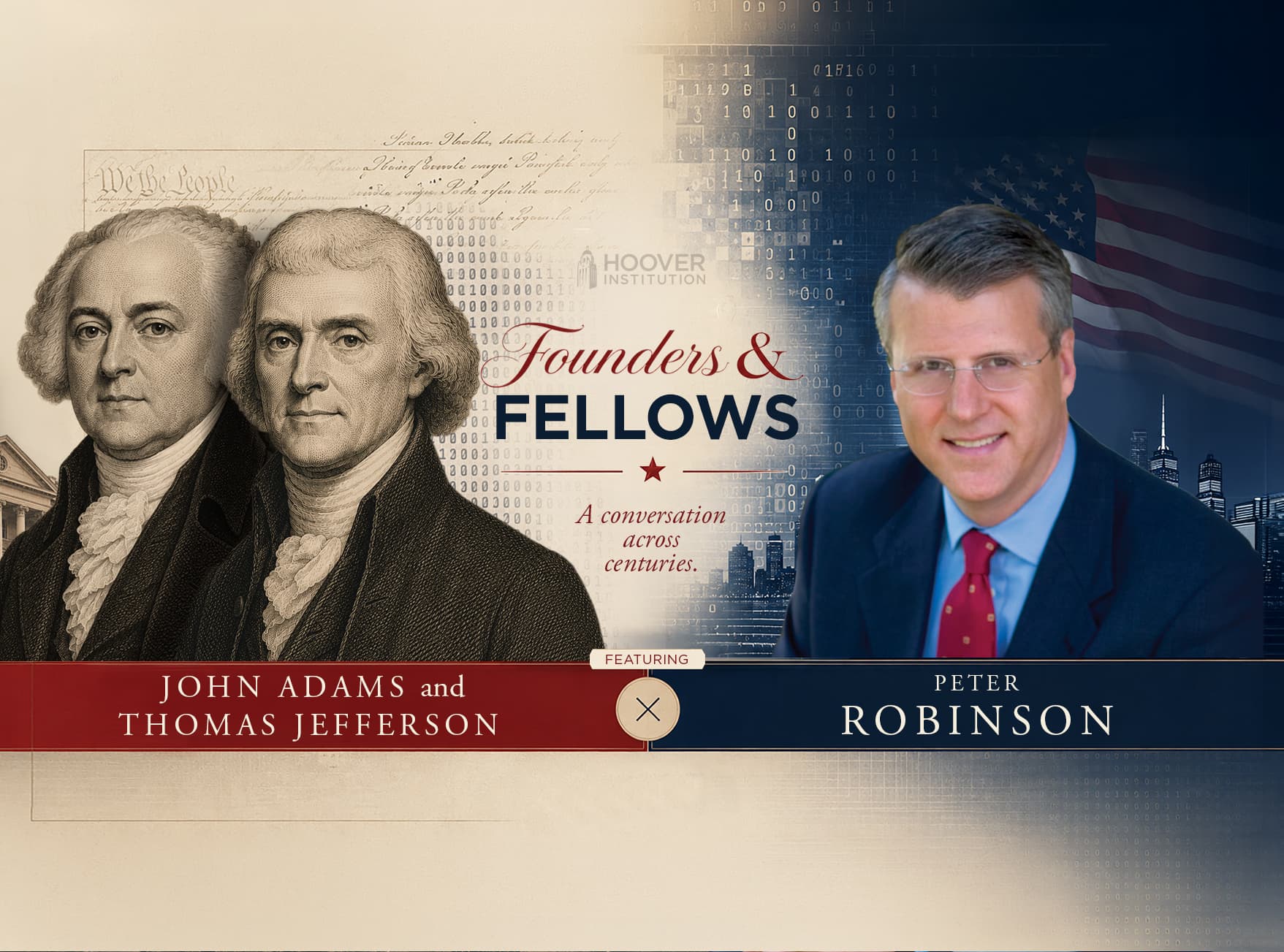
The letters that John Adams and Thomas Jefferson exchanged in old age represent a trove so rich that I have found myself returning to it again and again since I picked up the collection in college. “You and I ought not to die,” Adams wrote to Jefferson in 1813, “until we have explained ourselves to each other.”
Adams and Jefferson first exchanged letters in 1777, when Adams remained in the Continental Congress but Jefferson had returned to Virginia. Then they had kept up their correspondence throughout their diplomatic postings (Adams most famously in Britain, Jefferson in France), their service in the administration of George Washington (Adams as vice president, Jefferson as secretary of state), and during the administration of Adams himself (Jefferson as vice president). But when Adams ran for a second term as president in 1800, Jefferson ran against him—and won. The campaign proved so bitter that, on the day of Jefferson’s inauguration, Adams rose before dawn to leave Washington for Massachusetts, refusing to attend the ceremony. For the next eleven years the men cut each other off, exchanging not a word.
Then on January 1, 1812, Adams sent Jefferson a note, largely at the urging of Dr. Benjamin Rush, a signer of the Declaration of Independence who had sought for years to reconcile his two friends. Adams offered Jefferson little more than “many happy New Years”—his note came to fewer than 200 words—almost as if expecting to find himself rebuffed. But Jefferson’s reply—a letter of more than 800 words—proved effusive.
A letter from you . . . carries me back to the times when, beset with difficulties and dangers, we were fellow laborers in the same cause. . . . Of the signers of the Declaration of Independance I see now living no more than half a dozen on your side of the Potomak, and, on this side, myself alone. . . . No circumstances . . . have suspended for one moment my sincere esteem for you; and I now salute you with unchanged affections and respect. Th: Jefferson
Adams and Jefferson went on to exchange more than 150 letters.
The letters discuss history, science, political theory, and theology. Jefferson provides a detailed account of the Indians of Virginia; Adams, of the Indians of Massachusetts. Passage after passage illuminates the country’s early history, and certain passages prove especially striking. The discussion of the French Revolution, for instance. Jefferson had admired the upheaval while Adams had loathed it. “The French Patriots,” Adams wrote in July 1813,
Appeared to me like young Schollars from a Colledge or Sailors flushed with recent pay or prize Money, mounted on wild Horses, lashing and spurring, till they would kill the Horses and break their own necks. . . . Where is now, the progress of the human Mind? When? Where? And how? Is the present chaos to be arranged into Order?
When Jefferson replied in October, he admitted that the French Revolution failed—but insisted on the gradual enlightenment of mankind even so. “The world will recover from the panic of the first catastrophe,” he wrote. “Science is progress, and talents and enterprize on the alert.”
We see here the two opposed ways of looking at the world that have informed much of American history, the conservative and progressive outlooks—or, as Thomas Sowell has described them, the “constrained vision” and “unconstrained vision.” In the persons of Adams and Jefferson, the letters demonstrate, these two tendencies have been with us since the very beginning.
One subject comes up only obliquely. On December 10, 1819, Jefferson wrote to Adams about the “Missouri question.” Missouri, the first part of the Louisiana Purchase to have been organized into a territory, now wanted to enter the Union—as a slave state. The South championed the Missouri cause. The North opposed it. (The following year, President James Monroe would sign the Missouri Compromise, admitting Missouri as a slave state balanced by Maine, which the measure admitted as a free state.) The “Missouri question,” in other words, was the question of slavery.
All the other issues of the day, Jefferson wrote, represent only “waves [that] will pass under the ship.”
But the Missouri question is a breaker on which we will lose the Missouri country by revolt, and what more, God only knows. From the battle of Bunker’s hill to the treaty of Paris we never had so ominous a question. . . . I thank god that I shall not live to witness it’s issue.
How did Adams reply? In a recent letter to a different correspondent Adams had demanded the “total extirpation of slavery from the United States.” Did the abolitionist Adams repeat that demand to the slaveowner Jefferson? Did he deliver a polemic? Scarcely. “The Missouri question,” Adams merely wrote, “I hope will follow the other Waves under the Ship and do no harm.”
This exchange offers a couple of insights. One concerns the extent of the two founders’ friendship. Adams knew that Jefferson was in declining health—in a previous letter Jefferson had complained of three illnesses in just a few months—that Jefferson had been forced to mortgage much of his land, and that in any event Jefferson had already lived all his life with a contradiction, suffering what we might now call “cognitive dissonance.” Although opposed to slavery—at the Continental Congress Jefferson had called the slave trade an “execrable commerce”—he had always been a slaveowner. Now Jefferson was all but confined to Monticello, an old man who depended on slaves to harvest his crops and cook his food and tend to him in his ill health. What good would it have done, Adams seems to have reasoned, to have started a fight with Jefferson now? Instead, Adams let him off.
Which brings us to the other insight. This concerns the nature of slavery itself. The institution proved so terrible that even two of the most literate men the nation has ever produced could never quite bring themselves to discuss it with each other directly, relying on euphemism instead.
Many exchanges return to one question: Can a government be good if its people are bad? If the people practice vice instead of virtue? If they are corrupt or depraved? “I confess,” Jefferson wrote on December 10, 1819, “that I [cannot] see how this aenigma can be solved.”
Eleven days later Adams replied.
Will you tell me how to prevent riches from becoming the effects of temperance and industry? Will you tell me how to prevent riches from producing luxury? Will you tell me how to prevent luxury from producing . . . vice and folly? When you will answer me these questions, I hope I may venture to answer yours.
The situation was even worse, Adams argued, than Jefferson had suggested. It wasn’t just that good government was impossible with bad people. Good government would lead to prosperity—and prosperity would lead to vice. Good government, then, would create bad people. And if Adams worried about the effects of prosperity in his day, how much more worried should we be now, as AI promises prosperity at levels Adams could never have imagined?
Then Adams’s argument suddenly shifted.
Yet all these ought not to discourage us from exertion, for . . . I believe no effort in favour of Virtue is lost, and all good Men ought to struggle both by their Council and Example.
Here we find something like a statement of faith. Although we cannot know what will come of our actions—although life will indeed involve its enigmas—we must struggle on all the same. No effort on behalf of virtue is lost. If such a belief sustained Adams, then perhaps we might draw strength from it ourselves.
Thomas Jefferson composed his final letter to John Adams on March 25,1826, at the age of eighty-two. He asked permission for his grandson Thomas Jefferson Randolph to visit Adams, now ninety. “Like other young people, he wishes to be able, in the winter nights of old age, to recount to those around him what he has heard and learnt of the Heroic age preceding his birth.” In his final letter to Jefferson, Adams replied on April 17. “Your letter is one of the most beautiful and delightful I have ever received.”
On the Fourth of July 1826, half a century after the Declaration of Independence, Thomas Jefferson died at Monticello just after noon. John Adams died at Quincy that evening. Unaware of Jefferson’s death, Adams spoke these final words: “Thomas Jefferson still lives.”
In their letters, both still live.
Peter M. Robinson is the Murdoch Distinguished Policy Fellow at the Hoover Institution, where he writes about business and politics and hosts Hoover’s video series, Uncommon Knowledge with Peter Robinson.