 Powered by
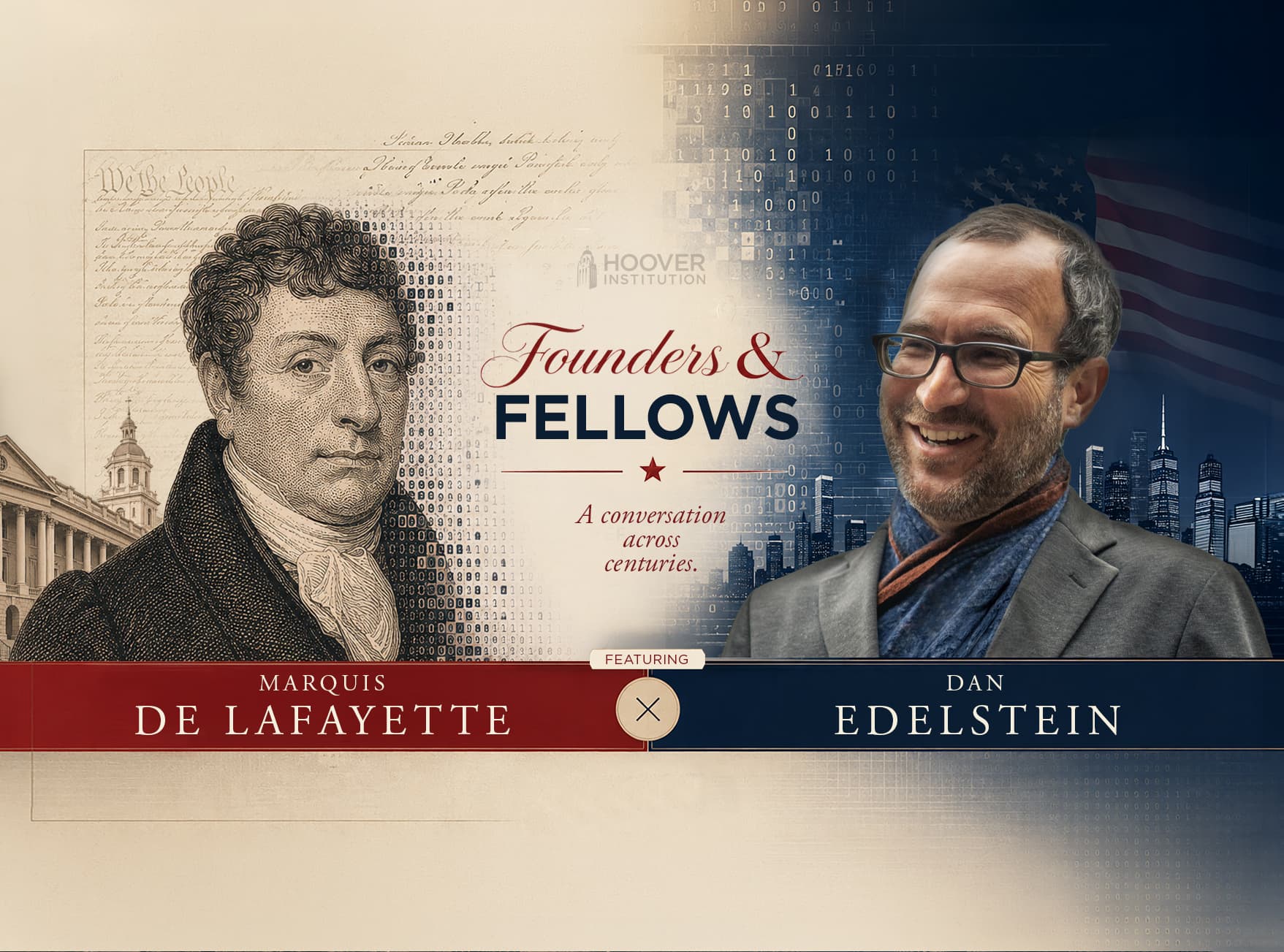
Known in his day as the “hero of the two worlds,” the Marquis de Lafayette was perhaps the most prominent member of his generation to play a decisive role in both the American and the French Revolutions. In the United States, he is fondly remembered, and his achievements are duly recognized: a park bearing his name extends directly north of the White House. By contrast, his reputation in France is more mixed, if not a little tarnished. What accounts for this difference?
Lafayette’s role in the American Revolution was primarily military and diplomatic. He served as a major general in the Continental Army and enjoyed a close, almost filial relationship with his commander, George Washington. He served with distinction, playing a crucial part in pinning Cornwallis down at Yorktown. He was also an indefatigable promoter of American interests back home, leading a parallel diplomatic charge to commit French troops on the side of the Americans (or, from a French perspective, against the British). After the war, he became an abolitionist, proposing and even implementing plans to emancipate slaves and hire them as paid laborers instead.
Given the crucial role of French guns, silver, and ships in securing American victory, Lafayette’s contributions are well worth celebrating. He took a victory lap through the American states in 1824–25, reuniting with old friends such as Thomas Jefferson, and received a hero’s welcome wherever he went. Dozens of American cities, towns, and counties were named after him. Why, then, is he less celebrated in France?
At first, his popularity did extend back across the Atlantic. In his Parisian residence, he displayed a copy of the Declaration of Independence, leaving an empty frame beside it: that space, he would tell visitors, is for a future French declaration. He in fact penned one of the earliest versions of what would become the “Declaration of the Rights of Man and of the Citizen” (Déclaration des droits de l’homme et du citoyen), sharing early drafts with Jefferson. It was through that correspondence that “resistance to oppression” was added to Lafayette’s proposal, and ultimately found its way into article 2 of the final declaration.
The early years of the French Revolution saw Lafayette’s star rise higher still. Named commander of the National Guard after July 14, 1789, he rode out behind the market women who marched to Versailles that October. They stormed the palace, sending Marie-Antoinette fleeing through a secret passage. Lafayette saved the royal family, leading them out onto a balcony and bestowing a kiss on the queen’s hand to vouchsafe her patriotism. Then the crowd led the king, the queen, and their children back to Paris, where they would remain under popular supervision.
Things started to go downhill for Lafayette two years later. On June 20, 1791, the king disguised himself and fled Paris with his family. He was stopped at Varennes, where the postmaster recognized his face, printed on every coin and paper money of the realm. The king was returned to Paris, but the damage to the monarchy was irreparable. Protesters soon gathered on the Champs de Mars to demand a republic. On July 17, the mayor, Jean-Sylvain Bailly, declared martial law; Lafayette ordered the red flag raised, and the National Guard started to fire. Dozens of demonstrators were killed, in what became known as the Champs de Mars massacre. It was the first case of revolutionary-on-revolutionary violence.
This was also the first strike against Lafayette, sometimes revered as the moderate who could have saved the French Revolution. The only crime of the protesters whom he ordered shot in 1791 was that they wanted a republican constitution. Wasn’t the American Revolution also fought to end the “evil of monarchy,” as Thomas Paine had phrased it? Those who regard Lafayette as the “good” French revolutionary, largely for his moderation, usually contrast his behavior with the excesses of the Terror. But those dramatic actions were still over a year away when Lafayette gave orders to fire on unarmed protesters.
What’s more, it was Louis XVI himself who had precipitated the July 1791 crisis by abandoning Paris and seeking to join up with counterrevolutionary forces beyond the border.
Louis XVI was installed as a constitutional monarch all the same. Having resigned as commander of the National Guard in October 1791, Lafayette was soon given a new military command. He was sent off to the eastern front, to prepare for war. Instead, he sought to prevent a second revolution in Paris. He repeatedly inveighed against the Jacobin Club, both in print and in person. They responded in turn, branding him an aristocratic traitor. He was on the verge of being stripped of his command when an even greater transfer of power took place. On the night of August 9-10, 1792, Parisian crowds stormed the Tuileries Palace, overthrowing the monarchy.
This “second” French Revolution was Lafayette’s Rubicon. On August 17, he was indicted for treason by the new minister of justice, Georges Danton. Rather than return to Paris and face imprisonment and near-certain death, he deserted his post and crossed over into the Austrian Netherlands. His plan was to return to the United States, but he was arrested by Austrian troops. Unlike other émigrés, Lafayette was not welcomed by the enemies of the French. His leading role in revolutionary politics up until that point led him to be treated as a political prisoner. He would spend the next five years in Austrian and Prussian jails.
Prison turned out to be the best way to redeem his reputation. It probably also saved his life. When he was finally freed in 1797, thanks to Napoleon’s efforts, the Paris radicals who had branded him a traitor had themselves perished in the ensuing Terror or the Thermidorian reaction. Lafayette’s own actions looked prophetic in hindsight.
On principle, Lafayette refused any involvement in, or honors from, Napoleon’s government. He served in the short-lived Chamber of Representatives during Napoleon’s Hundred Days (in 1815), and then as a liberal member of the Chamber of Deputies, under the restored Bourbons. He also became involved in hazier attempts to launch revolutions in France and beyond, through the Carbonari, a kind of revolutionary freemasonry that had sprung up in Italy in opposition to Napoleon. Unlike with some other revolutionaries, Lafayette’s brush with radicalism had not dimmed his enthusiasm for liberal reform. His conspiratorial efforts, however, did not pan out (and almost got him arrested for treason). Only in 1830 did a revolution break out again in Paris, ousting the Bourbon monarchs for a second and final time.
Here again, Lafayette played a curious role that has not endeared him to French républicains. As Parisian revolutionaries clamored for a republic, Lafayette decided to back Louis-Philippe d’Orléans, a distant cousin of the deposed Charles X. As in 1791, Lafayette rejected republicanism as a viable option for France. And so on July 31, the seventy-two-year-old general re-enacted a scene from 1789: he stood on the balcony of the Parisian Hôtel-de-Ville and this time bestowed a kiss on Orléans, symbolically choosing a constitutional monarchy over a republic. The July Monarchy, as it would be called, proved a disappointment, as had the brief constitutional monarchy of 1791–92.
The Marquis de Lafayette, who helped establish republicanism in America, never believed that it was possible in his own country. The hero of the two worlds has remained an unalloyed hero in only one of them.
Dan Edelstein is a senior fellow by courtesy at the Hoover Institution. He is also the William H. Bonsall Professor of French and, by courtesy, professor of political science and history at Stanford University. As the Nehal and Jenny Fan Raj COLLEGE Director, he directs Stanford’s first-year general education requirement. He also codirects the Stanford Civics Initiative and is the faculty codirector for the ePluribus Stanford initiative.