 Powered by
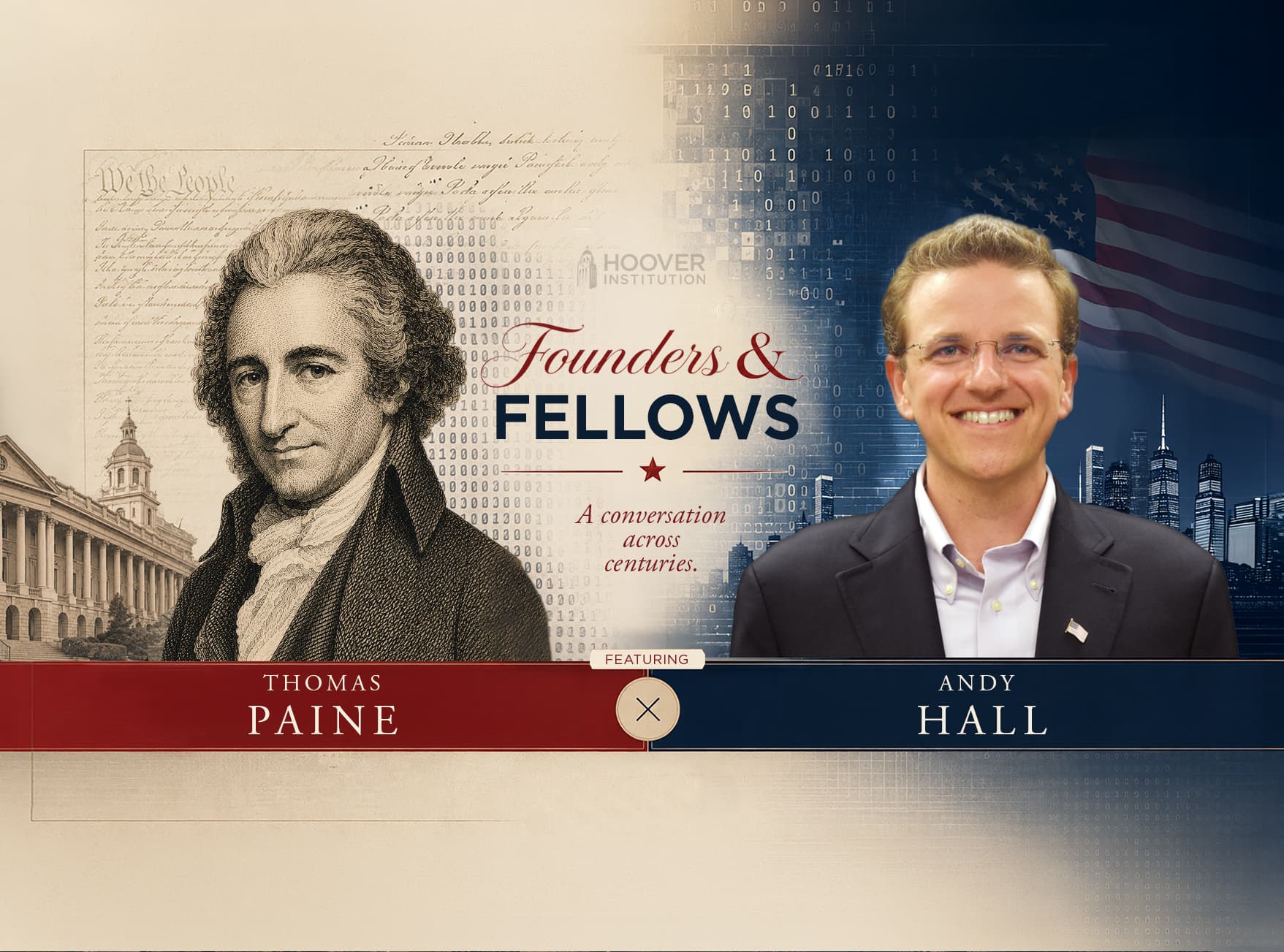
Thomas Paine is not the most famous founding father. He didn’t serve in high political office, help draft the Constitution, or sign the Declaration of Independence. But among a group who believed that the pen was mightier than the sword, his pen—or perhaps I should say, his quill—was the mightiest of all.
It was Paine who most memorably gave voice to the desire for independence, who spoke directly to the American people about why they should value their freedom, and who most emphatically rejected the idea that the accumulated traditions of the past—which could be antiquated or unjust—should govern the living.
Paine embodied an almost fanatical enthusiasm for America’s opportunity to wipe the political slate clean—to shed the encrustations of aristocracy and monarchy and deliberately construct a new system of government. “We have it in our power to begin the world over again,” he proclaimed in Common Sense. “The birthday of a new world is at hand.”
Today, we again stand before technologies that could allow us to remake representative government: to recover democratic possibilities that our existing institutions have lost, and to slough off some of the imperfections and corruptions that have accumulated within them. What might Paine make of this?
In his own time, Paine believed that the new science of representative government had solved one of democracy’s oldest problems. The democracies of the ancient world required citizens to gather and make laws in person. As their populations and territories expanded, this became, in Paine’s words, “unwieldy and impracticable.” Because the ancients had not discovered representation as a technology for governance, he argued, their democracies either collapsed or gave way to aristocracy and monarchy. Representative government allowed democratic principles to operate at a previously impossible scale.
For Paine, representative government was a technology for harnessing the intelligence of an entire society—not only a way to overcome the barriers of physical distance. “The representative system,” he wrote in Rights of Man, “is calculated to produce the wisest laws, by collecting wisdom from where it can be found.” Paine believed that a great deal of human intelligence ordinarily remained politically “dormant.” Properly designed institutions could awaken it and bring it into public life.
Our representative institutions aren’t entirely meeting that goal.
Citizens possess enormous amounts of relevant knowledge about their communities, occupations, and needs, yet our representatives don’t always do a good job of translating that into effective and reasoned policy. Elections compress thousands of complex choices down into a small set of options, and voters are frequently forced to choose only among a set of highly unpopular options—as in the 2024 presidential election, which featured two severely unpopular candidates, the third election in a row in which both candidates were viewed disfavorably on net. Meanwhile, on many issues, only the loudest and most extreme voices get heard, with the quieter but much larger group of reasonable citizens largely left out of the process.
Artificial intelligence (AI), though, could help us revisit Paine’s original promise. Imagine that every citizen had a personal political representative, a tireless, always-on AI agent that understood her values, explained legislation in terms relevant to her circumstances, compared politicians’ actions with their promises, and asked for her judgment when a genuinely important tradeoff arose. With such an agent, a person could engage on all the issues that matter to her, so that politics becomes less dominated by the small group of extreme people with nothing else going on in their lives. In this way, our agentic representatives might finally help representative government do what Paine had imagined: collect true wisdom wherever it can be found.
But Paine’s own experiences carry notes of caution, too. His extraordinary strength—his conviction that inherited institutions could be swept aside and rationally reconstructed—was closely connected to his greatest weakness. He sometimes wrote as if there were few or no downsides to wiping away the learned wisdom of the past. America, he declared, had “no occasion to roam for information into the obscure field of antiquity.” Its revolutionaries could act as though they “had lived in the beginning of time.”
But America did not truly begin from scratch, and it’s a good thing we didn’t. Our new government depended upon inherited law, colonial assemblies, religious communities, habits of local self-rule, and norms of compromise and restraint that no constitutional designer had created anew from whole cloth. Paine was superb at showing that institutions presented as sacred or inevitable were human constructions and could be improved. He was, perhaps, less attentive to the tacit knowledge and accumulated practices that offered useful insights on the right paths forward.
We should be equally suspicious of the idea that sufficiently intelligent machines can engineer away all the difficulties of self-government or allow us to start completely over. Futurists, tinkerers, and engineers of various stripes have often promised that previous waves of technology would similarly allow us to overhaul democracy, with mostly disappointing results. AI is not going to solve the fundamental problems of governance overnight.
Nevertheless, it presents a generational opportunity, and Paine would remind us to seize it boldly. Paine’s enduring contribution was to insist that the arrangements we live under were made by people and can therefore be remade by people. As we gaze now upon the opportunity to refashion self-government in a new age of machine intelligence, it is hard not to feel once more that “the birthday of a new world is at hand.”
Andy Hall is a senior fellow at the Hoover Institution and the Davies Family Professor of Political Economy at the Stanford Graduate School of Business (GSB). Hall is the founder and director of the Free Systems research lab, housed across the Hoover Institution and GSB, which studies how to preserve human liberty in an increasingly algorithmic world.