 Powered by
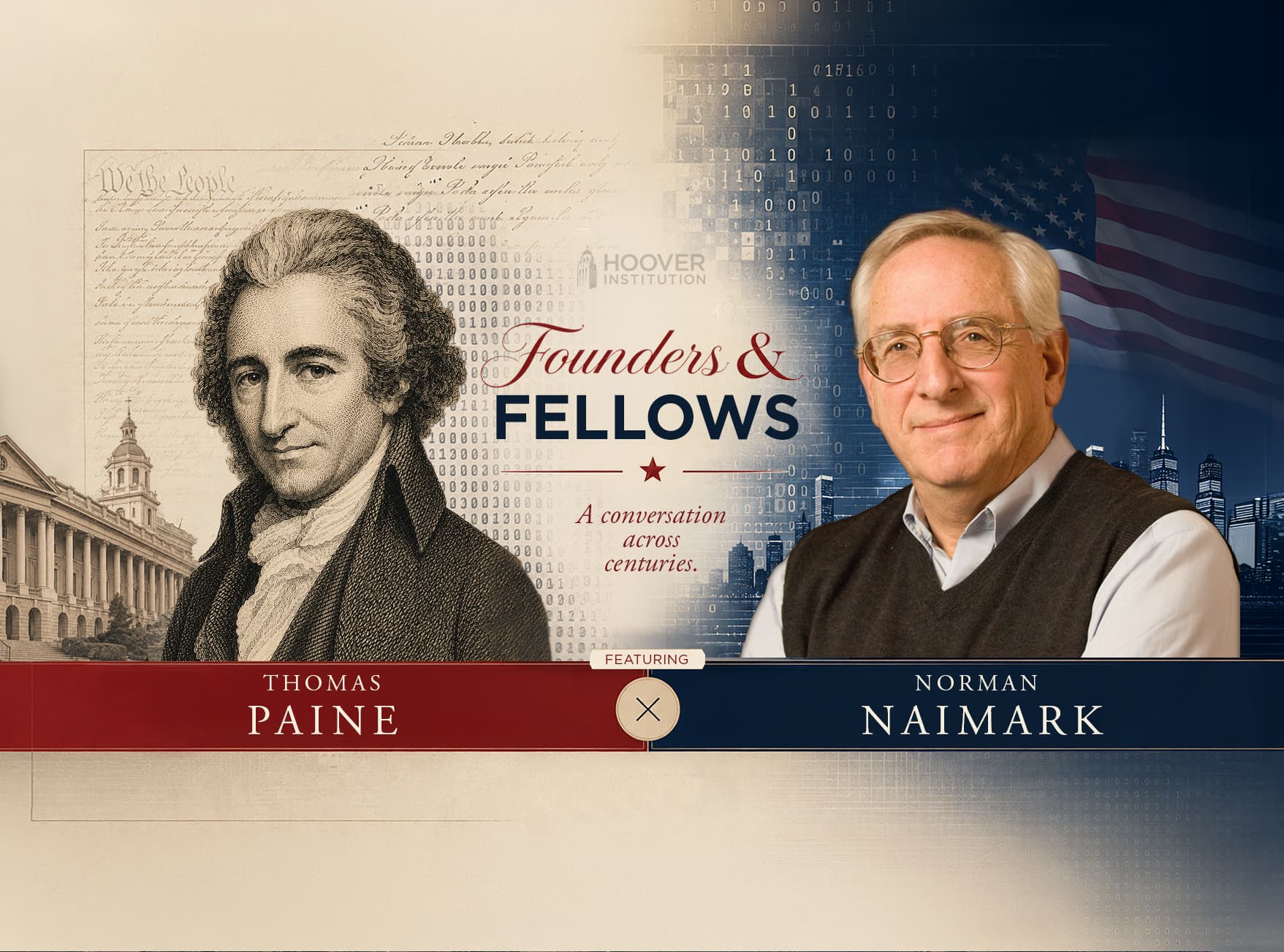
Tom Paine was an unusual founding father. He neither engaged in colonial politics nor signed the Declaration of Independence. He occupied no positions in the Continental Congress or in the newly founded American Republic. There is no statue of him in Washington, and he does not appear on our currency. But we cannot think about the making of the free and independent United States without him.
Some would call him a journalist or a polemicist, and he was both. But that doesn’t quite capture the crucial place he occupies in the pantheon of the Revolution. His writing during the time of revolutionary upheaval was so inspiring, his phrases so memorable, and his impact so lasting that his contributions are central to any history of the American Revolution.
Paine was born January 29, 1737, in Thetford, Norfolk, England. He came from a very modest background. His father, Joseph, was an artisan staymaker (a craftsman who made women’s corsets), and his son followed him into that occupation when he left school at age thirteen. Paine grew up nevertheless with a curious and inventive mind. He read newspapers; he showed an early interest in science and technology; and he debated contemporary issues in the pubs of London, where he had moved in June 1774. He never found success in the staymaking business and switched to being a teacher at one point, a privateer at another, and a minor customs official.
To his good fortune and ours, he met Benjamin Franklin, at the time the colonial agent of Pennsylvania in London, and received from him a letter of recommendation to his son-in-law (September 30, 1774) as “an ingenious worthy young man.” In October 1774, Paine boarded ship to Philadelphia.
As with so many other talented but unfulfilled immigrants before Paine and since, Paine’s fortunes changed dramatically for the better when he came to the New World. Paine found work at a new local journal, the Pennsylvania Magazine, courtesy of Franklin’s contacts.
The year was 1775 and the colonists were in an uproar over taxes and absolutist demands on their livelihoods. Moreover, colonial militia units had suffered violent attacks by Royalist troops at the battles of Lexington and Concord in April 1775. Most colonists, Paine later wrote, were ready to accommodate the British authorities so that they could live in peace. Paine entered the fray with the passionate conviction that natural law, the essence of the Enlightenment to which he was dedicated, dictated that the colonies must become independent.
In his anonymous pamphlet Common Sense (January 10,1776), Paine set forth the principles of independence and the need for self-government in the straightforward and logical terms that common folk could understand. He was a master rhetorician, stating his arguments not only clearly but with engaging and enlightening metaphors.
There could be no peace and prosperity in the colonies until they joined together, declared their independence, built up their army, and prepared themselves to fight for what was justifiably theirs: sovereignty. They had the ability to do so; they had the resources and the army; and most important, they had the strength of character. To wait was to invite either anarchy—and with it the excesses of a demagogue—or to suffer continuing British outrages.
Common Sense was a huge success. It provided important impetus to the gathering storm of opinion that resulted in the Declaration of Independence six months later.
Common Sense speaks to American citizens today in profound ways. Paine views government as a “necessary evil.” As reasonable as it is to be governed by one’s fellow men, government should never be an institution that lords over the people but instead takes its instructions from them. It should do so through a representative assembly that meets regularly, holds free elections, the key to democracy, and enjoins its representatives to constantly interact with their constituents. Paine was a fervent opponent of King George III, and all monarchies for that matter. Societies should be free of “rulers” of any sort, he argued. Still, a “Union of the States” would “take precedence” over the sovereign rights of individual states. “Only with a strong union could the country have influence abroad and security at home.”
The rule of law is the essence of Paine’s understanding of how a society could function without domineering political leaders. Monarchs made their own laws when and if they pleased and therefore were marked by a kind of original sin. But the decent treatment of human beings living in a Republic and the guarantee of their rights could only be institutionalized by the supremacy of law.
For Paine—and for the United States in its subsequent view of itself—the American Revolution was never just about the thirteen colonies or the North American continent. In this sense, he was a true Enlightenment thinker and, as he stated, a “universal citizen.” The American Revolution was a signpost for the world, demonstrating the supremacy of reason and republican virtue. The colonists could create something with their Revolution that would change the destiny of mankind forever, free it from its shackles of ignorance and tyranny, and create general prosperity. “We have it in our power to begin the world over again,” Paine wrote.
The founding fathers soon learned that it was one thing to declare independence, it was quite another to maintain it against British opposition. Paine himself went to war alongside Washington and suffered many of the same hardships that the Continental Army endured during the winter of 1776. Before crossing the Delaware on Christmas 1776 and surprising the Hessians at Trenton, Washington ordered the first of Paine’s thirteen “Crisis Papers” read to his troops, urging them to understand what they were fighting for: liberty and independence, not just for themselves, but for their progeny and for mankind. Probably no selection from Paine’s prose is cited so frequently as the opening of “The Crisis I”:
These are the times that try men’s souls. The summer soldier and the sunshine patriot will, in this crisis, shrink from the service of their country; but he that stands it now, deserves the love and thanks of man and woman. Tyranny, like hell, is not easily conquered; yet we have this consolation with us that the harder the conflict, the more glorious the triumph. What we obtain too cheap, we esteem too lightly: it is dearness only that gives everything its value.
In a hard moment of America’s struggle against the Axis in World War II (February 23, 1942), Roosevelt read Paine’s words in one of his Fireside Chats.
Thomas Paine lived by his principles. He returned to Europe in 1787, promoting revolution in France, where he was elected to the General Assembly, and publishing anti-monarchist tracts in England. Imprisoned in Paris during the Terror and indicted for sedition in England, he returned to America in 1802. He had given all the proceedings from his writings to worthy causes. On June 8, 1809, though still writing, Paine died in relative obscurity. But we will remember him; who could forget?
Norman M. Naimark is a distinguished visiting fellow at the Hoover Institution. He is also the Robert and Florence McDonnell Professor of East European Studies, emeritus, and a senior fellow (by courtesy) of Stanford’s Freeman-Spogli Institute.