 Powered by
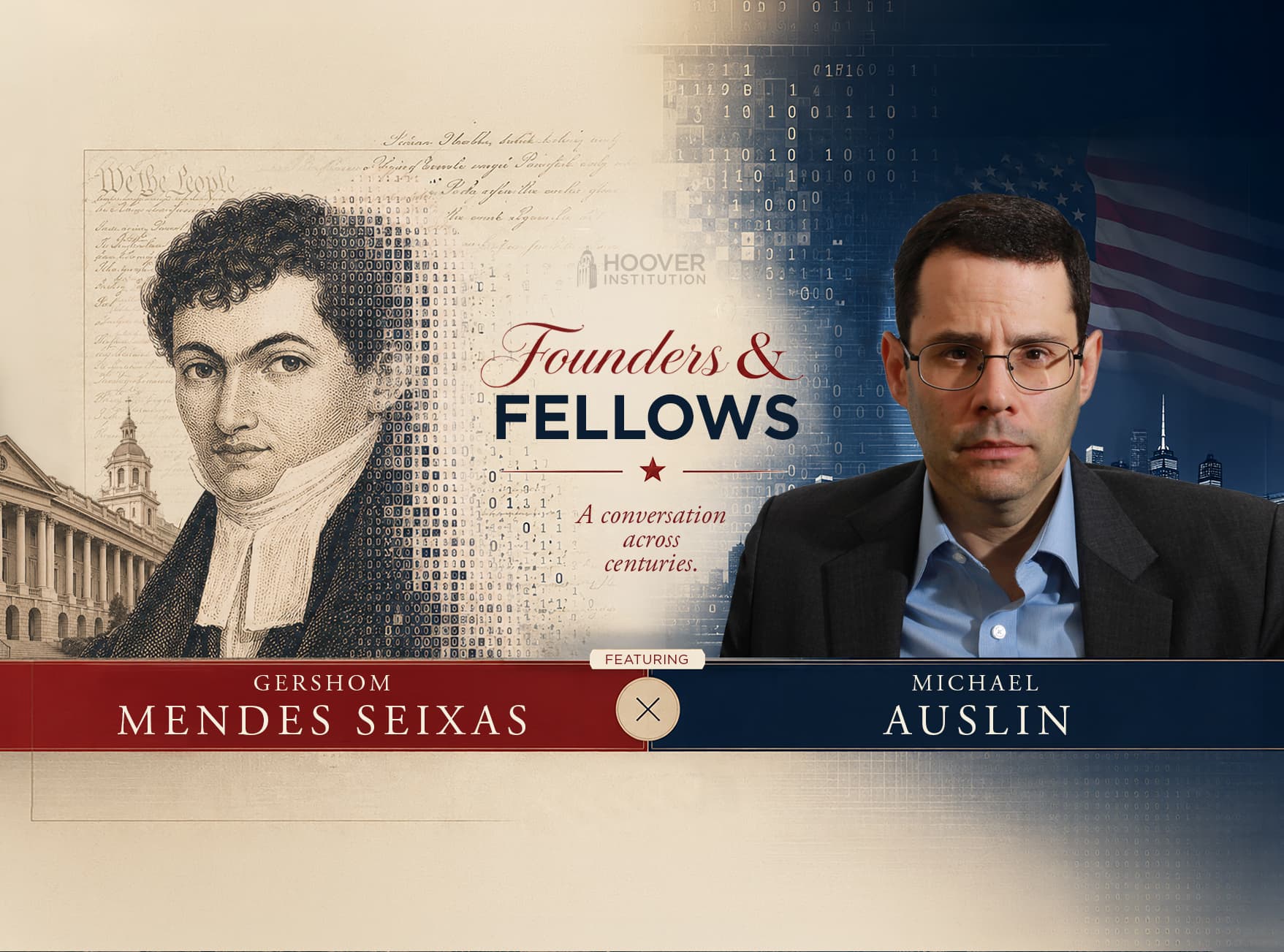
As he led his flock out of New York City in August 1776, allegedly carrying the sacred scrolls of the Hebrew Torah, Gershom Mendes Seixas may have been compared to a modern Moses. The spiritual leader of Shearith Israel, the oldest Jewish synagogue in the American colonies, was fleeing the specter of slavery from a new pharaoh, the king of England. Or so he would be portrayed, linking him with his fellow American Patriots, who hyperbolically used the same biblical language to describe their struggle against a tyranny they equated to that in the Old Testament.
Though not considered one of the founding fathers, Seixas (pronounced “Say-shus”) played a significant role in promoting the idea of religious equality in America. Over five decades of public effort, he helped in the slow process of bringing Jews toward acceptance by their countrymen, and thus contributed to fulfilling one of the major promises of the Declaration of Independence. He also was at the center of the first national movement of American Jewry during the Revolution, in Philadelphia.
Gershom Seixas was born in 1745 in New York to two illustrious families. His father descended from Spanish Sephardic Jews, while his mother came from the well-known Levy family of German Ashkenazi Jews, and the most prominent New York Jewish family. In him were mixed the two major strains of Jewish tradition, an unplanned strength when he would be called upon to unite the fractious, if tiny, community of American Jews.
He was hired by Shearith Israel in 1768 as a cantor, having no formal training as a rabbi, yet ministered to congregants for nearly half a century, while increasingly involving himself in secular issues that illustrated the right of Jews to play civic roles in the colonies and new nation.
It was perhaps during the War for Independence that Seixas made his most notable contributions. Through his actions, and those of other Jewish patriots, he worked to bring American Jews into the mainstream at the very moment of the country’s birth. Jews were certainly present during the Revolution. As a proportion of their population, Jews served in the Continental Army and colonial militias in numbers comparable to Christians. There was even a “Jews Company” from Charleston, South Carolina, made up primarily of Jewish merchants; tellingly, the unit was also known as the “Free Citizens of Charleston.”
Yet in the public square, Jewish presence was far less prominent. Into this breach stepped Gershom Seixas.
In March 1776, with the war going badly despite the British withdrawal from Boston, the Continental Congress called for a national day of fasting, humiliation, and prayer. In specifically mentioning Jesus Christ in their appeal, Congress naturally spoke for the majority-Protestant country. But Seixas took the call as an opportunity to show the same loyalty as was being asked of Christians and decided to hold religious services and a fast day at Shearith Israel on May 17, 1776. In sharing the national day with churches around the colonies, as Adam Jortner points out, Seixas was leading Jews towards a new promised land, stepping towards citizenship by acting like citizens (A Promised Land: Jewish Patriots, the American Revolution, and the Birth of Religious Freedom (Oxford, 2024)).
A few months later, when the British were on the cusp of capturing New York in the summer of 1776, Seixas decided to evacuate the city of his birth, fully throwing his support behind the Patriot cause. He led the pro-independence contingent of his congregation first to Connecticut and then, in 1780, to Philadelphia (a segment of Shearith Israel stayed in New York as Loyalists).
Philadelphia was Seixas’s destination, for he had been asked to become the head of Congregation Mikveh Israel, founded in 1740. As the British occupied or threatened the few large American cities during the war, those Jewish Patriots who fled New York, Savannah, and Charleston all came to Philadelphia—safe, it seemed, from British forces. There, they reconstituted Mikveh Israel as the first national synagogue of the United States, mixing Jews from different regions and traditions. Seixas ably led this new congregation, welcoming Pennsylvania officials to the consecration of its new house of worship, guiding it as it became a more democratized religious establishment, and presiding over the marriages of members from different cities, further integrating the country’s Jewish community.
Just as important, Seixas fought for civic inclusion for Jews in Pennsylvania, in 1783 opposing the state’s religious test for public office, which sought to limit to Christians the right to hold appointed or elected positions. This was a campaign that would take decades to fully achieve fruition nationally, but his efforts helped ensure that the test clause was prohibited by the US Constitution.
After the Revolutionary War, Seixas returned to New York in 1784, where he continued to actively participate in civic affairs. He would be made one of the original trustees of Columbia College in 1787 and officially participated as a clergyman in George Washington’s 1789 inauguration. He urged support for President Madison’s administration during the War of 1812, a conflict initially opposed by many merchant and shipping interests in the Northeast. Seixas died on July 2, 1816, the fortieth anniversary of the day the Continental Congress voted for Independence.
Gershom Seixas did not ask for special treatment, nor for Jews to separate into ethnic enclaves. Instead, this Patriot rabbi asked only that his co-religionists be accepted fully as citizens of the new nation, allowed and expected to take up their civic responsibilities on equal footing with their neighbors. As an example of civic-mindedness and love of country, this native-born American Jew contributed to the weaving of the durable fabric of America.
Michael Auslin is the Payson J. Treat Distinguished Research Fellow at the Hoover Institution and the author of National Treasure: How the Declaration of Independence Made America (Avid Reader Press/Simon & Schuster).