 Powered by
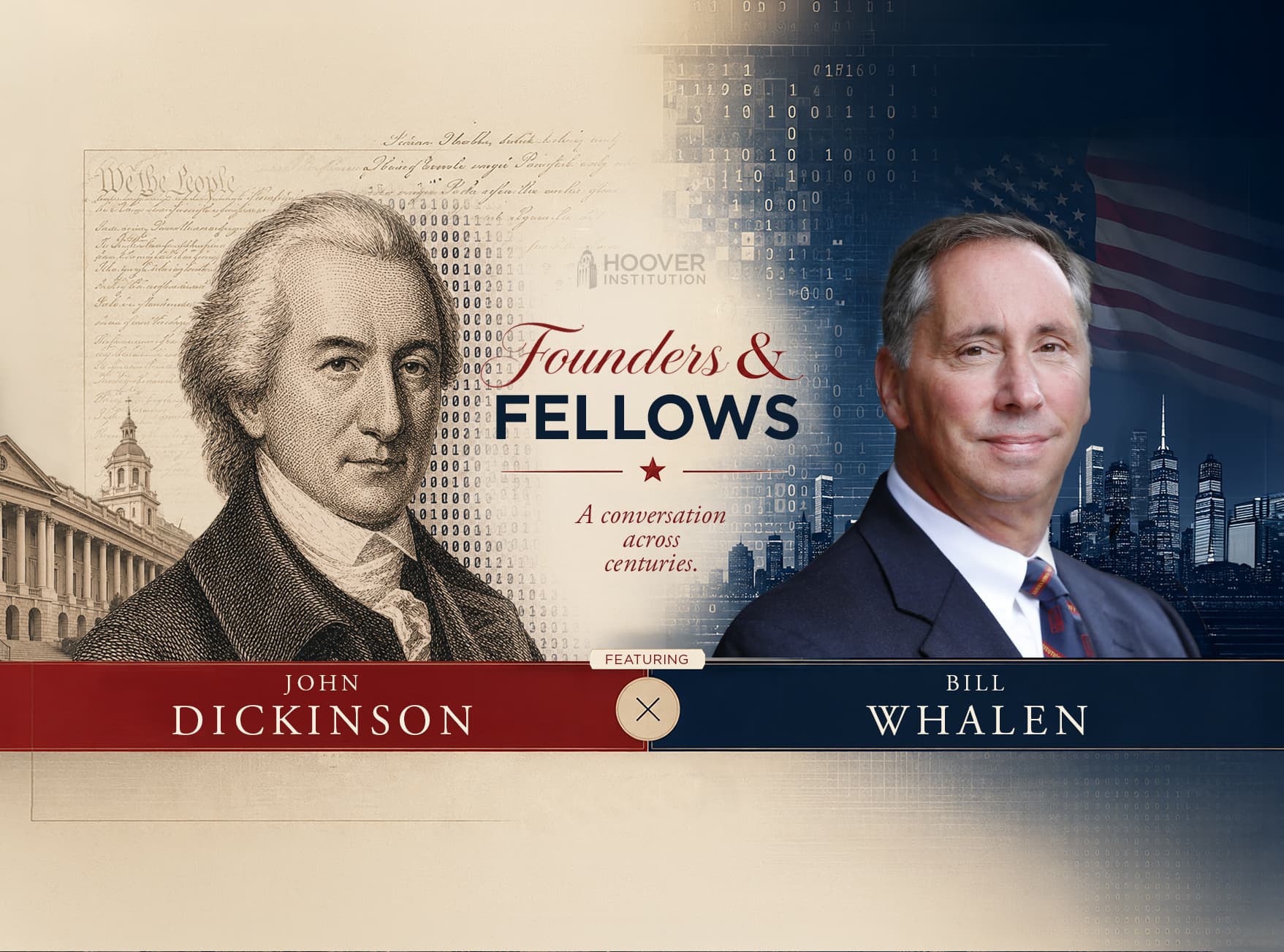
One way to make sense of America’s founding fathers is to liken the roster of players involved in that fabled eighteenth-century uprising to, of all things, the recent National Basketball Association draft—four compelling choices earning the lion’s share of attention, but lots of other talent who will contribute to the lifeblood of the league.
The founding fathers are similar in that the public has long glorified and romanticized a handful of marquee Patriots—Hamilton gets a Broadway play; Adams and Franklin are the subjects of HBO and Apple television series—while a slew of lesser-celebrated participants played key positions in the founding of the American republic.
So, let’s skip past the top picks in the “1776 draft” and focus instead on a “team player” in the revolution against taxation and tyranny: John Dickinson, aka “the Penman of the Revolution,” for his contributions in establishing the argument that the American colonies should stand up for their rights.
I’ll spare you the trouble of a Google search. Dickinson, homeschooled on a Maryland tobacco plantation and later a law student in Philadelphia and London (in 1757, he was admitted to the Pennsylvania bar), was one of the wealthiest members of the colonies’ landed gentry (similar to the landowning George Washington in that respect, though the general’s path to wealth came via marriage, not a family inheritance).
But what sets Dickinson apart from all but a select few founding fathers was his key role in three stages of the republic’s intellectual and political formation.
First, there’s Dickinson the voice of tax fairness.
In 1768, Dickinson anonymously penned Letters from a Farmer in Pennsylvania, to the Inhabitants of the British Colonies—a series of essays in response to the previous year’s Townshend Acts. These imposed new British taxes on goods imported to the American colonies—including everyday items like tea and paper—in the aftermath of the failed Stamp Act (repealed by Parliament in 1766, only nineteen months after its passage, in the aftermath of colonists’ protests, both economic and violent).
Not that Dickinson’s thoughts on taxation came as a surprise. Previously, and at the behest of the so-called Stamp Act Congress of 1766, he’d penned fifteen proposals (formally, the “Declaration of Rights and Resolves”) denouncing the British law as unconstitutional. Nearly a decade before Thomas Jefferson put quill to parchment and drafted the Declaration of Independence, Dickinson’s work marks the first time the American colonies had produced a document reflecting a very fed-up vox populi.
What’s notable about Dickinson’s “letters” (essays, actually): he lays the intellectual groundwork for the future Revolution by arguing that only the colonial assemblies had the authority to raise revenue—hence the slogan current in the colonies: “no taxation without representation.”
Second, there’s Dickinson’s complicated role in the Revolution itself, as an internally conflicted founder.
Dickinson ended up joining the fight to break away from the English mothership, but first he did his best to try to avoid a divorce—in July 1775, serving as primary author of the “Olive Branch Petition” asking King George III to enter an agreement with the colonies “upon so firm a basis as to perpetuate its blessings, uninterrupted by any future dissensions, to succeeding generations in both countries” (this put Dickinson at odds with John Adams, who by this point believed that a war was inevitable).
So, what did Dickinson do when—plot spoiler!—the king denied the petition and the war expanded beyond the early battlefields of Lexington, Concord, and Bunker Hill? He refused to sign Jefferson’s Declaration (“My conduct this day,” he lamented on July 4, 1776, “I expect will give the finishing blow to my . . . diminished popularity”).
But he also made a point to abstain from voting on independence—his realpolitik reasoning being that anything less than a unanimous voice would undermine the Revolution.
And then the “penman” does something rare for the men who had gathered in Philadelphia: Dickinson joins the fight and sees action with the Delaware Militia (the British Army making it a point to torch his estate on the outskirts of Philadelphia).
John Dickinson’s contributions to the founding of the republic don’t end on the battlefields, however. There’s a third chapter: the drafting of the US Constitution.
Here, it’s not so much taxation as it was equality that had Dickinson’s attention—specifically, states’ rights.
Attending 1787’s Constitutional Convention as a delegate from Delaware, Dickinson defied the concept of representation based solely on population. As he told James Madison, a Virginian and the Constitution’s primary architect: “Delaware would sooner submit to a foreign rule than be deprived in both branches of an equality of suffrage and thereby be thrown under the domination of the larger states.” The result would be the “Connecticut Compromise” having it both ways in Congress: the House of Representatives based on population, and each American state getting two US senators.
Now, imagine a world in which John Dickinson had a greater say as to what went into the Constitution in its inception. He believed in women’s political and legal rights—women not enjoying the right to vote until 1920 and the passage of the 19th Amendment.
The only founder to free his slaves during the early phase of the Revolution (1775–78), Dickinson also wanted human bondage prohibited by the Constitution—the result (another compromise to keep the Southern states on board) being the document’s Article 1, Section 9, a twenty-year limit on the importation of slaves.
John Dickinson had one last contribution to the birth of a republic. After the Constitutional Convention, Dickinson reverted to his “Penman” self—this time, producing nine essays under the pseudonym “Fabius” making the argument for the document’s ratification (a decade later, a second batch of “Fabius letters” would lament deteriorating conditions in France and caution against European entanglements).
American history is replete with irony, one such example being that Dickinson’s death in February 1808 coincided with the final year of Thomas Jefferson’s presidency—Jefferson, like Dickinson, a celebrated author and founding father, though one with a more complicated legacy regarding slavery.
To his credit, Jefferson honored the man who declined to sign his most famous body of work, saying of Dickinson: “Among the first of the advocates for the rights of his country when assailed by Great Britain, he continued to the last the orthodox advocate of the true principles of our new government: and his name will be consecrated in history as one of the great worthies of the Revolution.”
One final note on John Dickinson—another irony.
Like many a founding father, John Dickinson’s name is synonymous with higher learning. Jefferson and Benjamin Franklin, for instance, founded the University of Virginia and the University of Pennsylvania.
In Dickinson’s case, his surname was attached to a liberal-arts school in Carlisle, Pennsylvania. Another founding father, the Philadelphia physician Benjamin Rush, turned a struggling grammar school into what, a week after the signing of 1783’s Treaty of Paris and the formal end of the American Revolution, would be known as Dickinson College.
Here’s where American history, once again, tosses us a curveball.
Whereas John Dickinson, fueled in part by his Quaker sensibilities, opposed slavery, two of Dickinson College’s more notable alumni have a tarnished legacy regarding the same topic.
Roger Taney, a onetime US Supreme Court chief justice and Dickinson Class of 1795, delivered the majority opinion in 1857’s Dred Scott case dictating that Congress couldn’t ban slavery in US territories and that African-Americans, as non-citizens, enjoyed no legal protections.
Taney’s court delivered that ruling, which outraged America’s abolitionist North while emboldening its pro-slavery South, just two days after another Dickinson College alum, James Buchanan (Class of 1809), took the oath of office as America’s fifteenth president.
One of the many reasons the one-term Buchanan is deemed one of the nation’s worst presidents is this passage from his inaugural address suggesting that the nation’s agonistes over slavery would cease once the Taney court issued its ruling: “Most happy will it be for the country,” Buchanan orated, “when the public mind shall be diverted from this question and to others of more pressing and practical importance.”
Fortunately for America, John Dickinson didn’t have the same laissez faire attitude toward taxation and states’ rights.
Remember him, on every Fourth of July.
Even if he’s not your first-round pick as a favorite founder.
Bill Whalen is the Virginia Hobbs Carpenter Distinguished Policy Fellow in Journalism at the Hoover Institution. He is a regular contributor to Hoover’s channels California on Your Mind and Defining Ideas, and hosts the Matters of Policy & Politics podcast. Prior to joining the Hoover Institution, Whalen was the chief speechwriter and director of public affairs for California governor Pete Wilson.