 Powered by

De-dollarization refers to actions by governments, corporations, and financial market participants to reduce their use of the US dollar in international reserves, in trade invoicing and settlement, in cross-border finance, and in domestic transactions. Dollar dominance in international financial transactions endows the United States with the ability to inflict economic harm by imposing sanctions involving a range of activities like freezing assets and prohibiting banks from accessing the Swift payment-processing network or from clearing payments through the US banking system.
Regarding de-dollarization, Ken Rogoff states, “there is a huge appetite for alternative transaction vehicles among friends and foes alike, outside the prying eyes and the global reach of US authorities.”
Should the United States be concerned about de-dollarization? The data indicate that the dollar remains dominant in international reserves, in transactions in the foreign exchange market, and in international holdings of US Treasury securities, but there is cause for concern in their pricing relative to close substitutes.
Countries are taking actions to de-dollarize, but the major threat to the international status of the dollar comes from the size of current and projected US government budget deficits.[i]
Changes in the dollar’s status
Countries use international reserves to intervene in the foreign exchange market, to manage imbalances in foreign trade, and to insure themselves against global financial shocks. If a country imports more than it exports, it must sell assets, such as bonds, stocks, and real estate, to foreigners. If foreign investors do not demand these domestic assets, the public sector can sell international reserves. International reserves also assure foreign investors that the country’s debt can be repaid.
Consequently, countries demand high-quality assets that can be easily sold, especially in a crisis. Historically, gold served this purpose, but the government liabilities of trustworthy countries, first from the United Kingdom and then the United States, also came to be held.
Figure 1 shows the shares of international reserves denominated in different currencies from 1947 to 2025.
Figure 1: Currency shares of foreign exchange reserves
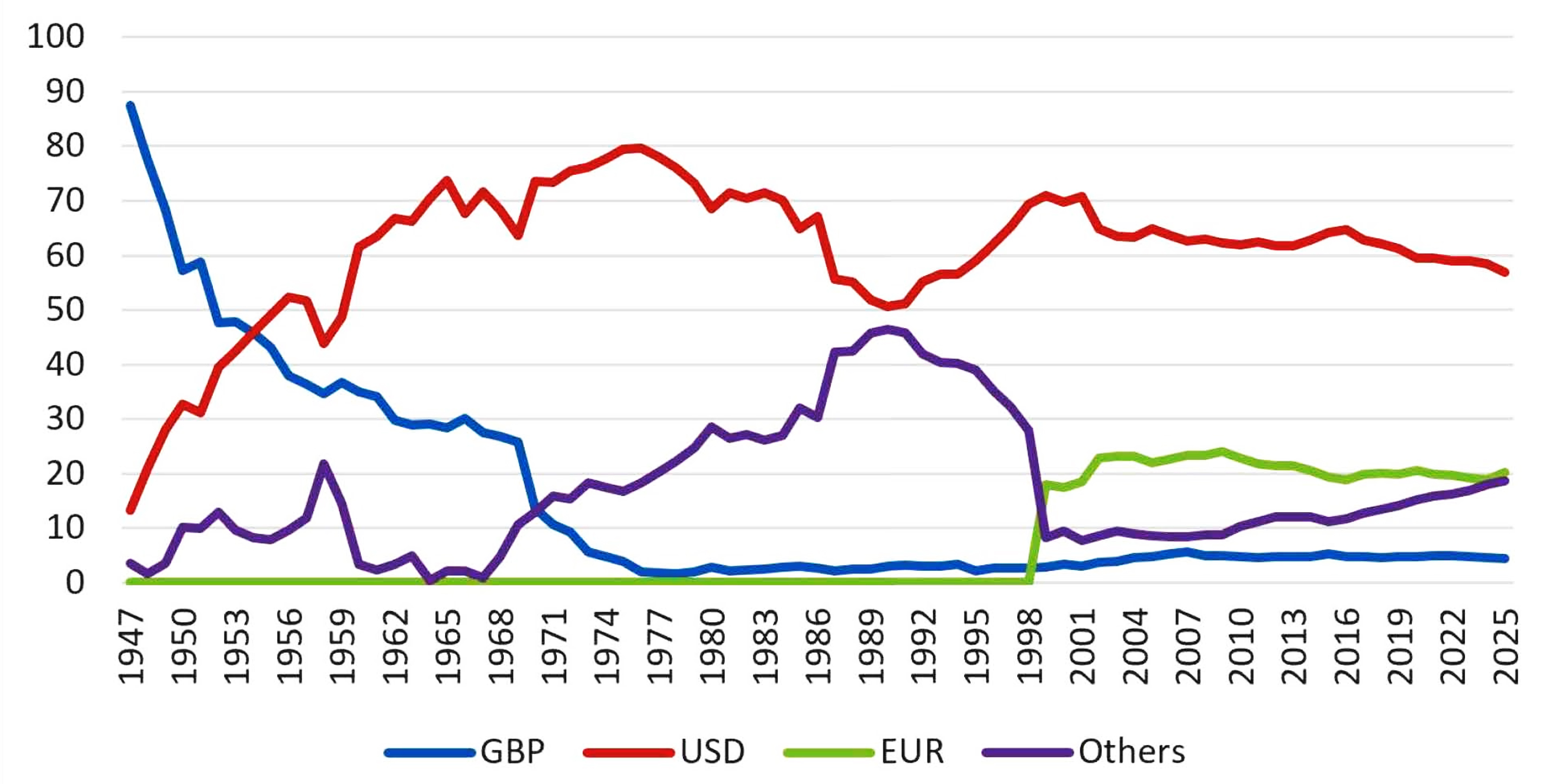
In 1947, 87.4 percent of international reserves were British pounds (GBP). The post–World War II decline of the GBP and rise of the US dollar (USD) is unsurprising, as the Bretton Woods system of fixed exchange rates committed the United States to convert dollars into gold at $35 an ounce with other currencies pegged to the dollar. The accumulation of USD international reserves allowed the United States to import more than it exported and to sell US government debt to the rest of the world, which rankled other countries. In 1965, Valéry Giscard d’Estaing, the French minister of finance, stated that this situation gave the United States an “exorbitant privilege.”
The Bretton Woods system collapsed in August 1971 when President Nixon suspended the convertibility of dollars into gold, thereby thrusting the foreign exchange market into disarray.
As countries struggled with the new system of floating exchange rates, the share of USD international reserves increased, peaking at 79.7 percent in 1976 before falling to 50.6 percent in 1990. After rising to 71.0 percent in 1999, the share of USD international reserves declined to 56.8 percent in 2025. The creation of the euro in 1999 led to euro international reserves of approximately 20 percent, a proportion that has remained relatively constant, while the category labeled “Others” shows diversification across a variety of currencies including the Chinese renminbi, which was 2.0 percent of international reserves in 2025.
These percentages mask the magnitude of total international reserves, which increased from $1.9 trillion (tn) in 1999 to $13.1 tn in 2025. Hence, although the percentage of USD assets fell over the past twenty-six years, total USD assets in international reserves rose from $1.35 tn to $7.44 tn. Clearly, USD assets remain dominant in international reserves even as the percentage of USD assets in total reserves trends downwards.
Changes in the use of the dollar
The dollar is dominant in foreign exchange market transactions. Figure 2 plots the shares of several currencies in these transactions.
The BIS conducts a triennial survey of central banks requesting daily quantities of currencies traded in foreign exchange markets, including transactions in spot, forward, swap, option, and other derivative markets. Daily trade across all currencies grew from $3.9 tn in 2010 to $9.6 tn in 2025.
Figure 2: Foreign exchange market turnover shares (1989–2025)
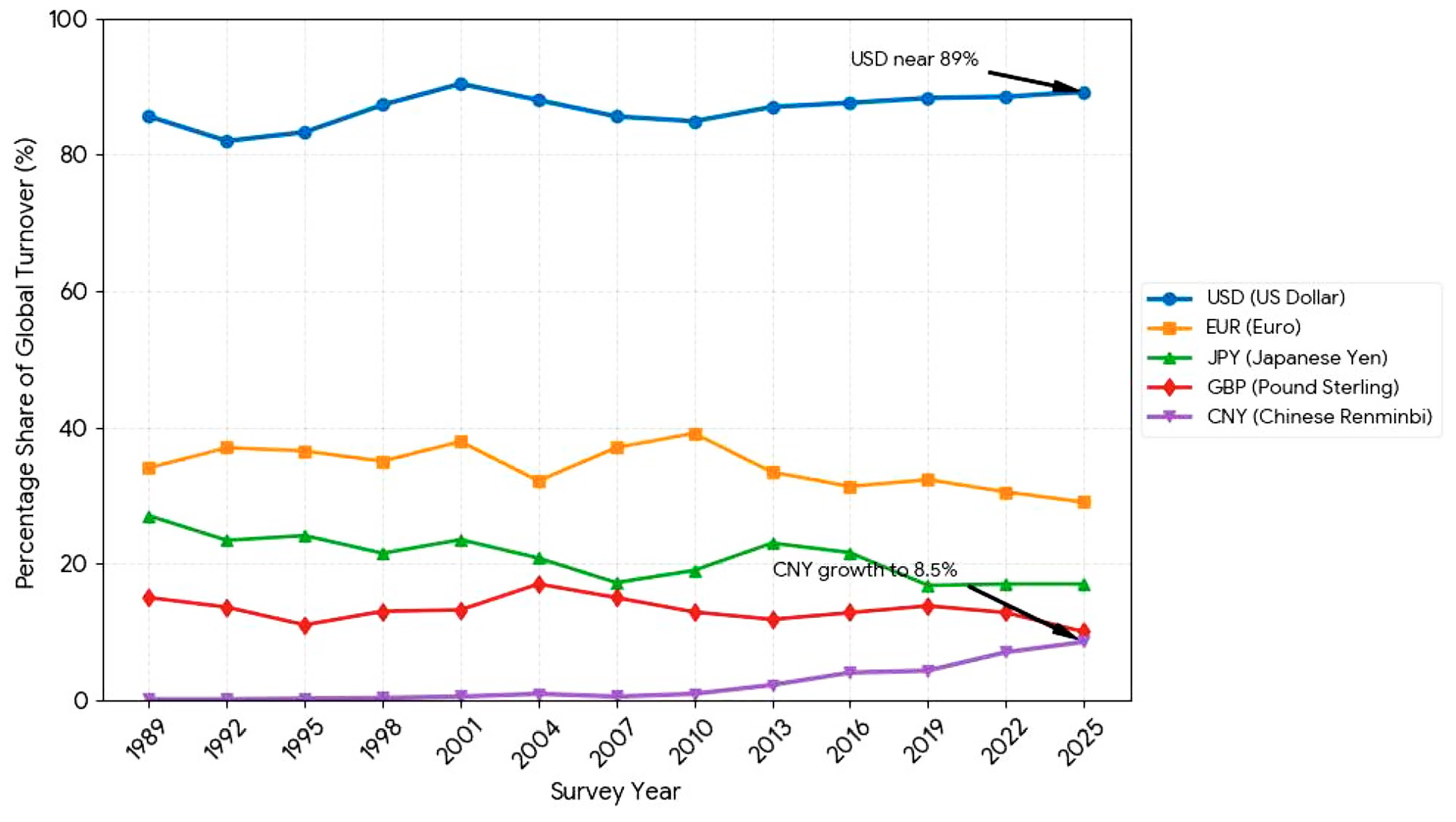
Since transactions involve two currencies, the shares sum to 200 percent. With almost 90 percent of transactions involving the dollar, it remains the world’s “vehicle currency” because it facilitates transactions between currencies that do not have a direct, active bilateral market. While the proportion of dollar foreign exchange transactions shows some minor fluctuations, it is actually increasing slightly even as the magnitude of total transactions increases.
Although the euro, the Japanese yen, and the British pound all show declining trends in the percentage of transactions, because the value of transactions is increasing dramatically, the dollar value of transactions in these currencies increased. For 2025, daily foreign exchange transactions were $2.77 tn for the euro, $1.61 tn for the yen, $0.98 tn for the pound, and $0.81 tn for the renminbi. Hence, while the dollar remains dominant with $8.5 tn of daily trade, there is huge and growing market in other major currencies as well.
Changes in domestic and foreign holdings
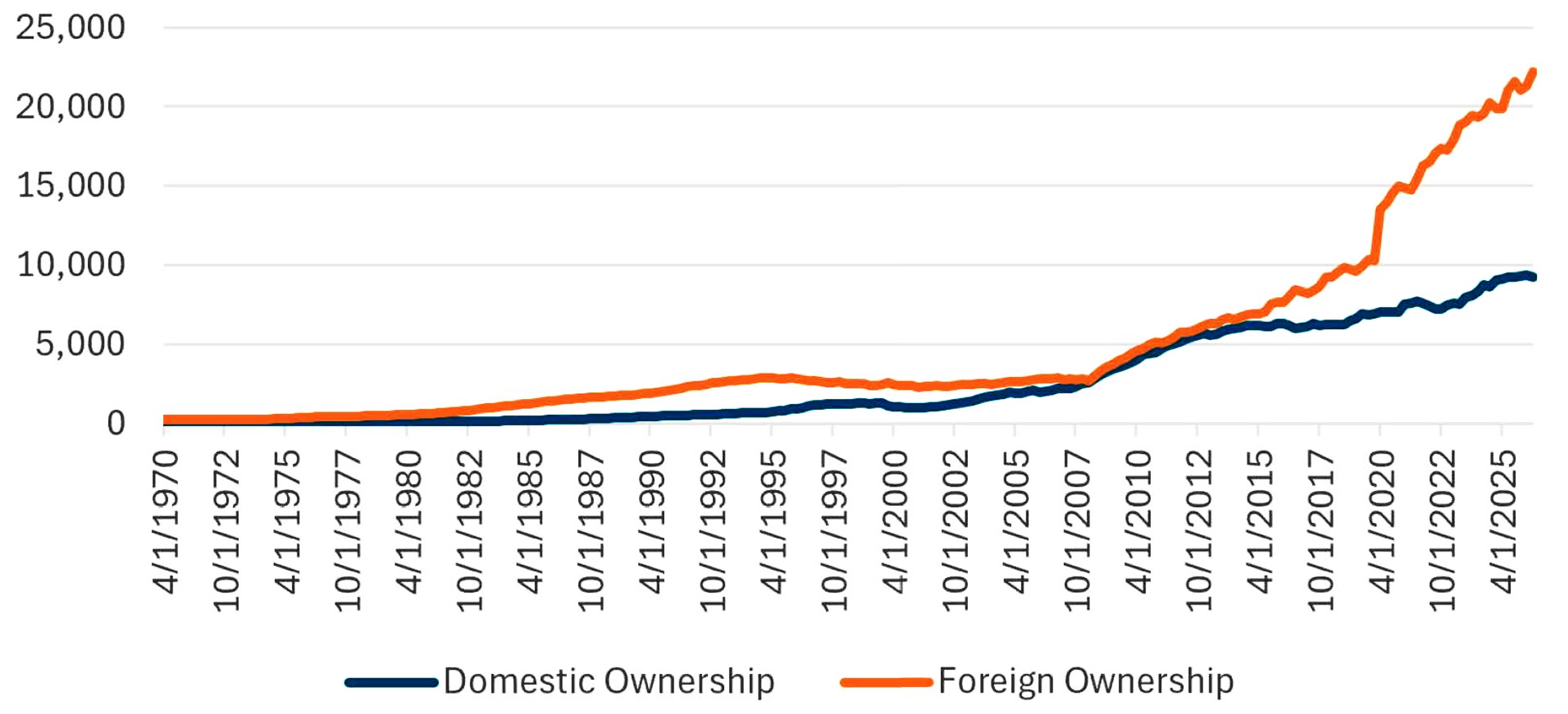
Are attempts to de-dollarize causing the equilibrium international holdings of US Treasuries to fall? The answer is yes when viewed as a percentage of outstanding debt, but no when viewed in dollar terms. Foreigners held almost 50 percent of US Treasuries between 2009 and 2015 but now hold around 30 percent. Nevertheless, Figure 3 shows that foreign ownership of US Treasuries is increasing.
There are three important facts here. First, in the mid-2010s, foreign ownership of US Treasuries of $6.2 tn was similar to domestic ownership of $6.9 tn. Second, the ongoing, large increase in US government debt that began in 2014 was accumulated primarily by US residents, who currently hold $22.2 tn of US Treasuries. The third fact is that foreigners continued to accumulate US Treasuries and now hold $9.2 tn.
Changes in pricing of US Treasury securities
To understand if these increases in US Treasuries and who holds them have affected their pricing, it is useful to examine changes in their yields relative to those on similar assets.
Historically, US government bonds had relatively low yields because they served as quintessential safe assets—that is, assets that investors value highly because they have known future cash flows and low default risk. Safe assets are easy to value and to trade, and can be used as collateral for loans in repurchase agreements or to meet margin requirements in derivatives transactions. Consequently, investors hold these assets at rates of return below those on other close substitutes, just as people hold non-interest-earning cash for the convenience of making purchases.
Figure 3: Domestic and foreign ownership of US Treasury securities
Researchers have assessed changes in the relative pricing of US Treasuries in several ways. Before the 2008 Global Financial Crisis (GFC), interest rate swap spreads, the difference between the fixed interest rate of the swap and the yield on a US Treasury security of comparable maturity, were generally positive, but they turned negative at the thirty-year maturity in 2009. They have remained negative and have migrated down the term structure of interest rates. Trading in swaps is collateralized and marked to market, and swaps are now viewed as having lower default risk than US Treasuries. This was the first evidence of significant changes in the pricing of US Treasuries.
Wenxin Du, Ritt Keerati, and Jesse Schreger report average USD interest rate swap spreads in basis points (bp) per annum for several maturities and time periods. The five-year swap spread averaged 16.02 bp during 2010–15, and -20.24 bp during 2021–25. Thus, we see that as the outstanding supply of US Treasuries increased, the Treasury yield increased above the corresponding swap fixed interest rate.
The pricing of US Treasuries also changed relative to the yields on foreign government bonds of similar maturities in which the foreign exchange risk has been eliminated via a sale of foreign currency for dollars in the forward market or the currency swap market which creates a synthetic dollar bond. If US and foreign bonds had the same default risk, liquidity, and performance in a crisis, investors would be indifferent to holding the outright dollar bond or the synthetic dollar bond and their dollar yields would be equal.
Economists would say that covered interest rate parity (CIP) holds. Hence, CIP deviations for government bond yields tell us about a combination of relative default risk, relative liquidity, and relative risk due to performance in a crisis.
Du, Keerati, and Schreger also investigate CIP deviations between the yields on synthetic dollar bonds and US Treasuries. These annualized average CIP deviations turned negative post-GFC for all G10 countries except Japan and for the five-year maturity were 21.4 bp between 2000 and 2006 and -25.1 bp between 2023 and 2025.
These government bond CIP deviations are the sum of CIP deviations for currency swaps that involve secured overnight financing rates plus the difference between the USD interest rate swap spread and its foreign currency counterpart. The currency swaps are marked to market and involve short-term interest rates that are secured by collateral to make them effectively risk free. Positive CIP deviations from currency swaps imply that those who are long the dollar side of the swap are required to pay more in interest than the secured overnight USD interest rate. For the five-year maturity the CIP deviations for currency swaps averaged 12.89 bp during 2010–15 and 19.98 bp during 2021–25. Thus, it is the negative USD interest rate swap spread that drives the negative CIP deviations.
These changes in the pricing of US Treasuries are concerning because with $32 tn of bonds outstanding, each 10 bp increase in the required yield requires an additional $32 billion of interest per year.
Is there an alternative to the dollar?
Given countries’ desires to de-dollarize, how are they reacting? Some European economists view the current situation as favorable for improving the international status of the euro. Helene Rey and Ludovic Subran write about “our euro, your solution,” which references the November 1971 statement by US Treasury Secretary John Connally to G10 finance ministers after the collapse of the Bretton Woods system that “the dollar is our currency, but it’s your problem.”
Rey and Subran stress that to improve the euro’s international status, it must increase the issuance of European safe assets. Currently, the European Commission (EC) has issued bonds that are backed by the budget of the EC with about €800 billion outstanding. These bonds are not the joint and several liabilities of the individual countries of the European Union.
The fundamental problem with generating more common eurozone debt is the absence of sufficient political unity to have all the countries agree on a repayment mechanism when they have very different outstanding debts and fiscal situations. For example, the French and German debt-to-GDP ratios are 118 percent and 64 percent, respectively, and their ten-year government bond yields are 4.79 percent and 3.44 percent. France wrestles with a budget deficit of 5.4 percent of GDP, while Germany’s is 0.35 percent. Without comparable default probabilities, common eurozone debt seems politically problematic. Rogoff recognizes this issue but cautions that Russia’s ongoing invasion of Ukraine may ultimately force greater fiscal and political unity in the eurozone.
The Chinese government would certainly like the renminbi to be the currency of choice to replace the dollar in international finance, but current international holdings of renminbi debt represent only roughly 1 percent of total international debt, which is comparable to the shares of debts of Japan and Australia. China’s severe capital controls that isolate its domestic financial market from international financial markets would also have to be relaxed.
There are other responses, though, that are increasingly successful. Since 2015, the Cross-Border Interbank Payments System (CIPS) of the People’s Bank of China clears cross-border yuan payments involving financial transactions including bonds, derivatives, and foreign exchange. Driven by geopolitical shifts, CIPS transaction volumes skyrocketed to an annualized run-rate of over $30 tn (¥206 tn RMB) last year. CIPS now connects more than 5,000 financial institutions across 190 countries.
Even in the technologically new era of stablecoins, the dollar remains dominant. Carolyn Wilkins notes that about 98 percent of stablecoin capitalization is dollar denominated. While the United States leads in the stablecoin private money space, the central banks of other countries, including the European Central Bank, are preparing to launch central bank digital currencies (CBDC). As the world transitions to tokenized trading of assets on distributed ledgers, as discussed by Laurie Hodrick, the existence of a euro CBDC, targeted for release in 2029, could provide a springboard for additional use of the euro in international finance.
At their September 2026 summit, the BRICS countries shelved their plan for a common currency. Nevertheless, they are expanding BRICS Pay to integrate their individual country electronic payment systems, such as India’s UPI, Brazil’s Pix, and China’s WeChat Pay, to allow individuals and firms to use these domestic systems in cross-border transactions without using the US dollar.
For example, a Brazilian traveler to India can purchase something using their Pix account on their smartphone, their Brazilian real bank account is immediately debited, and the Indian seller’s rupee bank account is immediately credited. Information about the transaction is sent to the BRICS Pay Decentralized Clearinghouse Messaging System that nets payments and receipts daily. After netting all transactions between the two Brazilian and Indian banks, a net payment is made. Currently, the settlement system requires individual banks to hold accounts in all currencies, which is inefficient. Eventually, the BRICS countries would like aggregate settlement to be in the CBDCs of the individual currencies.
Conclusions
Although many governments, corporations, and individuals throughout the world desire to replace the dollar in various uses in international finance, it continues to be widely used in foreign exchange market transactions, as a reserve currency, and as an investment vehicle. Where we see a substantive difference from the period before the GFC to today is in the increase in the yield on US Treasuries relative to other major government bonds.
While foreign investors continue to accumulate US Treasuries, they are not keeping pace with the increases caused by US government budget deficits. Hence, a larger proportion of outstanding US Treasury securities is now held domestically. Does this explain the CIP deviations discussed above?
While no clear competitor to the dollar exists, dollar dominance is far from secured.
I agree with Rogoff that the greatest danger to dollar supremacy comes not from desires to de-dollarize, but from the magnitude of current and projected US government budget deficits and the complacency about them engendered by the period of ultra-low interest rates. This environment appears ripe for continued inflation if not an outright fiscal crisis.
Nevertheless, the desire to de-dollarize is real. The lack of a clear alternative means that it will take time to be realized, but the supply of alternative assets need not change. Changes in demand for currencies as investors try to de-dollarize can affect the prices of assets, causing depreciation of the dollar relative to non-dollar currencies in foreign exchange markets. Without changes in fiscal policy, a fiscal crisis with substantial dollar depreciation becomes more likely over time.
[i] For additional discussion of the international role of the dollar, see John Cochrane, who discusses how the international financial system could evolve to have an enhanced role for the dollar, Emilio Ocampo, who argues that increased dollarization of the Western hemisphere is both practical and desirable, and Arvind Krishnamurthy, who quantifies how much the United States would lose from the loss of the dollar’s internation reserve currency status.
Robert J. Hodrick is the Nomura Professor Emeritus of International Finance at the Columbia Business School, a research associate at the NBER, and a visiting fellow at the Hoover Institution. The author is grateful to Laurie Simon Hodrick and John Cochrane for valuable comments.