 Powered by

Twenty-six years ago, Alberto Alesina and Robert Barro convened a conference on currency unions at the Hoover Institution. At the time, Europe was launching the euro, Ecuador had adopted the US dollar, El Salvador was preparing to follow, and Argentina’s Convertibility regime appeared to have overcome decades of chronic inflation. In a follow-up volume and subsequently in a formal model, Alesina and Barro made the case that monetary and trade integration were mutually reinforcing. They concluded that in an increasingly globalized world, larger currency areas would emerge, resulting in substantially fewer currencies than countries.
Momentum for monetary integration picked up in Congress. Senator Connie Mack introduced the International Monetary Stability Act, which sought to facilitate official dollarization by sharing part of the seigniorage the United States would obtain from countries adopting the dollar. The bill reflected a broader recognition that monetary integration could become an instrument of hemispheric policy.
However, Mack’s bill stalled in committee and never became law. With Argentina’s 2001 crisis, support for monetary integration among academics and policymakers waned and the fixed-versus-floating debate was settled in favor of flexibility. Flexible exchange rates with inflation-targeting regimes became the dominant paradigm for emerging-market economies. Monetary sovereignty regained its appeal, while hard monetary commitments were deemed too rigid and costly, undermining the appeal of monetary integration for Latin America.
The fixed-vs.-floating debate deserves to be reopened
A quarter of a century later, the empirical evidence suggests that the promises of floating exchange rates have not fully materialized, at least in Latin America. The available evidence shows that the largest floaters (such as Brazil and Mexico) obtained a modest gain in de facto monetary independence and experienced much greater exchange-rate and interest rate volatility and significantly lower GDP per capita growth when compared to the ASEAN 5.

Nor is there evidence that floating regimes in Latin America prevented real exchange-rate appreciation. Since 2006, the median appreciation of the floaters was not statistically distinguishable from that of the officially dollarized economies. Notably, real exchange-rate appreciation in Ecuador was lower than in Peru, two examples of the contrasting paradigms. Also, the region’s strongest currency appreciations took place in Argentina, under a variety of regimes, and Uruguay, under floating exchange rates.
Although these data do not settle the debate conclusively, they challenge the usual arguments that floating exchange rates contribute to greater macroeconomic stability and growth and prevent a systematic loss of competitiveness through unsustainable real exchange-rate appreciation.
There may be a theoretical explanation for these results. Argentine economist Julio H. G. Olivera argued that in an international monetary system dominated by a hegemonic currency, only its issuer can simultaneously control the quantity of its money and its international value. For heteronomous countries, Mundell’s trilemma is reduced to a dilemma: they can choose between controlling the quantity of their currency or fixing its value against the hegemonic currency. A floating exchange rate therefore provides less autonomy than is commonly assumed.
Olivera’s contribution was largely forgotten, but recently Hélène Rey reached a similar conclusion empirically: with internationally mobile capital, flexible exchange rates do not necessarily insulate domestic monetary conditions from those prevailing in the center country. Silvia Miranda-Agrippino and Rey provide further support, documenting powerful spillovers from US monetary policy to global asset prices, credit flows, and financial conditions, including in countries with floating exchange rates. Ṣebnem Kalemli-Özcan identifies one channel that constrains monetary autonomy in emerging market and developing economies (EMDE): US monetary policy affects global risk perceptions, capital flows, and domestic credit spreads, limiting the ability of domestic monetary policy to control financing conditions. More recently, Mikael Juselius and Dora Xia have documented that central banks in EMDE with both high external foreign currency debt and shallow FX markets adjust their policy rates in step with US monetary policy surprises.
In other words, the constraint does not disappear under a floating regime; exchange rates and interest rates become the adjustment variables. This is particularly important in Latin America, which historically has been a net dollar debtor. This matters for growth. Greater exchange-rate volatility raises uncertainty about relative prices and the cost of capital, shortening investment horizons. The data show that it is negatively correlated with fixed investment and GDP growth.
Another typical objection to using the dollar as a monetary anchor in Latin America has also weakened recently. Historically, a stronger US dollar was negatively correlated to commodity prices. Since the United States became a net energy exporter in 2020, the correlation has reversed. If recent trends continue, the dollar may respond to commodity shocks in a way that is more aligned with the economic structure of much of Latin America than in the past.
The case for hemispheric monetary integration
Beyond these theoretical and empirical considerations, the change in the economic and geopolitical context in the past quarter of a century suggests several reasons to reconsider the monetary integration of the Americas.
First, the dollar’s status as the dominant reserve currency is being threatened, which in the current fiscal context could prove detrimental to the United States.
Second, China has become a major lender, investor, and trading partner throughout Latin America. In response, the United States is seeking to strengthen economic ties with the rest of the hemisphere in energy, food, critical minerals, infrastructure, manufacturing, payments, and supply chains.
To address both issues, the United States has a decisive advantage. The dollar is the region’s monetary anchor. Governments borrow in it, corporations issue debt in it, commodities are priced in it, trade is invoiced in it, and households turn to it whenever confidence in domestic institutions declines. China can finance infrastructure projects, provide currency swaps to central banks, and extend development lending. It cannot offer the currency that Latin American households, firms, and investors prefer.
Latin America is de facto a dollar area. Three countries—Ecuador, El Salvador, and Panama—have the dollar as their currency and several others firmly peg their currency to it. Others, including Argentina, Bolivia, Costa Rica, Paraguay, Peru, and Uruguay, have bimonetary financial systems in which the dollar coexists with the domestic currency. Throughout the region, the dollar is widely used as a store of value and, in several countries, as a means of payment. Most bilateral trade within the region is invoiced in dollars and long-term financing is predominantly denominated in dollars. As documented by Eduardo Levy Yeyati, this spontaneous dollarization reflects, among other factors, a long history of price and exchange-rate instability. Geography, trade, tourism, and cultural ties with the United States also play an important role.
There is another, less obvious, dimension to the region’s dollarization. Despite the emphasis economists and policymakers place on exchange-rate flexibility, with the notable exceptions of Brazil, Chile, Colombia, and Mexico, the real exchange rates of most Latin American countries have remained closely aligned with that of the United States. This embedded dollarization may help explain why the gains from floating have been difficult to identify. Countries that allowed greater divergence from US real-exchange-rate movements, such as Brazil and Mexico, have not enjoyed superior growth performance, while combined closer real-exchange-rate alignment with higher growth and greater stability.
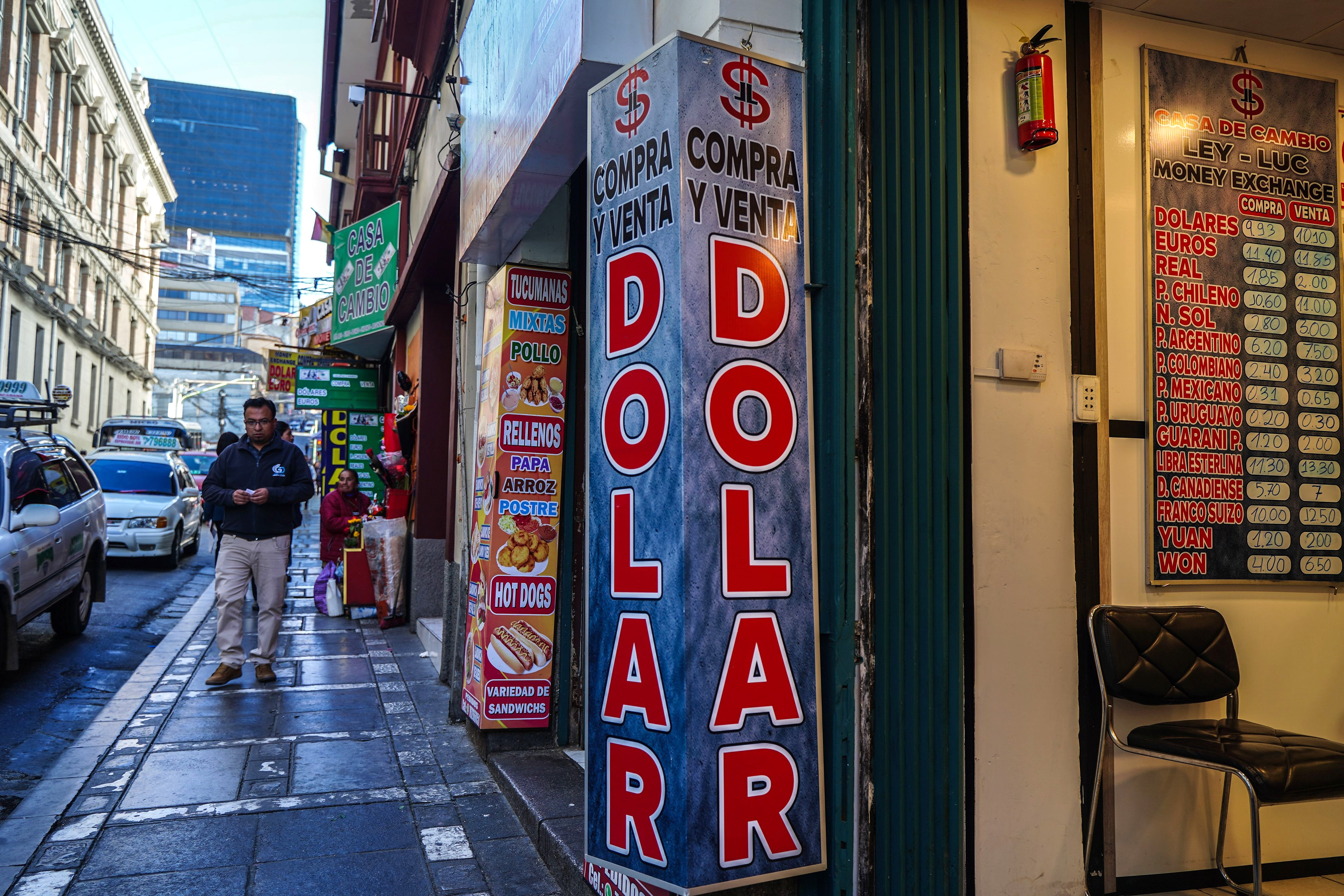
The inflationary outburst of 2022, the continued deterioration of the US fiscal position, and the persistence of inflation above the Federal Reserve’s 2 percent target since 2021 raise legitimate questions about the wisdom of relying on the dollar as a monetary anchor. These concerns should be put in perspective. Testifying before Congress in 1973, Milton Friedman explicitly advocated dollarization for developing countries such as Argentina despite being a severe critic of US monetary policy. “US policy has been bad,” he said, but it still made sense because “their policies have been far worse. There are no gyrations in American monetary policy which can hold a candle to the gyrations which have occurred in Argentinian domestic monetary policy.” Friedman’s argument is obviously most relevant to countries with a history of chronic monetary instability, such as Argentina and Venezuela.
The dollar has survived much more serious challenges to its credibility, including President Nixon’s suspension of gold convertibility in 1971 and double-digit inflation later that decade. Moreover, despite its recent depreciation, the real value of the dollar remains high by historical standards (more than two standard deviations above its average since May 1973).
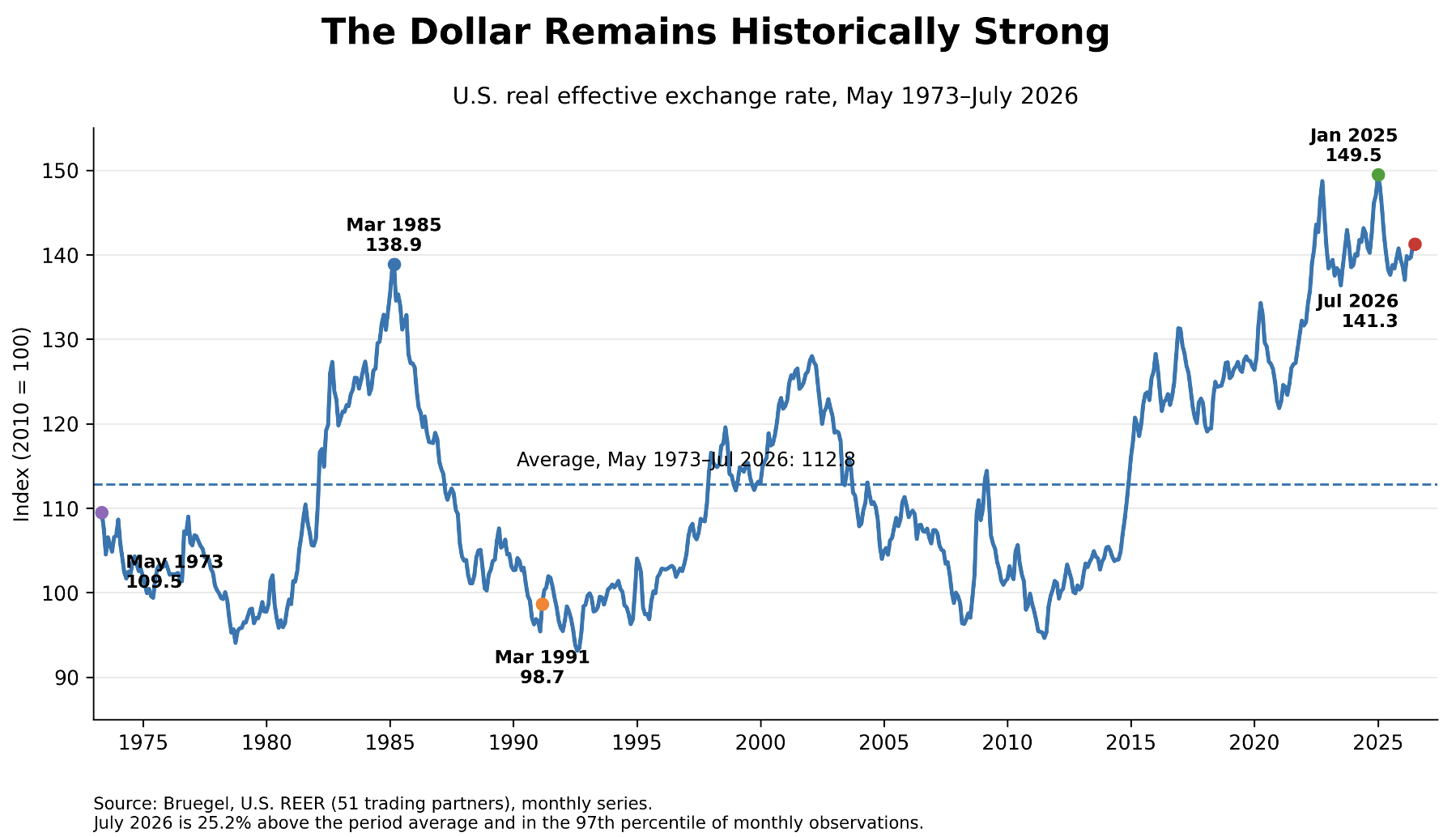
As Scott Sumner pointed out in 2023, when making the case for dollarization in Argentina, adopting the dollar when it is historically strong reduces the risk of subsequently importing a large dollar appreciation. This is particularly relevant for Argentina, whose Convertibility regime was severely strained by the sharp appreciation of the dollar in the second half of the 1990s.
The Americas Monetary Accord (AMA)
My concrete proposal is the Americas Monetary Accord (AMA). By expanding and institutionalizing the dollar’s role in the hemisphere, the AMA would itself help strengthen its international position.
Any effort towards hemispheric monetary integration must begin with the recognition of several key facts.
First, Latin America is no longer the inflationary outlier it was fifty years ago. During the 1970s, Latin American countries occupied many of the highest positions in global inflation rankings. In the twenty-first century, by contrast, only Venezuela and Argentina have persistently ranked among the world’s five highest-inflation economies. Brazil, Chile, Colombia, Mexico, Peru, Uruguay, and several Central American countries created institutions and policy frameworks that would have seemed improbable in the 1970s and 1980s.
Second, as Robert Barro noted more than a quarter of a century ago, “the dollarization of the Americas won’t happen without US leadership.”
Finally, given the US current fiscal position, any monetary integration initiative must not place a burden on taxpayers.
Several important implications follow from these facts. A quarter of a century ago, monetary integration was framed as a binary decision: officially adopt the dollar, or else. However, this strategy is unlikely to produce the desired results in the short and medium term. A more flexible approach will yield results faster without sacrificing the ultimate objective. Monetary arrangements are sovereign decisions and cultural attachment to a national currency is strong in many countries.
Countries with strong fiscal institutions, credible central banks, and relatively deep domestic financial markets may prefer to retain their own currencies. The objective should not be to force Latin American governments to adopt the dollar but to create a monetary architecture that accommodates different degrees and forms of monetary integration, including official dollarization, for those countries that choose it voluntarily. Such a format would not require a supranational central bank or a common timetable for integration as was the case with Maastricht.
My concrete proposal is the Americas Monetary Accord (AMA), a multilateral treaty with price stability as its principal monetary objective and the dollar as its common anchor.
Participation would be voluntary, and each country would join through an international treaty ratified according to its constitutional procedures. Treaty status is important not only legally but economically: by raising the political and institutional cost of reversal, it would strengthen the credibility of the monetary commitment.
The commitment of treaty participants would not be unconditional. AMA could include an optional exit clause if the inflation rate in the US exceeded a certain threshold for a sustained period.
The AMA closely follows Robert Mundell’s proposal for an Asian common currency area without a single currency: countries may retain their national currencies provided they remain fully convertible into the common currency at fixed parities.
The AMA applies the same principle to the Americas. Countries could choose between two forms of membership. Those wishing to retain their national currency would fix it to the dollar under a hard convertibility rule and would have to meet entry conditions including inflation convergence, adequate reserve backing, fiscal transparency, and a prohibition on monetary financing. Under this option, participating countries would retain their national currencies but commit to convertibility into dollars at a fixed parity. Since each currency would be fixed against the dollar, they would also be fixed against one another. The AMA would not create a supranational central bank or require a single currency.
Countries choosing official dollarization would not face an inflation-convergence requirement: the dollar would become legal tender and the exclusive unit of account of the financial system, although legacy domestic currency could continue to circulate for some time for cash transactions (as happened in El Salvador in 2001). All members would guarantee freedom to hold, borrow, lend, contract, and settle payments in dollars and would adopt compatible prudential and payment-system standards.
The AMA could initially be established by the United States together with Ecuador, El Salvador, and Panama, which are already dollarized, giving the accord an immediate multilateral foundation. If they so desired, it would be easy to incorporate other countries in the region that already peg their currency to the dollar. However, the simultaneous or early accession of a large economy such as Argentina and Venezuela would be key, as it would give the AMA greater economic and strategic weight. Other countries could subsequently join under either track as their political and institutional circumstances permitted.
Argentina is a special case. Argentines already hold roughly $250 billion in dollars outside the domestic financial system and an additional $40 billion in Argentine banks. By comparison, total peso M3 is equivalent to approximately $100 billion. Official dollarization would therefore not impose the dollar on Argentines but recognize a currency choice they have already made and allow those dollars to be brought into the domestic financial system and put to productive use.
The AMA also contemplates the creation of a regional emergency dollar-liquidity facility (ELF). One possible model is the Latin American Reserve Fund (FLAR), created in 1978 as a regional precedent for balance-of-payments and emergency liquidity financing. Its membership currently includes eight Latin American countries, with Chile’s central bank participating as an associate. AMA’s ELF could be designed either as a dedicated window within FLAR or as a new institution modeled on it. Participating countries would have skin in the game through paid-in capital and reserve contributions. Access would follow a funding waterfall: national liquid reserves first, then the member’s capital and the facility’s pooled resources, followed by market borrowing, with a pre-negotiated US Treasury backstop available only as the final layer and subject to conditions agreed in advance. The facility would provide temporary liquidity to solvent monetary authorities and would not finance fiscal deficits, sovereign debt service, or insolvent banks. The Federal Reserve would assume no automatic lender-of-last-resort obligation.
Those countries that officially adopt the dollar as their currency would receive an additional incentive. A mechanism along the lines proposed by two economists at the Chicago Fed in 1999 could preserve the seigniorage associated with the monetary base existing at the time of dollarization. This could be complemented by a predetermined US contribution to the country’s capital account at the regional liquidity facility, conditional on the country’s own contribution. The first mechanism would preserve existing seigniorage; the second would strengthen the liquidity safety net without creating an open-ended fiscal transfer from the United States.
The AMA could also leverage the growth of stablecoins to strengthen and promote hemispheric monetary integration. The IMF estimates that stablecoin transaction volume in Latin America and the Caribbean reached 7.7 percent of GDP in 2024, the highest ratio of any region in the world. The GENIUS Act establishes prudential standards for dollar-backed payment stablecoins in the United States and provides for reciprocal arrangements with foreign jurisdictions whose regulatory regimes are deemed comparable. The AMA could require Latin American countries to adopt compatible standards governing reserves, redemption, supervision, and financial integrity. This would facilitate the development of a regulated hemispheric market for dollar-backed stablecoins without requiring official dollarization. Governments would establish the institutional framework; markets would drive the process.
The use of US financial sanctions raises a different concern that may encounter resistance in Latin America. Such sanctions do not require a country to be dollarized to be effective. However, their imposition against another AMA member would undermine the monetary relationship on which the treaty is based. There is an important precedent: in 1988 the United States imposed severe sanctions on Panama under Manuel Noriega, seriously disrupting its banking system for several months. Yet Panama remained dollarized. The treaty should therefore allow a sanctioned member to suspend its obligations and withdraw if it so chooses.
Conclusion
A quarter of a century ago, the momentum for hemispheric monetary integration stalled. The consensus moved towards exchange-rate flexibility and monetary autonomy. The evidence accumulated since then and a radically different global geopolitical context suggest that this consensus must be reassessed. De jure hemispheric monetary integration makes strong strategic and economic sense not only for the United States but also for Latin America. However, it can only materialize if the US government proactively promotes it. Any initiative must recognize two important constraints: it must not impose a burden on US taxpayers nor force the adoption of the dollar on Latin American countries. The AMA offers a blueprint to get the process going.
Emilio Ocampo is a professor at UCEMA (Buenos Aires). He was an adviser to Javier Milei on dollarization during the 2032 presidential campaign. He is the coauthor, with Nicolás Cachanosky, of Dollarization: A Solution for Argentina (Editorial Claridad, 2022).