 Powered by

When professors complain that high school or college students do not know history, failing in survey after survey to identify foundational American figures or elementary facts of US history, are the students the ones at fault? Who is supposed to attract them to the study of the past and make it relevant? We professors need to look in the mirror.
That said, a problem worse than ignorance exists: junk history. By this we mean the history that everyone “knows” and cites or recites but has little or no basis in empirical reality. Junk history would be inconsequential were it not marshaled in policy debates as justification for action, up to launching wars. More than that, junk history can serve as a cognitive framework for requesting and processing information, drawing inferences, defining stakes, imagining available options—in short, for making decisions.
When Joseph Ledford and Daniel Sargent approached me at the Hoover History Lab proposing a conference about the uses of history in statecraft, we agreed that attention to abuses would provide perspective as well. History can mislead—and not only deliberately via manipulation, selectivity, and tendentiousness.
Junk history can be glaringly fictitious, directed at turning victims into perpetrators or other revisionist agendas. Holocaust denialism comes to mind. In some ways, though, history that is seemingly correct yet simplistic can be more insidious. Let us consider one infamous example.
Munich!
How often do protagonists in policy debates invoke that shameful episode from the fall of 1938 to decry compromise, diplomacy, or what back then was the long-standing and venerated practice known as appeasement—a combination of deterrence and diplomacy?
The basic facts of the Munich Pact are not in dispute. Nazi Germany was rearming, had annexed Austria, and was spewing threats while conducting cross-border covert destabilization operations against neighboring Czechoslovakia, which had a large German-speaking minority. Neville Chamberlain (prime minister of the United Kingdom), along with Édouard Daladier (prime minister of France), met Adolf Hitler in Munich’s Führer House to discuss his demands for annexation, with Italy’s fascist dictator Benito Mussolini presiding as dishonest broker. The powers kept the Czechoslovaks away from talks about their own fate and proceeded to hand over the Sudetenland—a fortified border region decisive for the defense of Czechoslovakia, with roughly three million (predominantly ethnic German) people, and the Škoda Works, one of Europe’s top weapons factories—to Hitler. They did not even seek compensation.
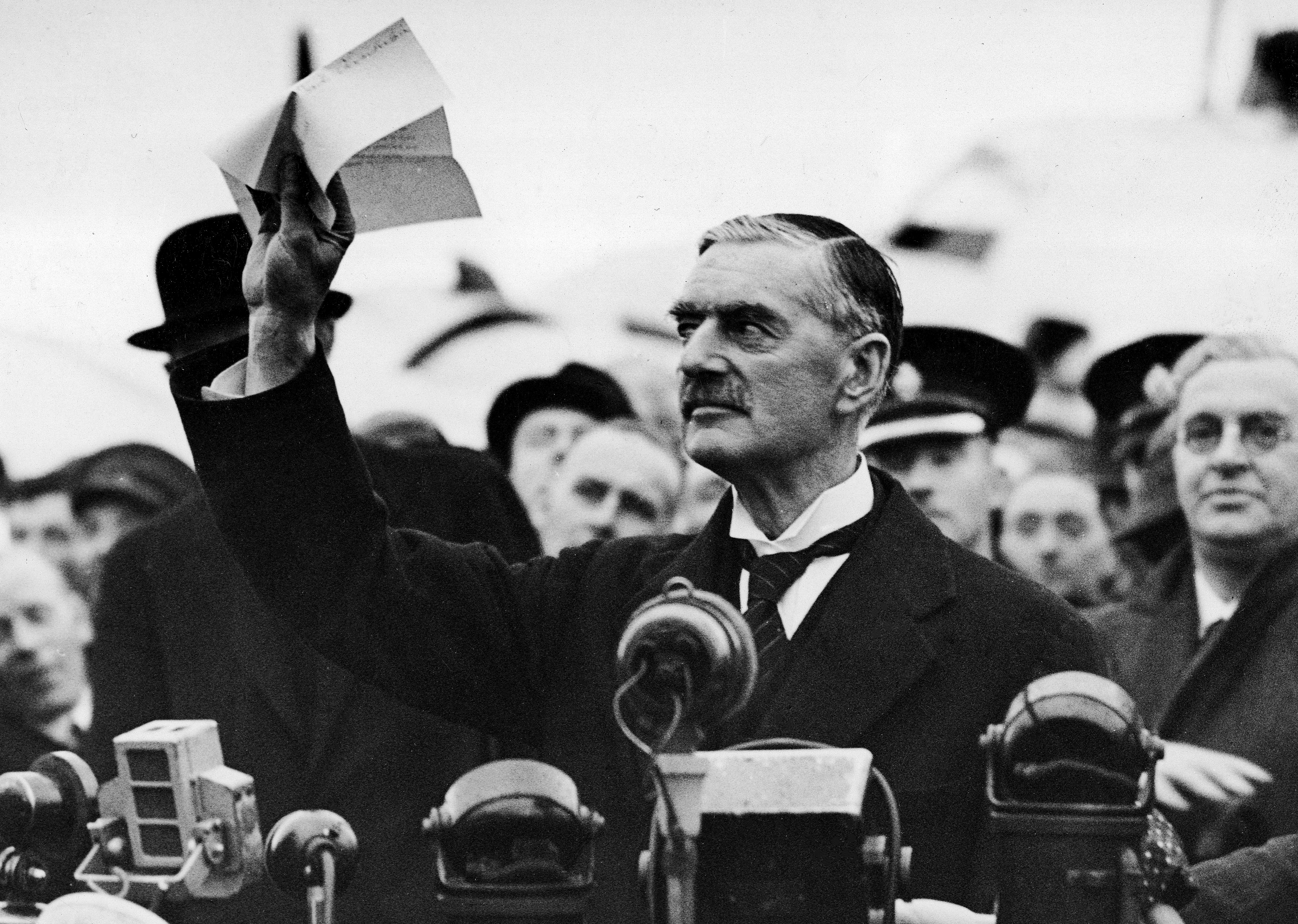
Chamberlain returned to London, ecstatic and fêted for having avoided war (“I believe it is peace for our time,” he triumphantly declared). In fact, most of the British establishment wanted to avoid a new world war and preserve the empire at any cost. So did trade unions and much of the business community. Backing for appeasement was widespread.
But another official in Chamberlain’s Tory party, Winston Churchill, told the Commons that Munich was “a total and unmitigated defeat,” and predicted that soon enough the rest of Czechoslovakia “will be engulfed in the Nazi regime.” Churchill’s prophecy came true.
Chamberlain was denounced for having delusions about his ability to manage Hitler. With his beak nose, top hat, cane, and inexperience in foreign policy, the British prime minister lent himself to enduring caricature. Munich’s eternal lesson was cast as the maxim that aggression left unchecked leads to greater aggression. Appeasement became a slur.
Chamberlain’s critics at the time argued that he should have instead forged an alliance with Josef Stalin and taken on Hitler. But according to Anthony Eden, who resigned as foreign secretary in early 1938 to express opposition to appeasement, Chamberlain worried that if he did the deal with Stalin, and they together defeated Hitler in war, the UK would be stuck with communists in occupation of the heart of Europe. How would he get them out?
Chamberlain’s prophecy also came true.
After June 1941, Churchill did that deal with Stalin, fought that war with Hitler, and won—and got stuck with communists implanted in Central Europe. Short of a new war, which British society overwhelmingly did not have the stomach (or capability) to fight, no one knew how to get the communists out. The upshot was the Cold War.
Churchill could be accused of the very charge he had flung at the man he replaced as prime minister: harboring illusions about how he could manage a dictator, in this case Stalin. Churchill took his own trip to a redoubt of evil, the Kremlin, in 1944 and negotiated the infamous percentages agreement, divvying countries up, without consulting them, into rival UK-Soviet spheres of influence. The differences with the Munich Pact are profound, of course. Nonetheless, Stalin did not uphold that “deal” either.
None of this should be regarded as an attempt to rehabilitate Chamberlain, or disparage Churchill, who helped guide the Allied wartime coalition to victory and then called out the Soviet menace. Chamberlain, at a minimum, can be faulted for having failed to drive rearmament while assiduously pursuing negotiations, such that his lack of credible deterrence rendered his diplomacy toothless. Just as bad, he signaled weakness, desperation to do a deal. Still, “Munich” was not so clear cut, as too often portrayed. The main proposed alternative was problematic, too.
Munich lives on mostly as junk history, a simplistic morality tale summoned to level accusations of insufficient resolve or outright capitulation whenever some politician fails to bring another country to heel miraculously, or to launch a war, whatever the chances of success and the consequences.
In 1962, for example, during the Cuban Missile Crisis, General Curtis LeMay informed President John F. Kennedy that a decision not to bomb Cuba would be “almost as bad as the appeasement at Munich.” Kennedy instead looked to the history of the miscalculations in the run-up to the First World War. Had he feared the stigma of “Munich,” it is possible that neither the writer nor the readers of this essay would be alive.
More recently, the charge of “Munich” has been heard in response to calls for negotiations, after Russia’s February 2022 full-scale invasion of and expanded occupation of Ukraine. Whatever the advisability of such proposals, accusations of wanting to hand over Ukrainian territories to Russia, Munich-style, in the manner of Chamberlain, make no sense: Vladimir Putin has already seized them.
Many other cases in many different countries can be found in a new volume of essays, History’s Dead-Hand Grip: Politics, Statecraft, and “Lessons” of the Past (Hoover Institution Press, 2026), that draws from that conference on the uses and abuses of history. For instance:
The rise and fall of horses as a part of human industry has ramifications for a future shaped around artificial intelligence—but the story is not nearly so straightforward as the tale of technological replacement told by tech-optimists.
Four syndromes, including self-serving historical narratives, affect Israeli security policy. This shows a need to account for more historical factors.
The Saudi ruling family is reshaping the history of its founding, writing Wahhabism out of the narrative to accommodate the direction the rulers want to take.
The cumulative effect of these and the other essays is, we hope, to demonstrate anew the importance and impact of history, as well as rigor and humility.
The greater our attention to history, the more voluminous our evidence, the more critical our use of sources, the more cautious our historical analogies, the more grounded will be our debates about the past, present, and possible futures, and, perhaps, the better the decisions we will take or choose not to take. Hopes for and humility about that prospect together propel the Hoover History Lab.
Stephen Kotkin is the Kleinheinz Family Senior Fellow at the Hoover Institution as well as a senior fellow at Stanford’s Freeman Spogli Institute for International Studies. He is the author of Stalin: Waiting for Hitler, 1929–1941, and Stalin: Paradoxes of Power, 1878–1928. He is also the Birkelund Professor in History and International Affairs (emeritus) at the Princeton School of Public and International Affairs (formerly the Woodrow Wilson School), where he taught for thirty-three years.