 Powered by
Africa is often painted with the same dismissive brush as Brazil: it is the continent of the future —and always will be. For decades, US policymakers have talked about Africa’s increasing importance while largely failing to invest a corresponding increase in time, attention, and resources. Some of it has been gratuitous (Vice President Hubert Humphrey in 1968: “We in America are with you—materially, and with our hearts—in your effort to build a new and better continent”) and some genuine (President George W. Bush in 2003: “In a time of growing commerce across the globe, we will ensure that the nations of Africa are full partners in the trade and prosperity of the world. Against the waste and violence of civil war, we will stand together for peace”). With the exception of the Bush Administration, the result has generally been the same.
The case is stronger than ever for a reappraisal of Africa’s strategic value to US national interests. The continent will be home to one quarter of the world’s population by 2050 and hosts vast natural resources, including 30 percent of the critical minerals that power our modern world. Moreover, it is situated along major sea lines of communication and trade in the Atlantic Ocean, Indian Ocean, and Gulf of Aden. The region holds three non-permanent seats in the UN Security Council, and it represents one of the largest regional voting groups at the UN and other multilateral bodies. Africans currently sit at the top of several of the most important international organizations.
While no one contests the facts, US policymakers have not found it persuasive enough to shift their ranking of African issues; devote more attention and resources to the region; and most importantly, pursue policies that advance US interests in the near and long term. The paradox is that most obvious priorities (US global leadership and access to critical minerals, for example) cannot be realized if other dimensions of the US-Africa relationship are ignored or de-emphasized. In other words, it is not a case of standalone choices, but rather a set of interlocking decisions that will either succeed or fail together.
In this paper, we will examine five critical choices. The first two focus on Africa’s role in a new global economic and security commons followed by three questions pertaining to the future of US engagement in the continent.
1. How genuinely should we seek to integrate Africa into a new global order?
By virtue of sheer size and scale alone, Africa’s governments, institutions, and people are positioned to play an important role in defining the shape of the new international order. They have the potential to cast the deciding vote on vital issues such as the future of trade, technology, and global governance. But, in this contest to write new rules of the road, it remains uncertain whether Africans will be leaders or laggards. If Africans stay on the sidelines, it almost certainly will undercut the durability of emerging global commons. At the same time, their increasing geopolitical independence could result in challenging the United States to the benefit of its geopolitical adversaries.
In the past, there have been shallow debates about Africa’s significance in global affairs. In 1972, the CIA asked, “if you ‘win’ Black Africa, what have you won?” In his 2002 book Does America Need a Foreign Policy? Henry Kissinger stressed the “absence of overriding security interests” on the continent—a theme echoed in some of Under Secretary of War for Policy Elbridge Colby’s think tank-era writings. To be sure, the US government has courted African support during times of global strife. Those appeals, however, represented extraordinary moments in a relatively stable international system. It is not the world as we currently know it.
As the global order unravels, Africans are becoming more involved, at least episodically, in the debate over what’s next. This is partly due to the region’s growing population share and its positioning in international bodies. While the default position is often non-aligned or neutral, Africans are starting to ask pointed questions about US leadership. African leaders raged against the unfairness of vaccine distribution and debt relief. Nine African countries voted against suspending Russia from the Human Rights Council and the majority abstained in UN votes condemning Russia’s invasion of Ukraine. And they have become more critical of the United States: AU Commission Chair Mahamoud Ali Youssouf last year declared “we cannot accept visa bans, we cannot accept unfortunate tariffs that have nothing to do with the rules and regulations of the WTO,” while Ghanaian President John Mahama accused President Donald Trump of normalizing the erasure of black history.
This is an urgent challenge because it is not possible to build a durable international order without genuine buy-in from African nations. It is also problematic because the United States cannot expect to retain its leadership position if it attempts to foist a new global system on the world’s youngest and fastest-growing region. On the other hand, too few Africans have tabled a bold vision for the future. To be sure, they are deeply disillusioned with the current state of the world, but they shy away from opining on a new dispensation. For a more effective and durable new commons, it is imperative that Africans more consistently act as agenda setters, only just agenda takers.
The United States also will need to calibrate its approach. A more prosperous and secure world must include more African voices. Moreover, there is geopolitical advantage to lead the call for greater integration. It is equally true that the pursuit of that outcome will require persuading many leaders and publics that an international order that benefits the United States is advantageous to Africans. The question is whether the United States leans in— accepting more disputes, more coordination, and inevitable disagreements over China—or goes through the motions, continuing with minimal consultations with Africa in its quest for a new economic and security commons.
2. How aggressively should we pursue access to critical minerals?
Africa is essential to US economic competitiveness and a clean-energy transition. It is home to many of the rare-earth and critical minerals we need to power our modern economy. The continent’s share of the world’s mined minerals is unrivaled: 76 percent of manganese, 70 percent of cobalt, 63 percent of platinum metals, 29 percent of bauxite, 17 percent of copper, and 11 percent of lithium, as well as many rare-earth minerals. The United States, however, has limited access to these resources, especially relative to China. It is a strategic vulnerability, but closing the gap comes with tough tradeoffs.
The United States has been out of the critical minerals game for more than a decade. The sale of Freeport-McMoRan’s stake in Democratic Republic of the Congo’s (DRC) massive Tenke Fungurume mine in 2016 marked the end of major US participation in the sector, and the lack of US processing capacity means most African minerals still flow through China. The Biden and Trump administrations have tried to rectify this shortfall—Biden through a $4 billion railway connecting the DRC’s mining sector to Angola’s port of Lobito and Trump through DFC investments in potash in Gabon, graphite in Mozambique, and a joint venture with the DRC’s state-owned mining enterprise.
The dilemma, however, is twofold. First, US lobbying for critical minerals has nudged African governments to cut corners to reallocate assets to US firms, some of which are unqualified. For example, the DRC government has repeatedly, with a stroke of a pen, changed its leasing agreements and confiscated assets held by foreign firms at US officials’ bidding. Even more troubling is the entrance of US firms that lack the technical and financial capacity to develop the Congolese mining sector. The US government’s promotion of a no-holds-barred approach risks undermining the credibility of US mining firms and emboldening African governments to treat concessions as reversible.
The second issue is a growing disconnect between US and African goals. The United States is laser-focused on access to critical minerals whereas African governments are seized with in-country processing and beneficiation. Most US firms give lip service to this aspiration but discount its financial viability, setting the stage for a showdown over the terms of mining deals. African leaders already are showing their pique: Nigeria’s President Bola Tinubu stated “no one can take any metal out of Nigeria without adding value,” Namibia banned the export of unprocessed lithium, and Gabon decreed it will stop exporting raw manganese by 2029. This approach is being adopted by more countries by the day.
The United States will need to reassess how hard and fast to pursue its access to critical minerals in Africa. If it bends rules, backs unqualified firms, and ignores African objectives, it may find itself with little to show for its efforts and engender greater hostility from African governments and publics.
3. How much should we prioritize geopolitical competition?
A favorable resolution to US efforts to craft a new global order and secure access to critical minerals in part hinges on its approach to geopolitical rivalries. African leaders have consistently bristled at US framing of being the “partner of choice,” insisting that they want a “choice of partners.” As Guinean leader Mamadi Doumbouya explained in September 2023, “we are neither pro- nor anti-American, neither pro- nor anti-Chinese, neither pro- nor anti-French, neither pro- nor anti-Russian, neither pro- nor anti-Turkish…we are simply pro-African.” The growing number of external actors engaged with the continent poses a key challenge: if the United States pursues a zero-sum approach to geopolitical competition with its rivals, it will either spectacularly fail or overcommit resources disproportionate to its national security interests.
African leaders and publics today have more external partners than ever. Between 2010 and 2015, more than 150 new embassies opened in sub-Saharan Africa. Some of the most significant increases have come from Turkey and the Gulf states, especially Qatar and the United Arab Emirates. In addition, there has been an explosion of Africa summits, including ones staged by major and middle powers, as well as, surprisingly, Belarus, Indonesia, and Kuwait.
These foreign partnerships also are deeper and more substantive than during the Cold War. China has become the region’s most visible partner, with its massive trade ties (projected to be around $348 billion in 2025) and its overseas military base in Djibouti. Russia almost tripled its trade with sub-Saharan Africa between 2010 and 2018 and dispatched mercenaries to shore up pro-Moscow governments. Japan, India, and even Ukraine are investing in Africa’s economies and militaries.
In this crowded landscape, African leaders are adapting to the new reality, exploiting competition to lessen dependency on any single patron. Burkina Faso, Mali, and Niger, for example, kicked out UN, European, French, and US troops to the benefit of Russian-backed forces, while Angola welcomed greater US investment to rebalance its longstanding ties to China.
The critical question is how the United States should safeguard its interests, responsibly husband its resources, and continue to counter threats posed by its rivals’ activities in Africa. So far, there is little consensus on where and in which sectors the United States should compete with its adversaries. US officials continue to send mixed messages. State Department leadership has indicated that we will not compete “dollar for dollar” with China on projects such as building roads, whereas some in Congress have opined that we should confront China “country by country, interest by interest, partnership by partnership.” It is not only unfocused, but it ignores that China has become the most popular global or regional power in Africa; according to Afrobarometer, 60 percent of respondents described China’s influence on their country as positive compared to 53 percent for the United States.
The United States will need to make some difficult decisions. It cannot reasonably match Chinese investments across the continent, and it should refrain from implying that it will. It must be explicit about its concerns with regards to China, such as Beijing’s aspirations for a naval outpost on the Atlantic Ocean and the integration of Chinese AI into certain industrial and military activities. Moreover, the United States needs to reframe the conversation about geopolitical competition, more effectively balancing US national security interests, finite US resources, and African views on foreign relationships.
4. How seriously should we endeavor to address security challenges?
Another critical choice is how much to engage in peace and security matters across the continent. Africa is facing a series of existential security challenges. In 2023, the region had the highest number of state-based conflicts in the world and accounted for nearly half of all internally displaced people worldwide. It is now the epicenter of global terrorism with ISIS and Al-Qaida affiliates controlling swathes of territory. While many of these crises do not pose an immediate threat to the US homeland, it sets up a difficult choice: either dedicate real resources to meaningfully respond to these conflicts or risk further damaging trust in US leadership and possibly access to critical resources.
The withdrawal of the United States from the region during the past decade and a half—due to a fear of forever wars, tradeoffs with other priorities, or growing anti-Western sentiment—has left African governments skeptical, even disparaging, of the benefits of US partnership. Indeed, a West African prime minister asked me why we weren’t doing more to address extremism in the Sahel, which he viewed as a global threat on par with Russia’s invasion of Ukraine. The shrinking presence of the United States has damaged US influence and access while opening the door for foreign adversaries to gain footholds.
With limited resources and competing priorities in other parts of the world, the United States has been caught between a rock and a hard place. The consequences of inaction are high, but it is equally costly to respond to multiple conflicts across the region. Even seeking to prioritize different crises is far from straightforward. The decision to counter extremism in Somalia, for example, has been comparatively easier to act upon because those groups have shown an intent and capability to strike the US homeland. Responding to terrorism in West Africa or conflicts in DRC and Sudan, in contrast, is more challenging to find consensus. The threats to US national security are less direct and thus subject to more debate. The potential to disrupt larger economies and trade, create a massive humanitarian crisis, or even enable Moscow and other competitors to steal a march on Washington are of high concern, but some US decisionmakers have opted to underinvest and remain minimally engaged.
The United States, however, cannot remain on the sidelines if it wants to advance its other objectives in Africa. DRC President Felix Tshisekedi has been unambiguous about the quid pro quo, telling Fox News he favors a minerals-for-security deal. When the US government refuses to seriously respond to security conflicts, Russia moves into the vacuum and establishes itself in Burkina Faso, the Central African Republic, Mali, and Niger. Even when it fuels US public consternation about the United States losing parts of the continent, it rarely spurs preemptive action.
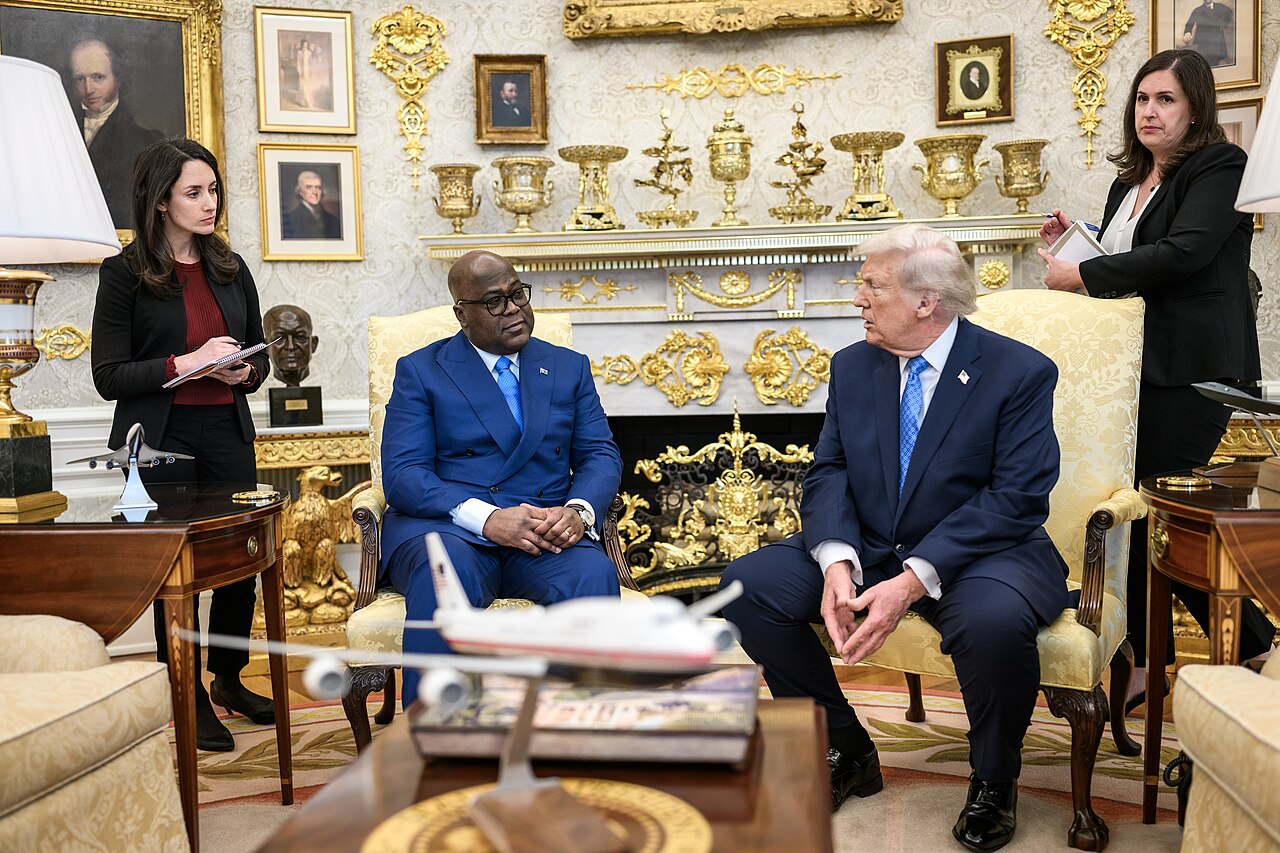
The United States will have to reexamine its engagement in peace and security. It may not see these conflicts as “our problem,” but we can’t advance US priorities if we ignore African ones. It will require more costs on the front end to reap more benefits on the back end. Indeed, when the United States previously committed to meaningfully address peace and security on the continent—training 60,000 peacekeepers and helping to resolve conflicts in Angola, Burundi, Liberia, and Sierra Leone—US popularity reached its apex and several African leaders agreed to side with the United States on contentious foreign policy issues, including the Iraq war in 2003.
5. How selectively should we build African partnerships?
The final critical choice centers around how rather than what the United States should do. With forty-nine sub-Saharan African countries, the US government is caught between big bets on a few countries or spreading its investments across the region. In the past, the US government went with the first option, primarily engaging Ethiopia, Kenya, Nigeria, and South Africa to play leading roles in regional peace and security, as well as serve as engines for economic growth. This approach, however, has become increasingly unsustainable and ineffective. To meet the moment, a more dynamic, but inherently difficult strategy is needed to advance US objectives.
In the past decade and a half, there has been a rise in African multipolarism, with power increasingly dispersed away from a handful of key anchor states and toward a collection of smaller regional influencers. While it remains important to engage with the big four, these countries are not as consistently willing or able to respond to US priorities. Smaller states, including Rwanda, Senegal, and Chad, are the continent’s most reliable peacekeepers, for example, while many critical resources reside in DRC, Guinea, Namibia, Tanzania, and Zambia. Even these countries, however, are not guaranteed to remain stable and frequent policy disagreements over political and other issues may limit their ability to partner effectively with Washington.
The United States, consequently, must consider how to devise an approach that factors in its evolving needs and the inherent volatility in its ties to the region’s governments. The US government should continue to invest in the anchor states, as well as the DRC, whose security and economies are critical to the region’s overall stability. At the same time, the United States, by necessity, will need to work with other states and diverse coalitions, as it has in the DRC or in West Africa. The critical question is how to reaffirm ties to the anchor states while innovating to accommodate more partners to respond most effectively to rising challenges and opportunities.
Conclusion
As sub-Saharan Africa becomes more strategically important to the United States, it is imperative to wrestle with fundamental questions about the US approach to the region. There are no easy answers, but it is malpractice to pretend we can continue with old policies or single-mindedly pursue US objectives to the detriment of African ones. We can only usher in a new economic and security commons by engaging with Africa in full, not on the cheap. But we have to make a conscious decision to do so. That is the most pressing choice we face.
Judd Devermont is an operating partner at Kupanda Capital and senior adviser (non-resident) at the Center for Strategic and International Studies (CSIS), where he served as the director of the Africa Program from 2018 to 2021. He previously was special assistant to President Biden and senior director for African affairs at the National Security Council from 2021 to 2024.