
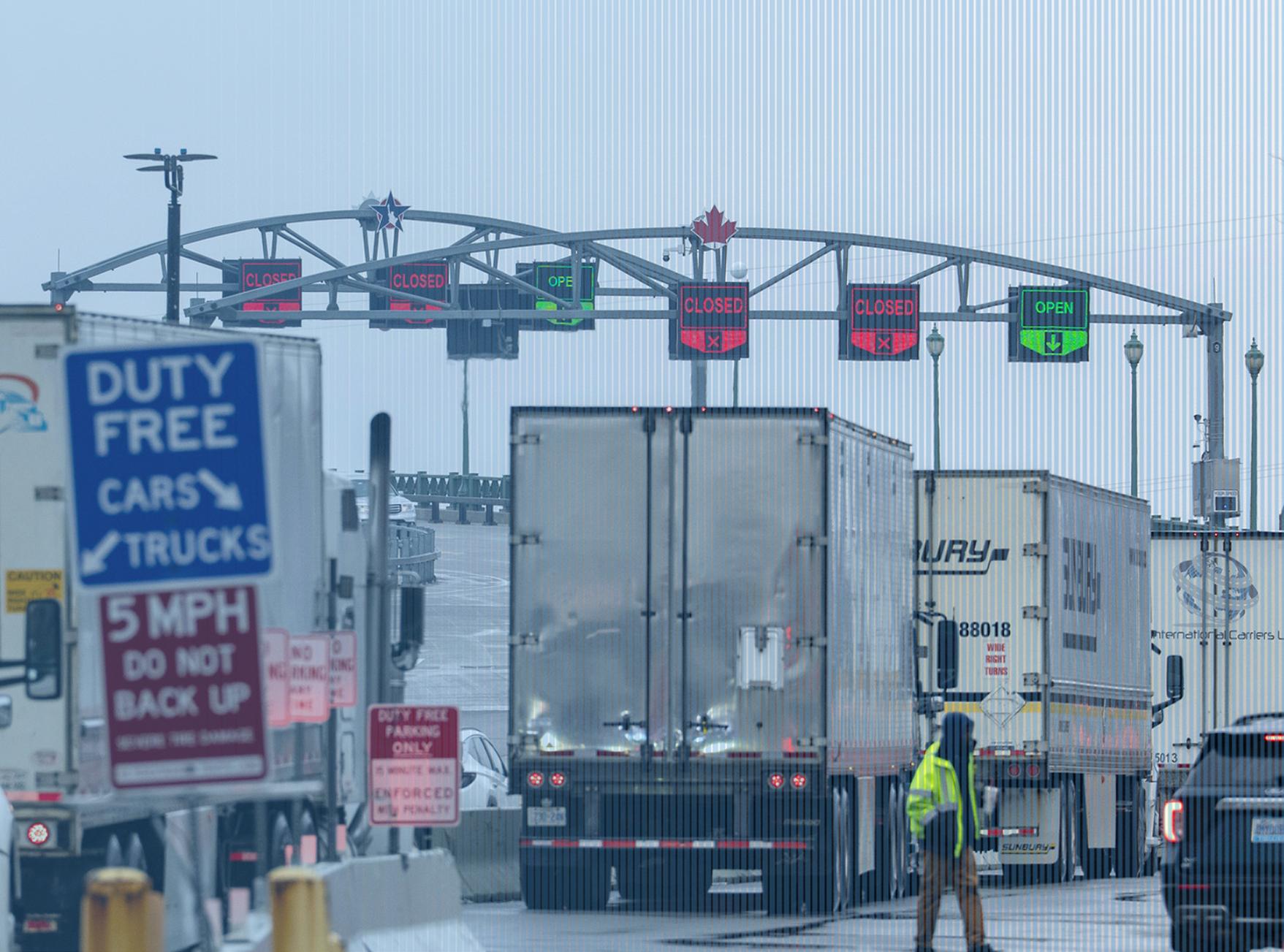
President Trump has succeeded, with uncanny regularity, in getting everyone to go off on a tangent while the larger problem smolders in plain sight. Trade policy is no exception.
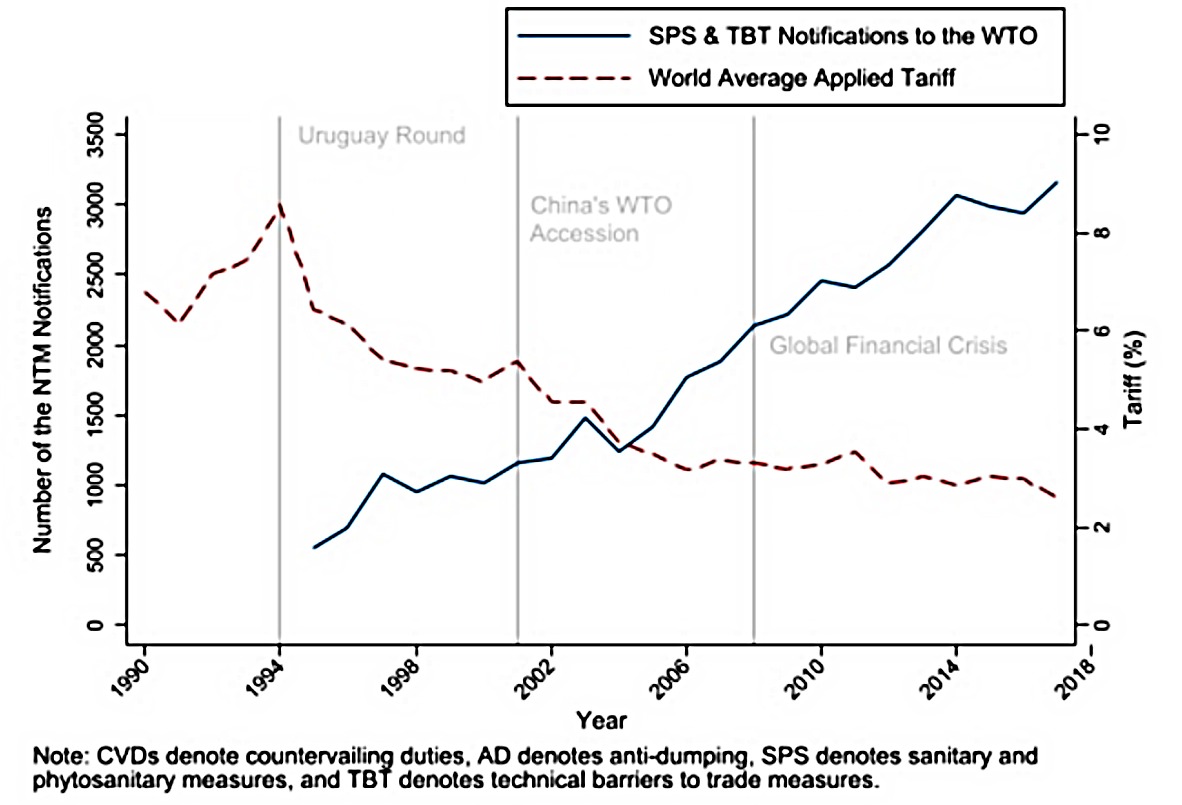
Between 2000 and 2017, the average global tariff rate fell from an already low 5 percent—the average rate was close to 50 percent in the 1950s—to about 2.5 percent. Meanwhile, the share of global imports subject to nontariff measures rose from about 15 percent in 2001 to roughly 90 percent in 2024. The world simply switched to innocent-looking “nontariff measures” as the weapon of choice in the trade war. As tariffs declined, notifications of sanitary and technical nontariff measures surged (Figure 1).
Yet for most of the past decade, the fussing and fighting have been about tariffs.
Figure 1: Tariffs down, nontariff measures up
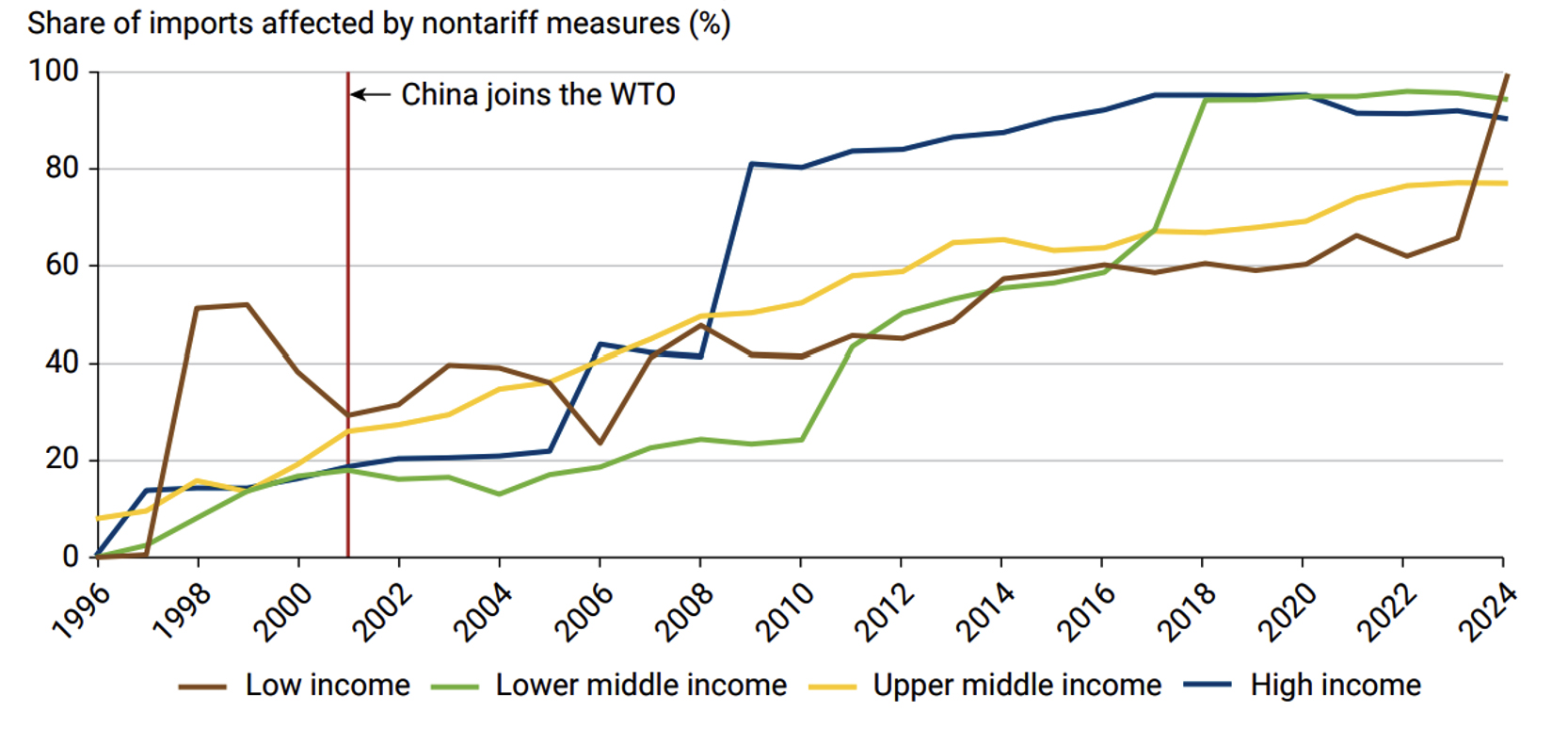
The result has been a debacle—the policy equivalent of leveling a shotgun to kill a cockroach in a closet. It might feel satisfying in the moment, since the United States has tolerated high trade barriers to its exports for decades. But it has left the largest barriers to trade largely untouched: nontariff measures now affect 90 percent of global trade, six times the share three decades ago. For farm products, the share is nearly 100 percent. These measures span the income spectrum—from the poorest economies to the richest. (Figure 2).
A double-edged sword
A tariff has an unambiguous purpose: to make an imported product more expensive and thereby protect domestic producers. It is imposed at the border, expressed as a number, and relatively easy to compare across countries. Nontariff measures are different. They include food-safety requirements, product standards, labeling rules, licensing systems, customs procedures, local-content requirements, and subsidies. Many of these are indispensable: no sensible person would want governments to stop testing food for contaminants, or checking toys for hazards, or inspecting imported cars for excessive emissions.
That ambiguity, however, is exactly what makes nontariff measures so attractive to protectionists. Tariffs loudly advertise their protectionist intent. Nontariff measures enable protectionists to pass off the same intention as a public service.
Governments learned this lesson quickly. After 1995, when the World Trade Organization was created, average tariff rates went down steadily from the already-low levels in the decades immediately before. But notifications to the WTO of new nontariff measures went up from nearly 600 to nearly 6,500 between 1995 and 2024. That was no coincidence: Governments simply switched away from measures that were being policed to measures that were hard to monitor.
The biggest change came after the Global Financial Crisis. The crisis intensified pressure to protect domestic jobs and businesses, but WTO commitments limited the scope for higher tariffs. Nontariff measures offered governments another way to tilt markets toward domestic producers. By 2014, technical regulations alone covered nearly 92 percent of the European Union’s goods imports, according to a US Commerce Department study. EU measures covered everything from climate and energy to cosmetics and toys.
Other economies followed. Europeans sometimes celebrate the spread of their standards as the “Brussels Effect.” Europe’s trading partners across the world might reasonably ask whether every part of that effect was benign. One thing is clear: The proliferation of standards was not accompanied by the broader market opening that trading partners were promised. There is a credible case to be made that protectionist measures in the guise of standards thwarted it.
Figure 2: Nontariff measures shoot up across all income groups after 2009
For the United States, that promise was central to the bargain. When the WTO was formed, America already had low tariff rates and low nontariff barriers. In exchange for accepting multilateral rules and giving up some scope for unilateral retaliation, it reasonably expected liberalization to spread into areas where American firms were highly competitive—notably agriculture and services. Instead, these turned out to be exactly the sectors that would be most prone to nontariff measures.
To add injury to insult, WTO rules allowed large economies like South Korea, India, and China to protect their markets by claiming “developing country status,” preserving protections that disadvantaged US exporters. South Korea, for example, used developing-country provisions to retain restrictions on rice imports through 2014. India initially benefited from an exception allowing export subsidies, then argued for more time after its eligibility expired. In 2019, a WTO panel rejected that argument; the challenged programs provided more than $7 billion a year, according to US officials.
Fight to the finish
That imbalance—America’s massive and relatively open market coexisting with protections retained by its major trading partners—became untenable as the world economy was remade. US liberal trade policies helped transform once poverty-stricken nations into major economic powers. Today, emerging-market and developing economies account for nearly 40 percent of global trade. Yet far too many of them cling to trade concessions granted when they were vastly poorer and smaller.
The United States, in short, has had solid grounds to question why rising economic powers should retain privileges that no longer befit their size and wealth.
Correcting that imbalance should have been the priority of the institutions charged with safeguarding the international economic order after World War II. That is exactly where all of them have fallen short. The WTO did well to bring tariffs down but could not discipline the use of nontariff measures, particularly in services. The World Bank and other multilateral institutions did not do enough to measure, publicize, and reduce such barriers. And the International Monetary Fund did too little to call out and confront the exchange-rate undervaluations that were distorting trade.
America should now turn its legitimate grievance into a renewed push for open markets. A common agenda with trading partners should drive liberalization in sectors where protectionism has been most persistent: services and agriculture. That requires agreements that discipline subsidies and prevent standards from becoming tools of exclusion, while preserving the ability of governments to protect health, safety, and the environment. Smaller economies—there are more than 150 of those—still depend on the WTO and have a big stake in its success. America should lead that effort—and finally train its fire on the trade barriers that matter most.
Indermit Singh Gill is a distinguished visiting fellow at the Hoover Institution. He was the World Bank Group’s chief economist and the senior vice president for development economics from 2022 to 2026. Before that, he served as the World Bank’s vice president for growth, finance, and institutions. In these roles, he helped shape the bank’s response to the extraordinary series of shocks that have hit the world economy since 2020.
 Powered by